


Cortical microtubules are responsible for gravity resistance in plants
- PMID: 20404495
- PMCID: PMC3001580
- DOI: 10.4161/psb.5.6.11706
Cortical microtubules are responsible for gravity resistance in plants
Abstract
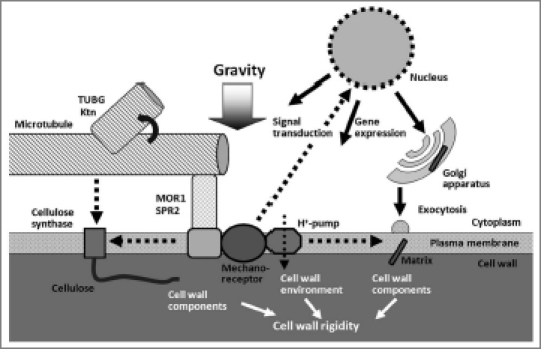
Mechanical resistance to the gravitational force is a principal gravity response in plants distinct from gravitropism. In the final step of gravity resistance, plants increase the rigidity of their cell walls. Here we discuss the role of cortical microtubules, which sustain the function of the cell wall, in gravity resistance. Hypocotyls of Arabidopsis tubulin mutants were shorter and thicker than the wild-type, and showed either left-handed or right-handed helical growth at 1 g. The degree of twisting phenotype was intensified under hypergravity conditions. Hypergravity also induces reorientation of cortical microtubules from transverse to longitudinal directions in epidermal cells. In tubulin mutants, the percentage of cells with longitudinal microtubules was high even at 1 g, and it was further increased by hypergravity. The left-handed helical growth mutants had right-handed microtubule arrays, whereas the right-handed mutant had left-handed arrays. Moreover, blockers of mechanoreceptors suppressed both the twisting phenotype and reorientation of microtubules in tubulin mutants. These results support the hypothesis that cortical microtubules play an essential role in maintenance of normal growth phenotype against the gravitational force, and suggest that mechanoreceptors are involved in signal perception in gravity resistance. Space experiments will confirm whether this view is applicable to plant resistance to 1 g gravity, as to the resistance to hypergravity.
Figures
Comment on
-
Gravity-induced modifications to development in hypocotyls of Arabidopsis tubulin mutants.Plant Physiol. 2010 Feb;152(2):918-26. doi: 10.1104/pp.109.147330. Epub 2009 Dec 14. Plant Physiol. 2010. PMID: 20018592 Free PMC article.
References
-
- Hoson T. Development of the anti-gravitational system in land plants and its implication for the interaction between plants and other organisms. Biol Sci Space. 2003;17:54–56. - PubMed
-
- Hoson T. The mechanism and significance of gravity resistance in plants. J Gravit Physiol. 2006;13:97–100.
-
- Hoson T, Soga K. New aspects of gravity responses in plant cells. Int Rev Cytol. 2003;229:209–244. - PubMed
-
- Hoson T, Saito Y, Soga K, Wakabayashi K. Signal perception, transduction and response in gravity resistance. Another graviresponse in plants. Adv Space Res. 2005;36:1196–1202.
-
- Soga K, Wakabayashi K, Hoson T, Kamisaka S. Hypergravity-induced increase in the apoplastic pH and its possible involvement in suppression of β-glucan breakdown in maize seedlings. Aust J Plant Physiol. 2000;27:967–972. - PubMed
Publication types
LinkOut - more resources
Full Text Sources
