


Does OsPHR2, central pi-signaling regulator, regulate some unknown factors crucial for plant growth?
- PMID: 20404569
- PMCID: PMC3001567
- DOI: 10.4161/psb.5.6.11645
Does OsPHR2, central pi-signaling regulator, regulate some unknown factors crucial for plant growth?
Abstract
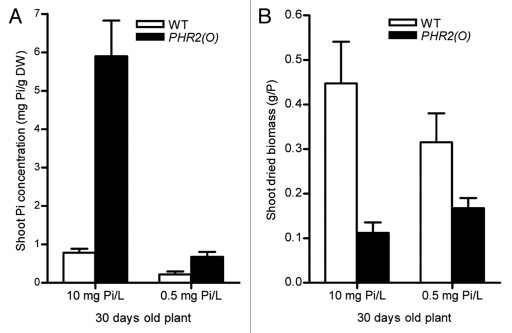
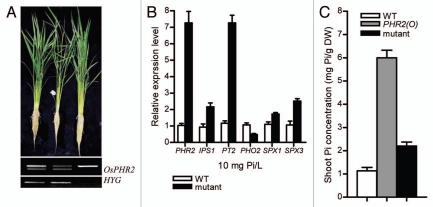
OsPHR2, the homolog of AtPHR1, is a central Pi-signaling regulator. The Pi-signaling pathway downstream of AtPHR1, similarly of OsPHR2,1,2 involves a noncoding RNA which targets mimicry of miR399. miRNA399 mediates cleavage of PHO2. (3,4) The regulating pathway downstream of OsPHR2 is negatively regulated by the Pi-signaling responsive gene OsSPX1. (5,6) Overexpression of AtPHR1 and OsPHR2 leads to an increased concentration of Pi in the shoot tissues with leaf toxic symptom and growth retardation similar as the phenotype of pho2 mutant, especially under Pi abundant conditions. (7,2,6) It has been known that the low affinity Pi transporter OsPT2 mainly contributes to the shoot Pi accumulation mediated by OsPHR2, and overexpression of OsPT2 results in shoot Pi accumulation and leaf toxic symptom and growth retardation under Pi abundant conditions. (6) Two curious questions are emerging from the reported results: How Os SPX1 functions on the negative regulation of the pathway and what mechanism of the growth retardation mediated by OsPHR2. For the second question, our favored hypothesis is that the growth inhibition mediated by overexpression of OsPHR2 is caused by toxic physiological effects due to excessive Pi accumulation in shoots (Pi toxicity). In fact, the toxic symptoms become diminished with decreased Pi levels in growth medium. However, the plant growth retardation mediated by overexpression of OsPHR2 may be caused by some unknown genetic factor(s) regulated by OsPHR2.
Figures
Comment on
-
OsSPX1 suppresses the function of OsPHR2 in the regulation of expression of OsPT2 and phosphate homeostasis in shoots of rice.Plant J. 2010 May;62(3):508-17. doi: 10.1111/j.1365-313X.2010.04170.x. Epub 2010 Feb 9. Plant J. 2010. PMID: 20149131
References
-
- Franco-Zorrilla JM, Valli A, Todesco M, Mateos I, Puga MI, Rubio-Somoza I, et al. Target mimicry provides a new mechanism for regulation of microRNA activity. Nat Genet. 2007;39:1033–1037. - PubMed
-
- Schachtman DP, Shin R. Nutrient sensing and signaling: NPKS. Annu Rev Plant Biol. 2007;58:47–69. - PubMed
-
- Wang C, Ying S, Huang H, Li K, Wu P, Shou H. Involvement of OsSPX1 in phosphate homeostasis in rice. Plant J. 2009;57:895–904. - PubMed
Publication types
LinkOut - more resources
Full Text Sources
Research Materials
Miscellaneous
