


Biological markers of auditory gap detection in young, middle-aged, and older adults
- PMID: 20404929
- PMCID: PMC2852420
- DOI: 10.1371/journal.pone.0010101
Biological markers of auditory gap detection in young, middle-aged, and older adults
Abstract
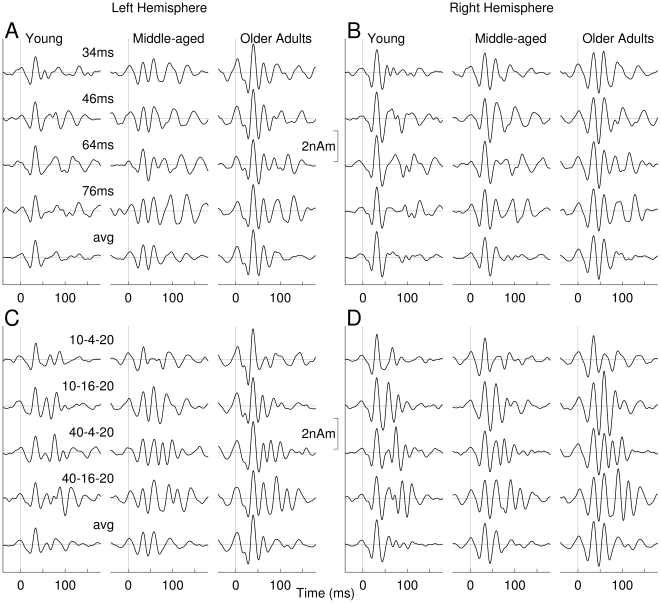
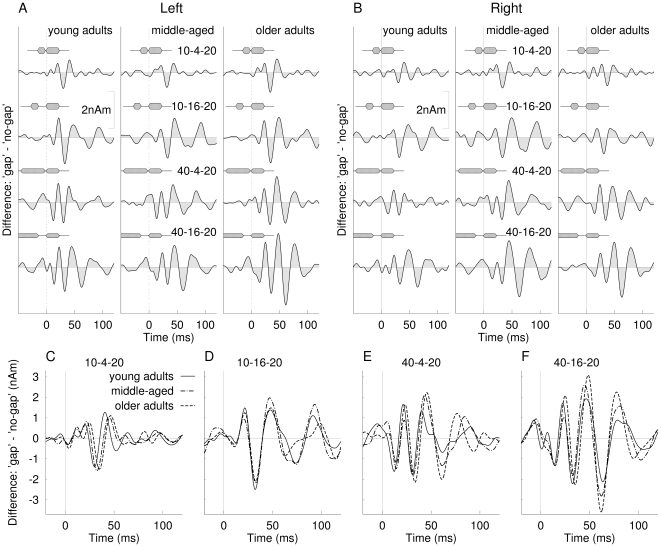
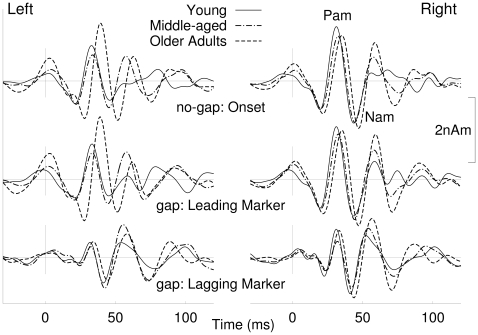
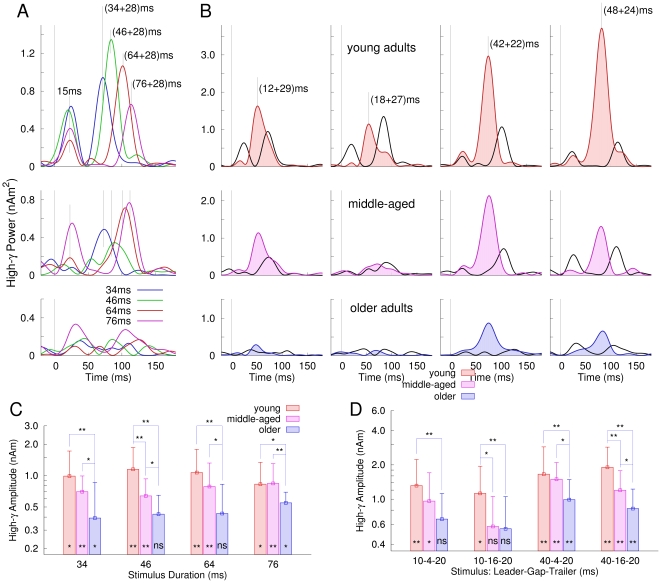
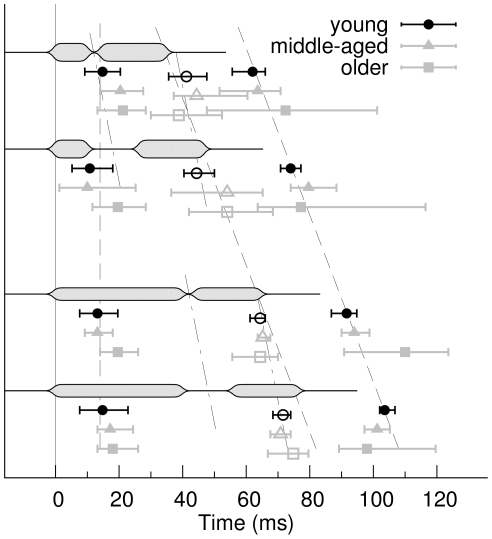
The capability of processing rapid fluctuations in the temporal envelope of sound declines with age and this contributes to older adults' difficulties in understanding speech. Although, changes in central auditory processing during aging have been proposed as cause for communication deficits, an open question remains which stage of processing is mostly affected by age related changes. We investigated auditory temporal resolution in young, middle-aged, and older listeners with neuromagnetic evoked responses to gap stimuli with different leading marker and gap durations. Signal components specific for processing the physical details of sound stimuli as well as the auditory objects as a whole were derived from the evoked activity and served as biological markers for temporal processing at different cortical levels. Early oscillatory 40-Hz responses were elicited by the onsets of leading and lagging markers and indicated central registration of the gap with similar amplitude in all three age groups. High-gamma responses were predominantly related to the duration of no-gap stimuli or to the duration of gaps when present, and decreased in amplitude and phase locking with increasing age. Correspondingly, low-frequency activity around 200 ms and later was reduced in middle aged and older participants. High-gamma band, and long-latency low-frequency responses were interpreted as reflecting higher order processes related to the grouping of sound items into auditory objects and updating of memory for these objects. The observed effects indicate that age-related changes in auditory acuity have more to do with higher-order brain functions than previously thought.
Conflict of interest statement
Figures
References
-
- Phillips DP. Auditory gap detection, perceptual channels, and temporal resolution in speech perception. J Am Acad Audiol. 1999;10:343–354. - PubMed
-
- Plomp R. Rate of decay of auditory sensation. J Acoust Soc Am. 1964;36:277–282.
-
- Green DM, Forrest TG. Temporal gaps in noise and sinusoids. J Acoust Soc Am. 1989;86:961–970. - PubMed
-
- Shailer MJ, Moore BC. Gap detection as a function of frequency, bandwidth, and level. J Acoust Soc Am. 1983;74:467–473. - PubMed
-
- Eddins AC, Peterson JR. Time-intensity trading in the late auditory evoked potential. J Speech Lang Hear Res. 1999;42:516–525. - PubMed
Publication types
MeSH terms
Substances
Grants and funding
LinkOut - more resources
Full Text Sources
Medical
Miscellaneous
