


Signaling, delivery and age as emerging issues in the benefit/risk ratio outcome of tPA For treatment of CNS ischemic disorders
- PMID: 20405577
- PMCID: PMC3467975
- DOI: 10.1111/j.1471-4159.2010.06613.x
Signaling, delivery and age as emerging issues in the benefit/risk ratio outcome of tPA For treatment of CNS ischemic disorders
Abstract
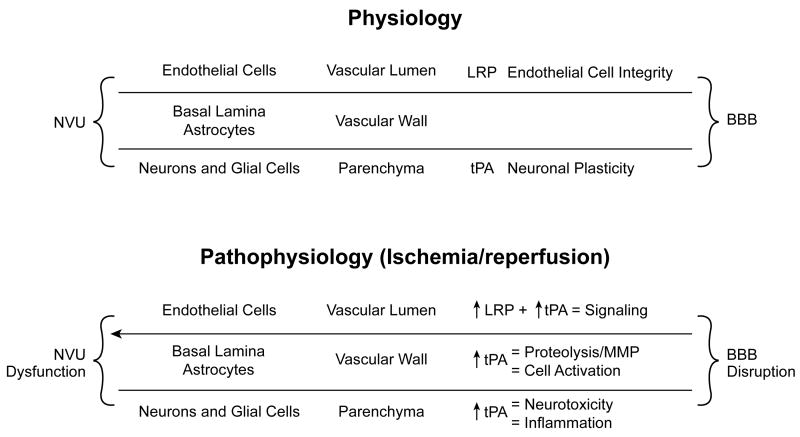
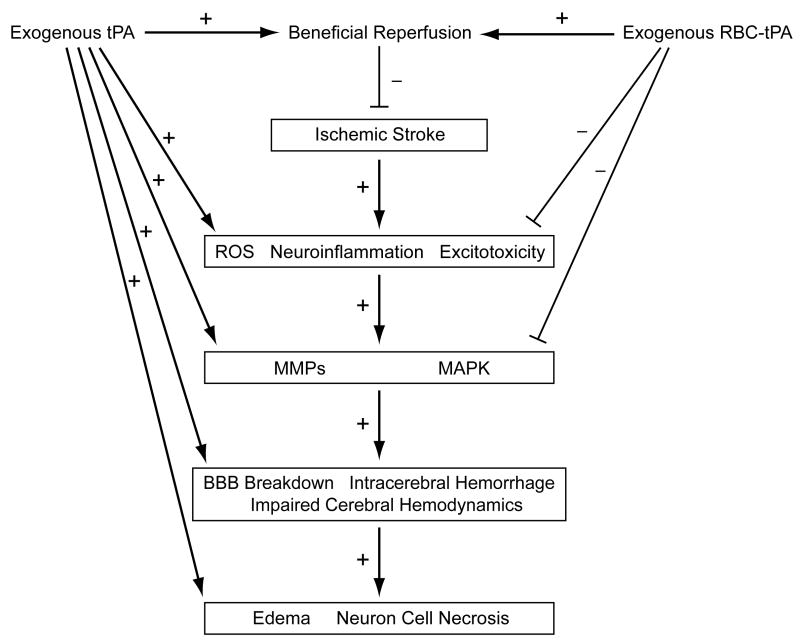
Stroke is a leading cause of morbidity and mortality. While tissue-type plasminogen activator (tPA) remains the only FDA-approved treatment for ischemic stroke, clinical use of tPA has been constrained to roughly 3% of eligible patients because of the danger of intracranial hemorrhage and a narrow 3 h time window for safe administration. Basic science studies indicate that tPA enhances excitotoxic neuronal cell death. In this review, the beneficial and deleterious effects of tPA in ischemic brain are discussed along with emphasis on development of new approaches toward treatment of patients with acute ischemic stroke. In particular, roles of tPA-induced signaling and a novel delivery system for tPA administration based on tPA coupling to carrier red blood cells will be considered as therapeutic modalities for increasing tPA benefit/risk ratio. The concept of the neurovascular unit will be discussed in the context of dynamic relationships between tPA-induced changes in cerebral hemodynamics and histopathologic outcome of CNS ischemia. Additionally, the role of age will be considered since thrombolytic therapy is being increasingly used in the pediatric population, but there are few basic science studies of CNS injury in pediatric animals.
Conflict of interest statement
There are no declared conflicts of interest.
Figures
References
-
- Abbott NJ, Ronnback L, Hansson E. Astrocyte-endothelial interactions at the blood-brain barrier. Nat Rev Neurosci. 2006;7:41–53. - PubMed
-
- Akkawi S, Nassar T, Tarshis M, et al. LRP and avB3 mediate tPA-activation of smooth muscle cells. AJP. 2006;291:H1351–H1359. - PubMed
-
- Amlie-Lefond C, Fullerton HJ. Thrombolytics for hyperacute stroke in children. Ped Hem Oncology. 2009;26:138–142. - PubMed
-
- Aoki T, Sumii T, Mori T, et al. Blood brain barrier disruption and matrix metalloproteinase-9 expression during reperfusion injury: mechanical versus embolic focal ischemia in spontaneously hypertensive rats. Stroke. 2002;33:2711–2717. - PubMed
-
- Armstead WM. Age dependent NMDA contribution to impaired cerebral hemodynamics following brain injury. Develop Brain Res. 2002;139:19–28. - PubMed
Publication types
MeSH terms
Substances
Grants and funding
- R01 CA083121/CA/NCI NIH HHS/United States
- HD57355/HD/NICHD NIH HHS/United States
- HL66442/HL/NHLBI NIH HHS/United States
- P01 HL076406/HL/NHLBI NIH HHS/United States
- R01 HL076206/HL/NHLBI NIH HHS/United States
- NS53410/NS/NINDS NIH HHS/United States
- CA83121/CA/NCI NIH HHS/United States
- HL81864/HL/NHLBI NIH HHS/United States
- T32 HL007971/HL/NHLBI NIH HHS/United States
- R01 HD057355/HD/NICHD NIH HHS/United States
- HL090697/HL/NHLBI NIH HHS/United States
- R01 HL090697/HL/NHLBI NIH HHS/United States
- R01 HL066442/HL/NHLBI NIH HHS/United States
- HL76206/HL/NHLBI NIH HHS/United States
- HL82545/HL/NHLBI NIH HHS/United States
- R01 NS053410/NS/NINDS NIH HHS/United States
- R01 HL077760/HL/NHLBI NIH HHS/United States
- HL76406/HL/NHLBI NIH HHS/United States
- HL77760/HL/NHLBI NIH HHS/United States
- R21 HL081864/HL/NHLBI NIH HHS/United States
- HL07971/HL/NHLBI NIH HHS/United States
LinkOut - more resources
Full Text Sources
Other Literature Sources
