Acupuncture for pain and dysfunction after neck dissection: results of a randomized controlled trial
- PMID: 20406930
- PMCID: PMC2881730
- DOI: 10.1200/JCO.2009.26.9860
Acupuncture for pain and dysfunction after neck dissection: results of a randomized controlled trial
Abstract
Purpose: To determine whether acupuncture reduces pain and dysfunction in patients with cancer with a history of neck dissection. The secondary objective is to determine whether acupuncture relieves dry mouth in this population.
Patients and methods: Patients at a tertiary cancer center with chronic pain or dysfunction attributed to neck dissection were randomly assigned to weekly acupuncture versus usual care (eg, physical therapy, analgesia, and/or anti-inflammatory drugs, per patient preference or physician recommendation) for 4 weeks. The Constant-Murley score, a composite measure of pain, function, and activities of daily living, was the primary outcome measure. Xerostomia, a secondary end point, was assessed using the Xerostomia Inventory.
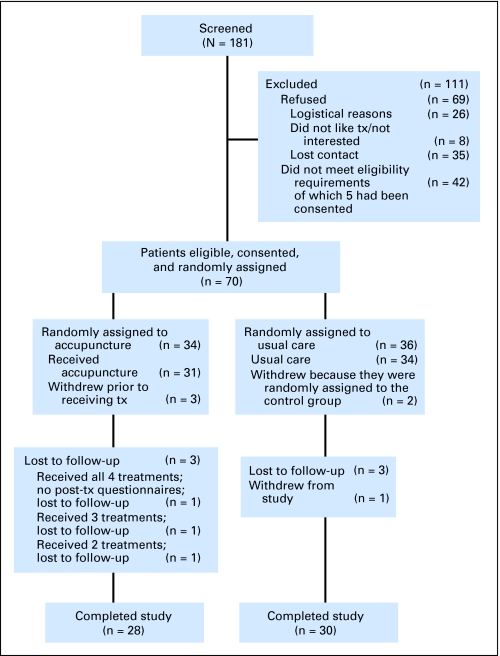
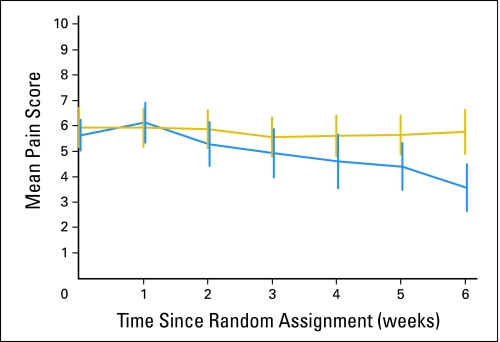
Results: Fifty-eight evaluable patients were accrued and randomly assigned from 2004 to 2007 (28 and 30 patients on acupuncture and control arms, respectively). Constant-Murley scores improved more in the acupuncture group (adjusted difference between groups = 11.2; 95% CI, 3.0 to 19.3; P = .008). Acupuncture produced greater improvement in reported xerostomia (adjusted difference in Xerostomia Inventory = -5.8; 95% CI, -0.9 to -10.7; P = .02).
Conclusion: Significant reductions in pain, dysfunction, and xerostomia were observed in patients receiving acupuncture versus usual care. Although further study is needed, these data support the potential role of acupuncture in addressing post-neck dissection pain and dysfunction, as well as xerostomia.
Conflict of interest statement
Authors' disclosures of potential conflicts of interest and author contributions are found at the end of this article.
Figures
References
-
- Jemal A, Siegel R, Ward E, et al. Cancer statistics, 2009. CA Cancer J Clin. 2009;59:225–249. - PubMed
-
- Robbins KT, Shaha AR, Medina JE, et al. Consensus statement on the classification and terminology of neck dissection. Arch Otolaryngol Head Neck Surg. 2008;134:536–538. - PubMed
-
- Krause HR. Shoulder-arm-syndrome after radical neck dissection: Its relation with the innervation of the trapezius muscle. Int J Oral Maxillofac Surg. 1992;21:276–279. - PubMed
-
- Leipzig B, Suen JY, English JL, et al. Functional evaluation of the spinal accessory nerve after neck dissection. Am J Surg. 1983;146:526–530. - PubMed
-
- Dijkrstra PU, van Wilgen PC, Buijs RP, et al. Incidence of shoulder pain after neck dissection: A clinical explorative study for risk factors. Head Neck. 2001;23:946–953. - PubMed
Publication types
MeSH terms
Grants and funding
LinkOut - more resources
Full Text Sources
Medical