


Urologist density and county-level urologic cancer mortality
- PMID: 20406931
- PMCID: PMC2881728
- DOI: 10.1200/JCO.2009.26.9597
Urologist density and county-level urologic cancer mortality
Abstract
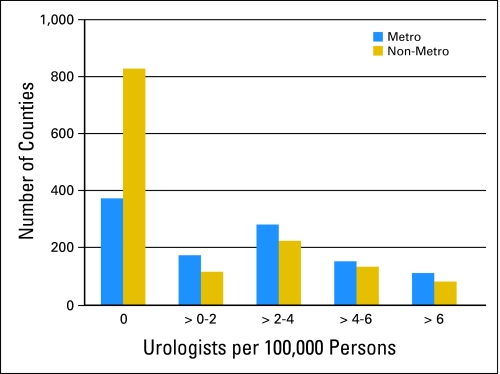
Purpose: The surgical work force distribution at the county level varies widely across the United States, and the impact of differential access on cancer outcomes is unclear. We used urologists as a test case because they are the first care providers for urologic cancers, can easily be identified from available data sources, and are unevenly distributed throughout the country. The goal of this study was to determine the effect of increasing urologist density on local prostate, bladder, and kidney cancer mortality.
Patients and methods: Using county-level data from the Area Resource File, US Census, National Cancer Institute, and Centers for Disease Control, regression models were built for prostate, bladder, and kidney cancer mortality, controlling for categorized urologist density, county demographics, socioeconomic factors, and preexisting health care infrastructure.
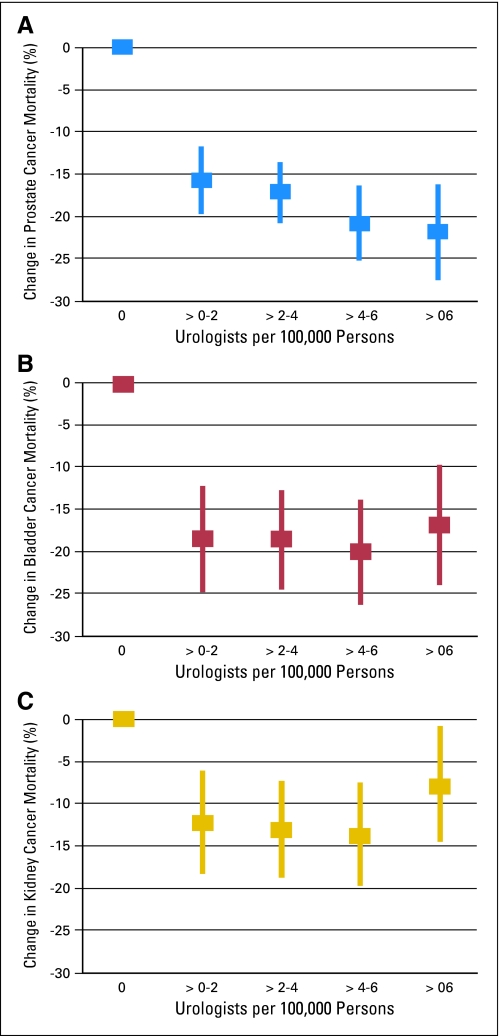
Results: For each of the three cancers, there was a statistically significant cancer-specific mortality reduction associated with counties that had more than zero urologists (16% to 22% reduction for prostate cancer, 17% to 20% reduction for bladder cancer, and 8% to 14% reduction for kidney cancer with increasing urologist density) relative to zero urologists. However, increasing density greater than two urologists per 100,000 people had no statistically significant impact on mortality for any of the tumors studied.
Conclusion: The presence of a urologist is associated with lower mortality for urologic cancers in that county, but increasing urologist density does not yield further improvements. Therefore, a nuanced and geographically aware policy toward the size and distribution of the future work force is most likely to provide the greatest population-level improvement in cancer mortality outcomes.
Conflict of interest statement
Authors' disclosures of potential conflicts of interest and author contributions are found at the end of this article.
Figures
References
-
- US Census Bureau. Population Projections. http://www.census.gov/population/www/projection/index.html.
-
- Cooper RA. The coming era of too few physicians. Bull Am Coll Surg. 2008;93:11–18. - PubMed
-
- Cooper RA. The future of specialty care in the US. Nat Clin Pract Rheumatol. 2008;4:333. - PubMed
-
- Macinko J, Starfield B, Shi L. Quantifying the health benefits of primary care physician supply in the United States. Int J Health Serv. 2007;37:111–126. - PubMed
-
- Phillips RL, Dodoo MS, Green LA. Adding more specialists is not likely to improve population health: Is anybody listening? Health Aff (Millwood) 2005;(suppl):W5-111–W5-114. - PubMed
