


ACE inhibition reduces infarction in normotensive but not hypertensive rats: correlation with cortical ACE activity
- PMID: 20407464
- PMCID: PMC2949242
- DOI: 10.1038/jcbfm.2010.57
ACE inhibition reduces infarction in normotensive but not hypertensive rats: correlation with cortical ACE activity
Abstract
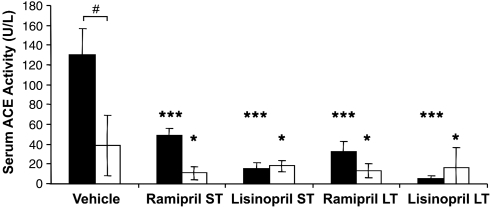
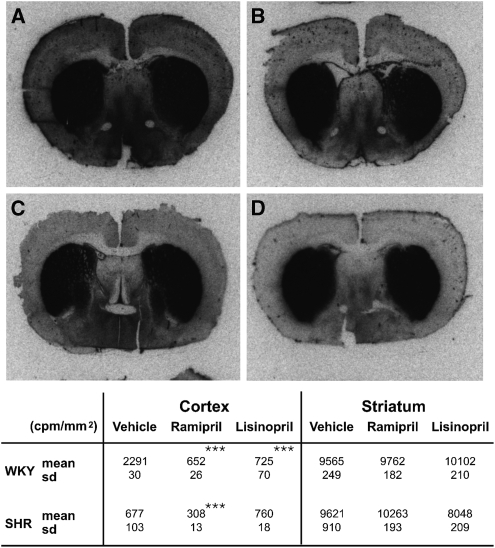
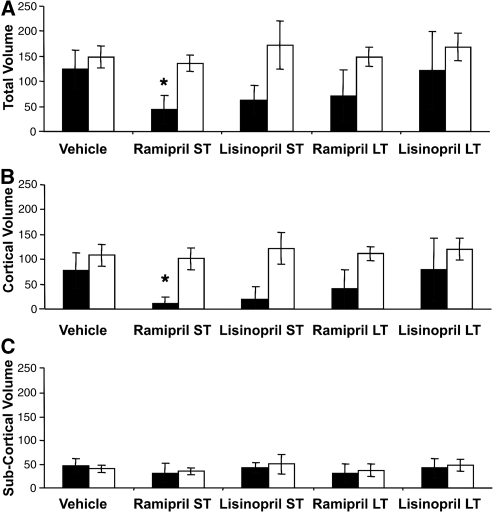
Angiotensin-converting enzyme (ACE) inhibition can reduce stroke risk by up to 43% in humans and reduce the associated disability, and hence understanding the mechanism of improvement is important. In animals and humans, these effects may be independent of the blood pressure-lowering effects of ACE inhibition. Normotensive (Wistar-Kyoto (WKY)) and hypertensive (spontaneously hypertensive rat (SHR)) animals were treated with the ACE inhibitors ramipril or lisinopril for 7 or 42 days before 2 hours of transient middle cerebral artery occlusion (MCAo). Blood pressure, serum ACE, and blood glucose levels were measured and stroke infarct volume was recorded 24 hours after stroke. Despite greater reductions in blood pressure, infarct size was not improved by ACE inhibition in hypertensive animals. Short-term ACE inhibition produced only a modest reduction in blood pressure, but WKY rats showed marked reductions in infarct volume. Long-term ACE inhibition had additional reductions in blood pressure; however, infarct volumes in WKY rats did not improve further but worsened. WKY rats differed from SHR in having marked cortical ACE activity that was highly sensitive to ACE inhibition. The beneficial effects of ACE inhibition on infarct volume in normotensive rats do not correlate with changes in blood pressure. However, WKY rats have ACE inhibitor-sensitive cortical ACE activity that is lacking in the SHR.
Figures
References
-
- 4S Group Randomised trial of cholesterol lowering in 4444 patients with coronary heart disease: the Scandinavian Simvastatin Survival Study (4S) Lancet. 1994;344:1383–1389. - PubMed
-
- Abbott RD, Curb JD, Rodriguez BL, Masaki KH, Popper JS, Ross GW, Petrovitch H. Age-related changes in risk factor effects on the incidence of thromboembolic and hemorrhagic stroke. J Clin Epidemiol. 2003;56:479–486. - PubMed
-
- Amarenco P, Bogousslavsky J, Callahan A, 3rd, Goldstein LB, Hennerici M, Rudolph AE, Sillesen H, Simunovic L, Szarek M, Welch KM, Zivin JA. High-dose atorvastatin after stroke or transient ischemic attack. N Engl J Med. 2006;355:549–559. - PubMed
-
- Arboix A, Miguel M, Ciscar E, Garcia-Eroles L, Massons J, Balcells M. Cardiovascular risk factors in patients aged 85 or older with ischemic stroke. Clin Neurol Neurosurg. 2006;108:638–643. - PubMed
-
- Arnaud C, Veillard NR, Mach F. Cholesterol-independent effects of statins in inflammation, immunomodulation and atherosclerosis. Curr Drug Targets Cardiovasc Haematol Disord. 2005;5:127–134. - PubMed
MeSH terms
Substances
LinkOut - more resources
Full Text Sources
Medical
Miscellaneous
