


Optimal body temperature in transitional extremely low birth weight infants using heart rate and temperature as indicators
- PMID: 20409098
- PMCID: PMC3864588
- DOI: 10.1111/j.1552-6909.2009.01087.x
Optimal body temperature in transitional extremely low birth weight infants using heart rate and temperature as indicators
Abstract
Objective: To explore body temperature in relationship to heart rate in extremely low birth weight (ELBW) infants during their first 12 hours to help identify the ideal set point for incubator control of body temperature.
Design: Within subject, multiple-case design.
Setting: A tertiary neonatal intensive care unit (NICU) in North Carolina.
Participants: Ten infants born at fewer than 29 weeks gestation and weighing 400 to 1,000 g.
Methods: Heart rate and abdominal body temperature were measured at 1-minute intervals for 12 hours. Heart rates were considered normal if they were between the 25th and 75th percentile for each infant.
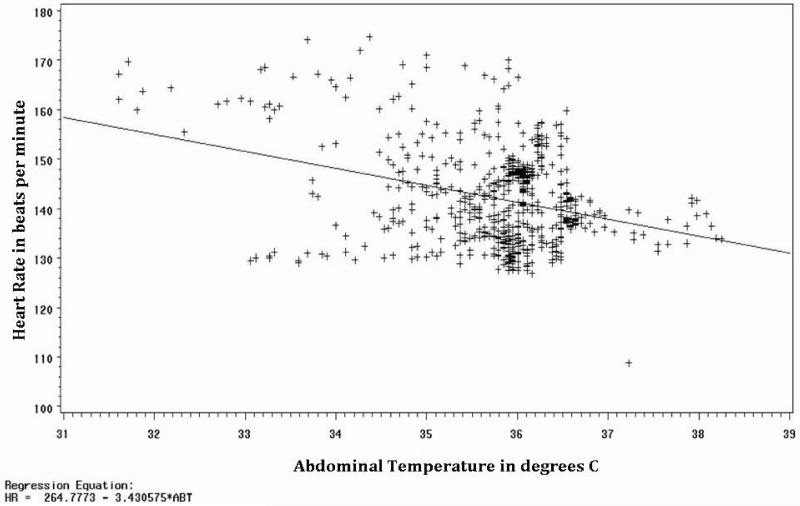
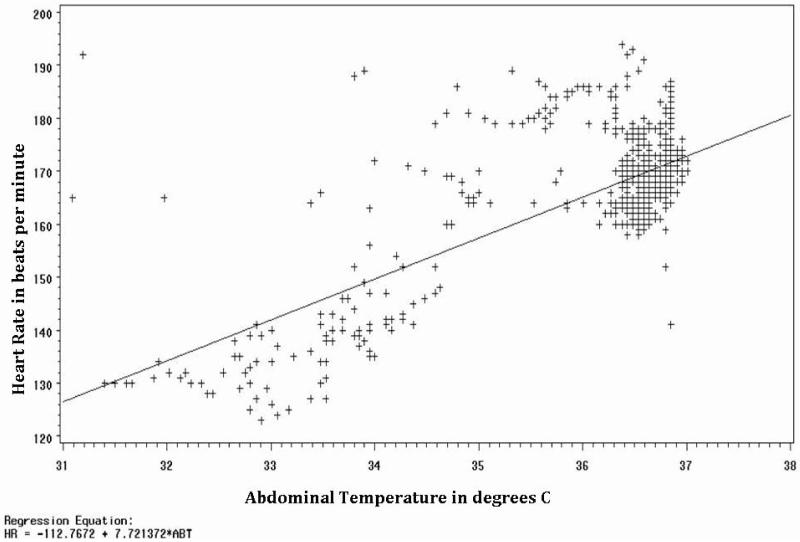
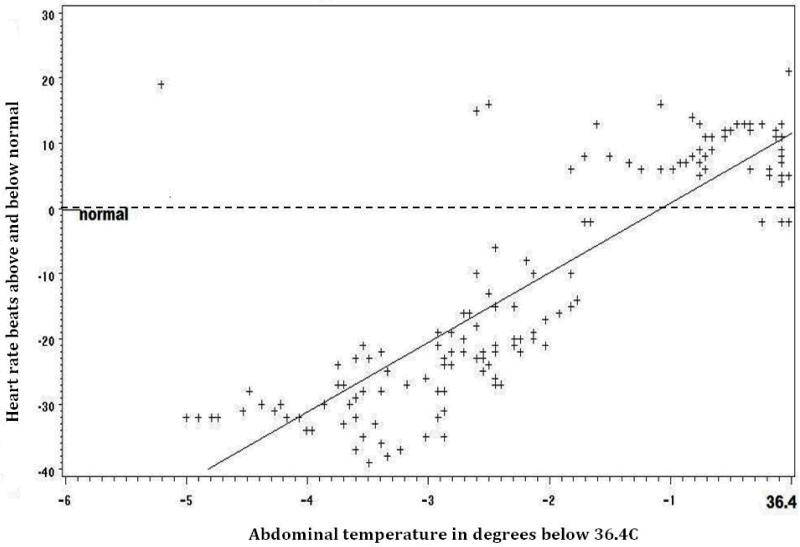
Results: Abdominal temperatures were low throughout the 12-hour study period (mean 35.17-36.68 degrees C). Seven of 10 infants had significant correlations between abdominal temperature and heart rate. Heart rates above the 75th percentile were associated with low and high abdominal temperatures; heart rates less than the 25th percentile were associated with very low abdominal temperatures. The extent to which abdominal temperature was abnormally low was related to the extent to which the heart rate trended away from normal in 6 of the 10 infants. Optimal temperature control point that maximized normal heart rate observations for each infant was between 36.8 degrees C and 37 degrees C.
Conclusions: Hypothermia was associated with abnormal heart rates in transitional ELBW infants. We suggest nurses set incubator servo between 36.8 degrees C and 36.9 degrees C to optimally control body temperature for ELBW infants.
Figures
References
-
- American Academy of Pediatrics. College of Obstetrics and Gyneclogists . Guidelines for Perinatal Care. second ed. American Academy of Pediatrics; Elk Grove, IL: 1988.
-
- Anderson P, Kleinman C, Lister G, Talner N. Cardiovascular function during normal fetal and neonatal development and with hypoxic stress. In: Polin R, Fox W, editors. Fetal and Neonatal Physiology. second ed. Vol. 1. Saunders; Philadelphia: 1998.
-
- Basu S, Rathore P, Bhatia B. Predictors of mortality in very low birth weight neonates in India. Singapore Medical Journal. 2008;49(7):556–560. - PubMed
-
- Bauer J, Hentschel R, Zahradnik H, Karck U, Linderkamp O. Vaginal delivery and neonatal outcome in emtremely-low-birth-weight infants below 26 weeks of gestational age. American Journal of Perinatology. 2003;20(4):181–188. - PubMed
-
- Bell E. Infant incubators and radiant warmers. Early Human Development. 1983;8:351–375. - PubMed
Publication types
MeSH terms
Grants and funding
LinkOut - more resources
Full Text Sources
Medical
