. 2010 Apr 21:11:259.
doi: 10.1186/1471-2164-11-259.

Major role for mRNA stability in shaping the kinetics of gene induction

Affiliations

Major role for mRNA stability in shaping the kinetics of gene induction

Ran Elkon et al. BMC Genomics. .

Abstract

Background: mRNA levels in cells are determined by the relative rates of RNA production and degradation. Yet, to date, most analyses of gene expression profiles were focused on mechanisms which regulate transcription, while the role of mRNA stability in modulating transcriptional networks was to a large extent overlooked. In particular, kinetic waves in transcriptional responses are usually interpreted as resulting from sequential activation of transcription factors.

Results: In this study, we examined on a global scale the role of mRNA stability in shaping the kinetics of gene response. Analyzing numerous expression datasets we revealed a striking global anti-correlation between rapidity of induction and mRNA stability, fitting the prediction of a kinetic mathematical model. In contrast, the relationship between kinetics and stability was less significant when gene suppression was analyzed. Frequently, mRNAs that are stable under standard conditions were very rapidly down-regulated following stimulation. Such effect cannot be explained even by a complete shut-off of transcription, and therefore indicates intense modulation of RNA stability.

Conclusion: Taken together, our results demonstrate the key role of mRNA stability in determining induction kinetics in mammalian transcriptional networks.


Figures
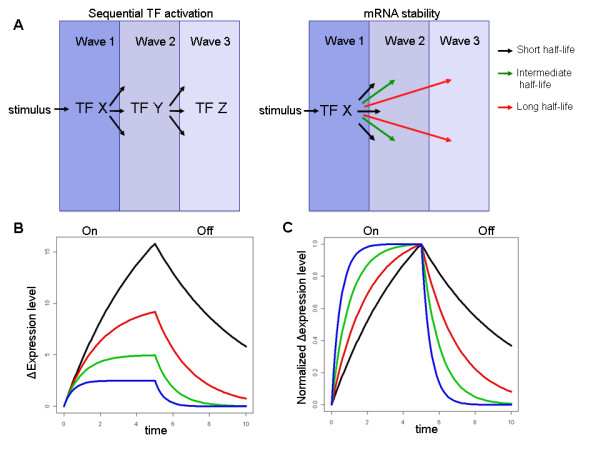
Figure 1
Figure 1
Kinetics of gene induction. (A) Two mechanisms which underlie the kinetics of gene induction are sequential activation of TFs and mRNA stability. While much research attention was given to the former, the latter was overlooked by many studies. Both mechanisms act in cells in parallel, and thus, the observed dynamics of transcriptional response reflects their superposition. (In the cartoon, waves 1, 2 and 3 refer to early-, intermediate- and late- kinetic responses.) (B) The standard kinetic model predicts that the rapidity of a transition between former and new transcript steady states is determined by the transcript's stability (T1/2 = ln2/α). The figure shows simulated kinetic response of four mRNAs with the same transcription rate (β = 5) and different degradation rates (blue: α = 2.0; green: α = 1.0; red: α = 0.5; black: α = 0.2). A pulse stimulation was exerted at t = 0 and terminated at t = 5. Note that upon induction, the most unstable mRNA (blue, highest α) reaches the lowest steady-state level, but it does so very rapidly (lowest T1/2). (C) Transcription rates of the four mRNAs were adjusted to bring them to the same level at t = 5.
Figure 2
Figure 2
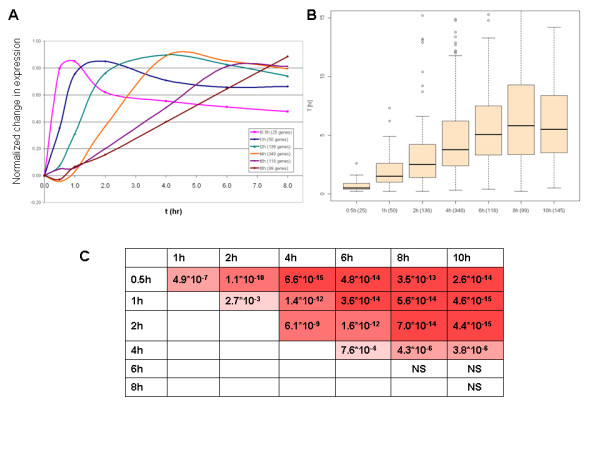
Kinetics of gene induction in response to IL2. (A) Kinetic clusters of genes induced by IL2 treatment. Genes were divided into clusters according to the first time in which they were induced by at least 2.0-fold (numbers of genes in each cluster are depicted in inset). Mean expression patterns of the clusters are shown. To bring genes to a similar scale, for each gene, relative expression levels to t0 (in log scale) were normalized to the gene's maximal fold of induction. After such manipulation, genes with similar kinetics but different magnitude of response show similar pattern. (B) Comparison of T half-life distribution between the different kinetic clusters. (At the X-axis, the number of genes assigned to each kinetic cluster is indicated next to the time point indicator. (C) P-values (Wilcoxon test) for the comparison between each pair of clusters. T half-life distribution of early-induced genes was significantly lower than those of genes that were induced at slower pace.
Figure 3
Figure 3
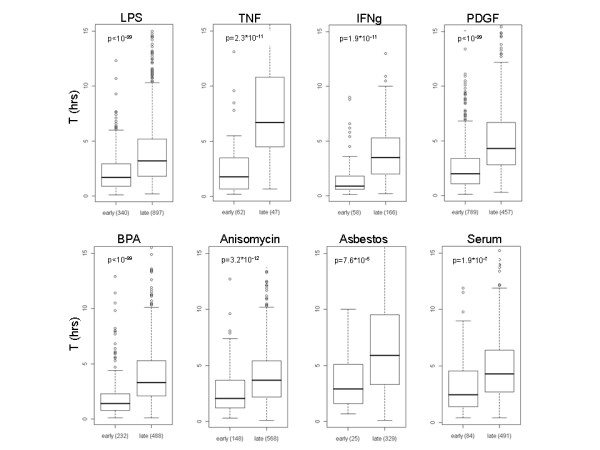
Global relationship between mRNA stability and kinetics of gene induction. For each dataset described in Additional file 1, we compared the T half-life distribution between early- and late- induced genes (that is, between genes that responded above the fold-change threshold specified in Additional file 1 before or at the 2 h time point and those that were induced later than 2 h). Numbers of early- and late-induced genes in each dataset are specified below the respective box-plots. (p-values were calculated using Wilcoxon test).
Figure 4
Figure 4
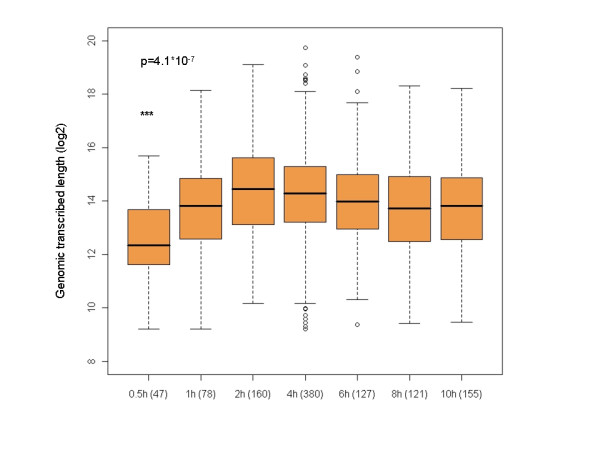
Correlation between response time and genomic transcribed length. Genes were divided into kinetic clusters according to the first time in which they were induced in response to IL2 (as shown in Figure 2), and distribution of genomic transcribed length was calculated for each cluster. The genes induced at 0.5 h were significantly shorter than all other induced genes (p = 4.1*10-7, Wilcoxon test).

Similar articles

Cited by

References

    1. Garcia-Martinez J, Aranda A, Perez-Ortin JE. Genomic run-on evaluates transcription rates for all yeast genes and identifies gene regulatory mechanisms. Molecular cell. 2004;15(2):303–313. doi: 10.1016/j.molcel.2004.06.004. - DOI - PubMed
    1. Dolken L, Ruzsics Z, Radle B, Friedel CC, Zimmer R, Mages J, Hoffmann R, Dickinson P, Forster T, Ghazal P. et al.High-resolution gene expression profiling for simultaneous kinetic parameter analysis of RNA synthesis and decay. RNA (New York, NY) 2008;14(9):1959–1972. - PMC - PubMed
    1. Cheadle C, Fan J, Cho-Chung YS, Werner T, Ray J, Do L, Gorospe M, Becker KG. Control of gene expression during T cell activation: alternate regulation of mRNA transcription and mRNA stability. BMC genomics. 2005;6(1):75. doi: 10.1186/1471-2164-6-75. - DOI - PMC - PubMed
    1. Keene JD. RNA regulons: coordination of post-transcriptional events. Nature reviews. 2007;8(7):533–543. doi: 10.1038/nrg2111. - DOI - PubMed
    1. Narsai R, Howell KA, Millar AH, O'Toole N, Small I, Whelan J. Genome-wide analysis of mRNA decay rates and their determinants in Arabidopsis thaliana. The Plant cell. 2007;19(11):3418–3436. doi: 10.1105/tpc.107.055046. - DOI - PMC - PubMed

Publication types

LinkOut - more resources