. 2010 May;16(5):809-15.
doi: 10.3201/eid1605.091136.

Influenza outbreaks during World Youth Day 2008 mass gathering

Collaborators, Affiliations

Influenza outbreaks during World Youth Day 2008 mass gathering

Christopher C Blyth et al. Emerg Infect Dis. 2010 May.

Abstract

Influenza outbreaks during mass gatherings have been rarely described, and detailed virologic assessment is lacking. An influenza outbreak occurred during World Youth Day in Sydney, Australia, July 2008 (WYD2008). We assessed epidemiologic data and respiratory samples collected from attendees who sought treatment for influenza-like illness at emergency clinics in Sydney during this outbreak. Isolated influenza viruses were compared with seasonal influenza viruses from the 2008 influenza season. From 100 infected attendees, numerous strains were identified: oseltamivir-resistant influenza A (H1N1) viruses, oseltamivir-sensitive influenza A (H1N1) viruses, influenza A (H3N2) viruses, and strains from both influenza B lineages (B/Florida/4/2006-like and B/Malaysia/2506/2004-like). Novel viruses were introduced, and pre-WYD2008 seasonal viruses were amplified. Viruses isolated at mass gatherings can have substantial, complex, and unpredictable effects on community influenza activity. Greater flexibility by public health authorities and hospitals is required to appropriately manage and contain these outbreaks.


Figures
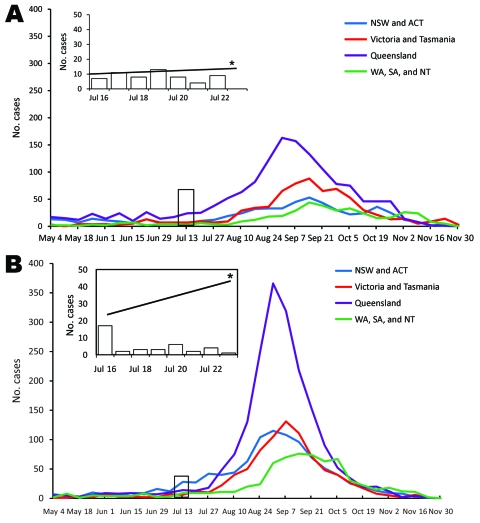
Figure 1
Figure 1
Laboratory-confirmed influenza A (A) and B (B) cases during World Youth Day 2008 (WYD2008; insets) compared with national seasonal influenza data (main graphs). Data are presented as the number of laboratory-confirmed cases per day for WYD2008 and per week for national influenza surveillance. Because laboratory methods to detect community influenza activity vary between different states, the relative effects of influenza in each state are not comparable. NSW, New South Wales; ACT, Australian Capital Territory; WA, Western Australia; SA, South Australia; NT, Northern Territory. *Background rate of laboratory-confirmed influenza for NSW/ACT included for comparison. †National data are inclusive of influenza cases diagnosed by antigen detection, nucleic acid testing, and viral isolation.
Figure 2
Figure 2
Relative effects of different influenza viruses before (pre) and after (post) World Youth Day 2008 for A) Australia; B) Western Australia; C) South Australia and Northern Territory; D) Queensland; E) New South Wales and Australian Capital Territory; and F) Victoria and Tasmania. The size of each pie chart is approximately proportional to the number of virus isolates analyzed from each region.
Figure 3
Figure 3
Phylogenetic trees illustrating relatedness of hemagglutinin sequences from influenza A (H1N1) (A), A (H3N2) (B), and B/Malaysia-like viruses (C) from pre–World Youth Day 2008 (WYD2008) Australian isolates (●), WYD2008 isolates (†), post-WYD2008 Australian isolates (▲), and related international isolates. Trees were constructed by using maximum-likelihood (DNAml) in PHYLIP. Only bootstrap values >60 are included.

References

    1. Church DL, Davies HD, Mitton C, Semeniuk H, Logue M, Maxwell C, et al. Clinical and economic evaluation of rapid influenza a virus testing in nursing homes in Calgary, Canada. Clin Infect Dis. 2002;34:790–5. 10.1086/338960 - DOI - PubMed
    1. Monto AS, Rotthoff J, Teich E, Herlocher ML, Truscon R, Yen HL, et al. Detection and control of influenza outbreaks in well-vaccinated nursing home populations. Clin Infect Dis. 2004;39:459–64. 10.1086/422646 - DOI - PubMed
    1. Ayob A, Selviendran N, Hampson AW, Barr IG, Kumarasamy V, Chua KB. Outbreak of influenza amongst residential school students in Malaysia. Med J Malaysia. 2006;61:168–72. - PubMed
    1. Besselaar TG, Botha L, McAnerney JM, Schoub BD. Antigenic and molecular analysis of influenza A (H3N2) virus strains isolated from a localised influenza outbreak in South Africa in 2003. J Med Virol. 2004;73:71–8. 10.1002/jmv.20063 - DOI - PubMed
    1. Young LC, Dwyer DE, Harris M, Guse Z, Noel V, Levy MH. Summer outbreak of respiratory disease in an Australian prison due to an influenza A/Fujian/411/2002(H3N2)-like virus. Epidemiol Infect. 2005;133:107–12. 10.1017/S0950268804003243 - DOI - PMC - PubMed

MeSH terms

Substances

LinkOut - more resources