. 2010 Aug;51(8):2153-70.
doi: 10.1194/jlr.M004796. Epub 2010 Apr 21.

Dynamic simulation of cardiolipin remodeling: greasing the wheels for an interpretative approach to lipidomics

Affiliations

Dynamic simulation of cardiolipin remodeling: greasing the wheels for an interpretative approach to lipidomics

Michael A Kiebish et al. J Lipid Res. 2010 Aug.

Abstract

Cardiolipin is a class of mitochondrial specific phospholipid, which is intricately involved in mitochondrial functionality. Differences in cardiolipin species exist in a variety of tissues and diseases. It has been demonstrated that the cardiolipin profile is a key modulator of the functions of many mitochondrial proteins. However, the chemical mechanism(s) leading to normal and/or pathological distribution of cardiolipin species remain elusive. Herein, we describe a novel approach for investigating the molecular mechanism of cardiolipin remodeling through a dynamic simulation. This approach applied data from shotgun lipidomic analyses of the heart, liver, brain, and lung mitochondrial lipidomes to model cardiolipin remodeling, including relative content, regiospecificity, and isomeric composition of cardiolipin species. Generated cardiolipin profiles were nearly identical to those determined by shotgun lipidomics. Importantly, the simulated isomeric compositions of cardiolipin species were further substantiated through product ion analysis. Finally, unique enzymatic activities involved in cardiolipin remodeling were assessed from the parameters used in the dynamic simulation of cardiolipin profiles. Collectively, we described, verified, and demonstrated a novel approach by integrating both lipidomic analysis and dynamic simulation to study cardiolipin biology. We believe this study provides a foundation to investigate cardiolipin metabolism and bioenergetic homeostasis in normal and disease states.


Figures

Fig. 1.
Fig. 1.
The schematic cardiolipin biosynthesis and remodeling pathway. CDP-DAG is used in the mitochondria to form the metabolic intermediate PG phosphate for the synthesis of PG through a dephosphorylation activity. Newly synthesized cardiolipin (immature cardiolipin) is formed by the condensation of PG and CDP-DAG. Immature cardiolipin is then deacylated to form monolysocardiolipin and then reacylated using acyl chains from acyl CoA or the sn-2 acyl chain of phosphatidylcholine and phosphatidylethanolamine. This remodeling process yields mature cardiolipin.
Fig. 2.
Fig. 2.
The strategy employed for cardiolipin dynamic simulation. 1: PG molecular species including regiospecificity were identified and quantified. Predicted immature cardiolipin was generated based on the concentration of PG species. 2: Immature cardiolipin was then deacylated with all chains being equally selected or with sn-1 or sn-2 selectivity followed by the reacylation with acyl chains 3: originating from phosphatidylcholine and phosphatidylethanolamine sn-2 positions (a) or acyl CoA (b) (with acyl selectivity inferred) representing transacylase and acyltransferase activities, respectively. Additionally, at this point, a portion of the cardiolipin molecular species can be nonselectively catabolized and immature cardiolipin species can be constantly added to represent a proportion of cardiolipin biosynthesis. 4: Cardiolipin remodeling will reach an equilibrium state in which the distribution of cardiolipin molecular species will not dramatically change relative to the distribution of acyl chains used for remodeling.
Fig. 3.
Fig. 3.
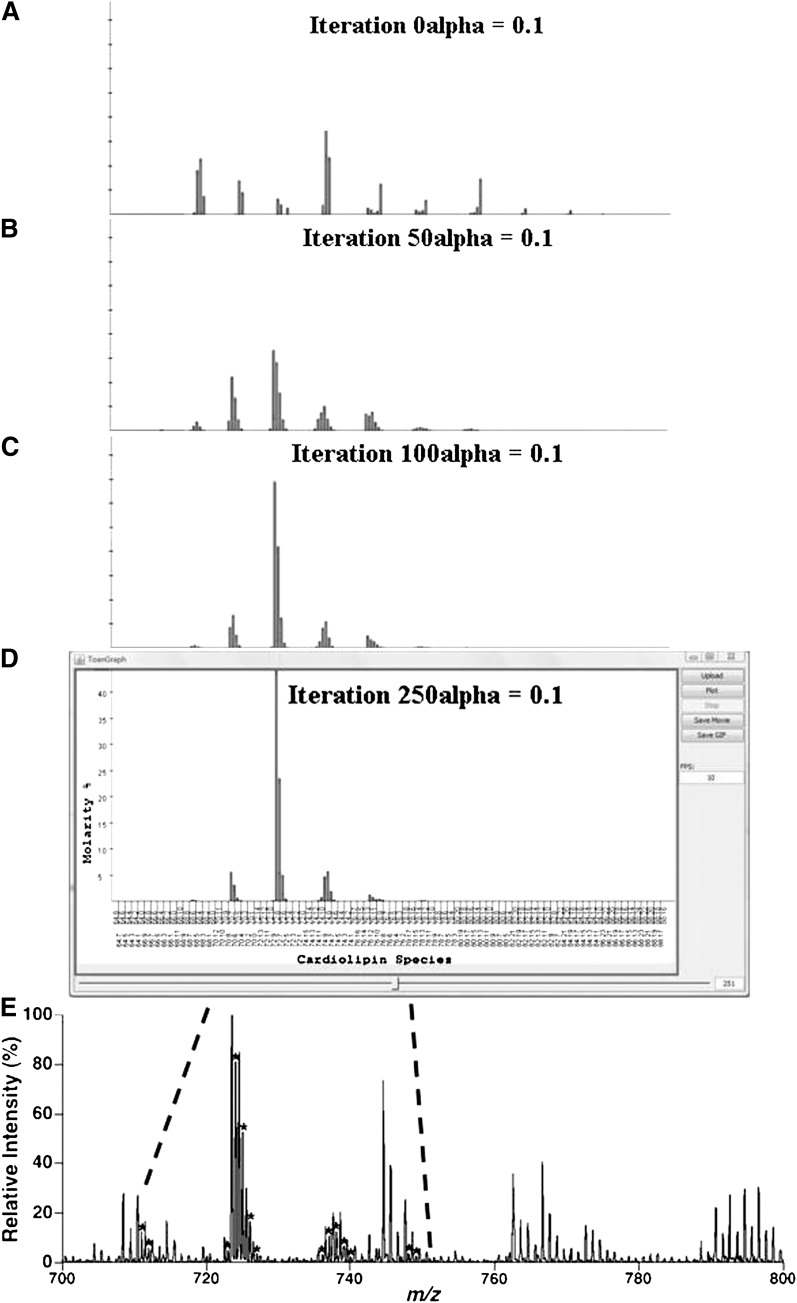
Dynamic simulation of myocardial cardiolipin molecular species. A: Predicted myocardial immature cardiolipin molecular species were generated representing time point 0. Generated distributions of cardiolipin molecular species were represented at iteration 50 (B), 100 (C), and 250 (D). E: A representative mouse myocardial cardiolipin distribution as determined by MDMS-SL. The asterisks indicate the individual ion peaks of mouse myocardial cardiolipin (15). The mouse myocardial cardiolipin molecular species detected and quantified by MDMS-SL as well as determined by the dynamic simulation were tabulated in Table 1.
Fig. 4.
Fig. 4.
Dynamic simulation of hepatic cardiolipin molecular species. A: Predicted hepatic immature cardiolipin molecular species were generated representing time point 0. Generated distributions of cardiolipin molecular species were represented at iteration 50 (B), 100 (C), and 250 (D). E: A representative mouse hepatic cardiolipin distribution as determined by MDMS-SL. The asterisks indicate the individual ion peaks of mouse hepatic cardiolipin. The mouse hepatic cardiolipin molecular species detected and quantified by MDMS-SL as well as determined by the dynamic simulation were tabulated in Table 2.
Fig. 5.
Fig. 5.
Dynamic simulation of brain cardiolipin molecular species. A: Predicted brain immature cardiolipin molecular species were generated representing at time point 0. Generated distributions of cardiolipin molecular species were represented at iteration 50 (B), 100 (C), and 250 (D). E: A representative mouse brain cardiolipin distribution as determined by MDMS-SL. The asterisks indicate the individual ion peaks of mouse brain cardiolipin. The mouse brain cardiolipin molecular species detected and quantified by MDMS-SL as well as determined by the dynamic simulation were tabulated in Table 3.
Fig. 6.
Fig. 6.
Validation of very low abundance cardiolipin isomeric species by product ion analysis using an Orbitrap-LTQ mass spectrometer. Product ion mass spectra of representative myocardial cardiolipin species were acquired using a high mass accuracy/resolution instrument as described under “Materials and Methods.” A: A product ion mass spectrum of cardiolipin species at m/z 723.48 demonstrates the presence of several very low abundance fragments (inset a) corresponding to fatty acyl carboxylates in addition to the abundant 18:2 carboxylate (m/z 279.23). B: A product ion mass spectrum of cardiolipin species at m/z 736.51 demonstrates the presence of several very low abundance fragments (inset c) corresponding to fatty acyl carboxylates in addition to the abundant 18:2 and 20:3 carboxylates (m/z 279.23 and 305.25, respectively). Insets b and d list the cardiolipin isomeric species and their composition determined by the dynamic simulation.
Fig. 7.
Fig. 7.
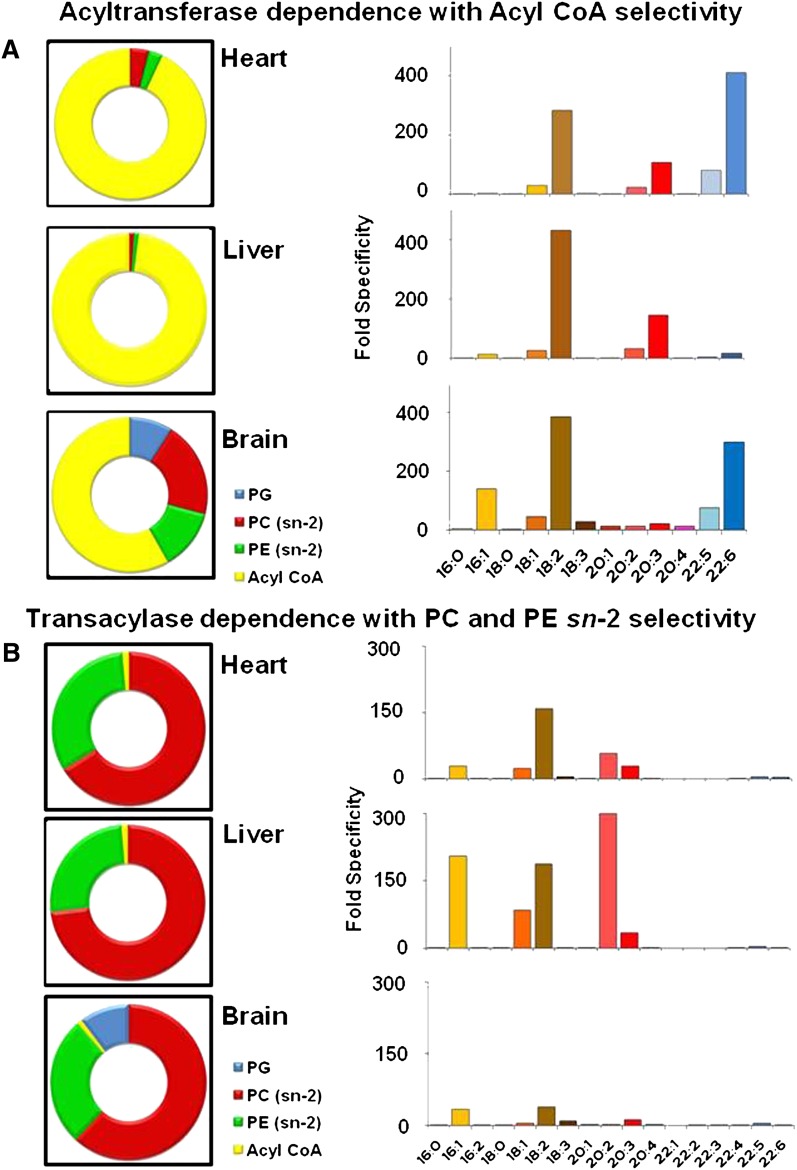
The contribution and selectivity of acyl chains for cardiolipin remodeling from different fatty acyl donor pools determined by dynamic simulation. Based on the acyl chains used to generate mature myocardial, hepatic, and brain cardiolipin, inference was used to determine the possible contribution from acyltransferase, transacylase, or cardiolipin biosynthesis activities. The possible proportion of acyl chains from PG, PC sn-2 positions, PE sn-2 positions, and acyl CoA as determined by MDMS-SL are represented in the chart that would match the acyl chain distribution used in the dynamic simulation. Selectivity of specific acyl chains for acyltransferase dependence (acyl CoA) (A) or transacylase dependence (PC or PE sn-2 acyl chains) (B) was inferred in the heart, liver, and brain. This inferences approach allows the comparison of different acyl selectivities for both acyltransferase and transacylase activities.

References

    1. Han X., Gross R. W. 2005. Shotgun lipidomics: electrospray ionization mass spectrometric analysis and quantitation of cellular lipidomes directly from crude extracts of biological samples. Mass Spectrom. Rev. 24: 367–412. - PubMed
    1. Dennis E. A. 2009. Lipidomics joins the omics evolution. Proc. Natl. Acad. Sci. USA. 106: 2089–2090. - PMC - PubMed
    1. Niemela P. S., Castillo S., Sysi-Aho M., Oresic M. 2009. Bioinformatics and computational methods for lipidomics. J. Chromatogr. B Analyt. Technol. Biomed. Life Sci. 877: 2855–2862. - PubMed
    1. Han X., Gross R. W. 2005. Shotgun lipidomics: multidimensional MS analysis of cellular lipidomes. Expert Rev. Proteomics. 2: 253–264. - PubMed
    1. Yang K., Cheng H., Gross R. W., Han X. 2009. Automated lipid identification and quantification by multidimensional mass spectrometry-based shotgun lipidomics. Anal. Chem. 81: 4356–4368. - PMC - PubMed

Publication types