. 2010 Jul;38(13):4547-57.
doi: 10.1093/nar/gkq181. Epub 2010 Apr 22.

Synergistic effects between analogs of DNA and RNA improve the potency of siRNA-mediated gene silencing

Affiliations

Synergistic effects between analogs of DNA and RNA improve the potency of siRNA-mediated gene silencing

Glen F Deleavey et al. Nucleic Acids Res. 2010 Jul.

Abstract

We report that combining a DNA analog (2'F-ANA) with rigid RNA analogs [2'F-RNA and/or locked nucleic acid (LNA)] in siRNA duplexes can produce gene silencing agents with enhanced potency. The favored conformations of these two analogs are different, and combining them in a 1-1 pattern led to reduced affinity, whereas alternating short continuous regions of individual modifications increased affinity relative to an RNA:RNA duplex. Thus, the binding affinity at key regions of the siRNA duplex could be tuned by changing the pattern of incorporation of DNA-like and RNA-like nucleotides. These heavily or fully modified duplexes are active against a range of mRNA targets. Effective patterns of modification were chosen based on screens using two sequences targeting firefly luciferase. We then applied the most effective duplex designs to the knockdown of the eIF4E binding proteins 4E-BP1 and 4E-BP2. We identified modified duplexes with potency comparable to native siRNA. Modified duplexes showed dramatically enhanced stability to serum nucleases, and were characterized by circular dichroism and thermal denaturation studies. Chemical modification significantly reduced the immunostimulatory properties of these siRNAs in human peripheral blood mononuclear cells.


Figures
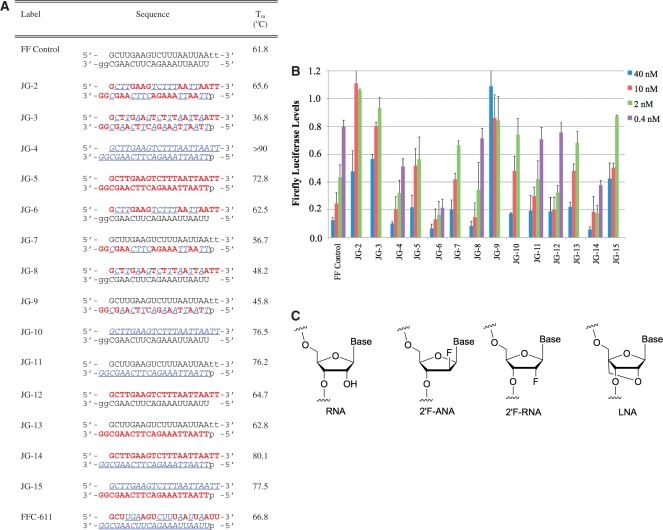
Figure 1.
Figure 1.
(A) Sequences and thermal denaturation studies of siRNAs targeting firefly luciferase mRNA (the JG series) from position +1818 to + 1836. (B) Activity of siRNAs modified with 2′F-ANA and 2′F-RNA (Sequences shown in (A)). mRNA target is firefly luciferase. n = 2 for select siRNAs at the 0.4 nM concentration, n = 4 for FF Control, JG-4, 6, 8, 11, 12, 14 at the 0.4 nM, 2 nM, 10 nM and 40 nM concentrations, n = 2 for JG-2, 3, 5, 7, 9, 10, 13, 15 at the 2 nM, 10 nM and 40 nM concentrations. Firefly luciferase levels were normalized to total cellular protein and luciferase counts of mock treated cells. Bars indicate standard deviation. (C) Chemical structures of ribonucleic acid (RNA), 2′-fluoroarabinonucleic acid (2′F-ANA), 2′-fluororibonucleic acid (2′F-RNA) and locked nucleic acid (LNA). Legend: RNA, dna, formula image, p = 5′ phosphorylation.
Figure 2.
Figure 2.
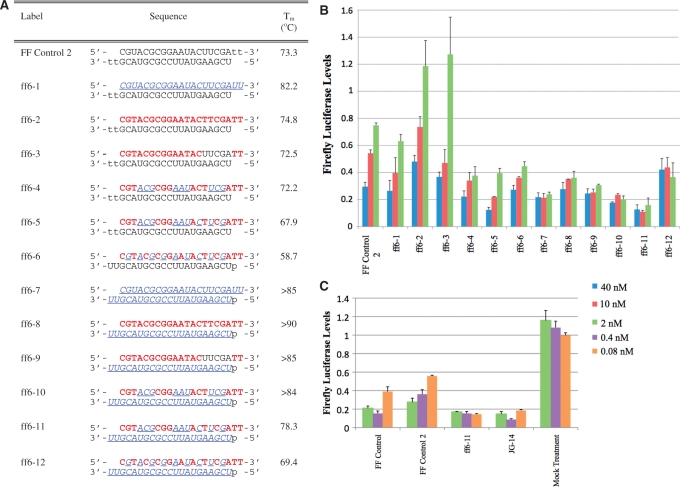
(A) Sequences and thermal denaturation studies of siRNAs targeting firefly luciferase mRNA (the ff6 series) from position +515 to +533. (B) Assays demonstrating activity of modified siRNAs. n = 2. Firefly luciferase levels were normalized to total cellular protein and luciferase counts of cells treated with scrambled (non-targeting) siRNAs. (C) Gene silencing assays to directly compare siRNAs targeting the two different regions of luciferase mRNA. The two unmodified siRNAs were tested, along with ff6-11 and JG-14 modification designs. n = 2. Firefly luciferase levels were normalized to total cellular protein and luciferase counts of cells treated with scrambled (nontargeting) siRNA. Bars indicate standard deviation. Legend: RNA, dna, formula image, p = 5′ phosphorylation.
Figure 3.
Figure 3.
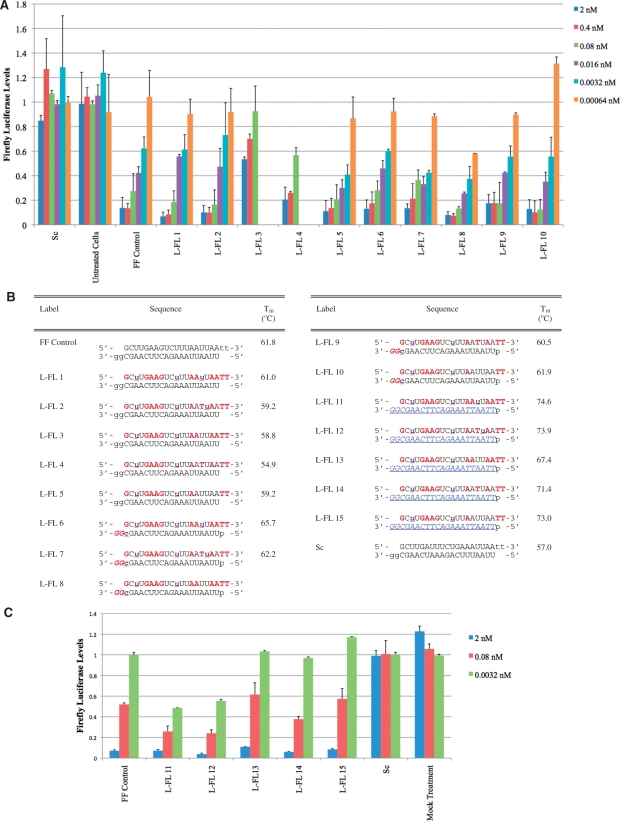
(A) Assays demonstrating activity of siRNAs modified with 2′F-ANA, and LNA [sequences shown in (B)]. mRNA target is the firefly luciferase gene. Firefly luciferase levels were normalized to total cellular protein and average luciferase counts of untreated cells. For 2, 0.4 and 0.08 nM concentrations, n = 2 (for Sc, L-FL 3, and L-FL4) or n = 4 (for FF Control, L-FL 1, 2, 5–10 and untreated cells). n = 2 for 0.016, 0.0032, 0.00064 nM concentrations. L-FL 3 and 4 were not tested at the bottom three concentrations. (C) Assays demonstrating activity of siRNAs modified with 2′F-ANA and LNA, with a 2′F-RNA antisense stand [sequences shown in (B)]. Firefly luciferase levels were normalized to total cellular protein and luciferase counts of cells treated with scrambled (nontargeting) siRNA. n = 2. Bars indicate standard deviation. Legend: RNA, dna, formula image, p = 5′ phosphorylation.
Figure 4.
Figure 4.
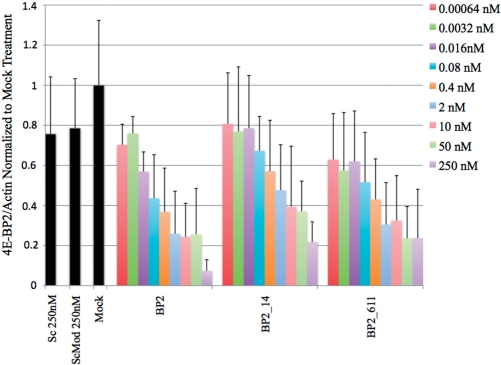
Densitometry analysis of western blot results following cell treatment with siRNAs modified with 2′F-ANA and 2′F-RNA (sequences shown in Table 1). mRNA target is 4E-BP2 in human HEK293T cells. siRNA concentrations ranged from 0.00064 to 250 nM. n = 10 for Sc 250 nM and ScMod 250 nM treatments, n = 13 for Mock treatment, n = 4 for BP2 0.00064–0.016 nM, n = 5 for BP2 0.08–250 nM, and n = 3 for all BP2_14 and BP2_611 treatments. Representative western blots are shown in Supplementary Figure S6. Bars represent standard deviation.
Figure 5.
Figure 5.
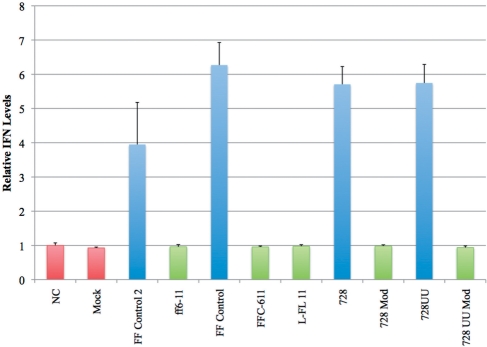
IFN levels in PBMC cells 24 h after treatment with siRNAs transfected using DOTAP, as measured by the HEK-Blue IFN assay. IFN levels in response to unmodified siRNAs are shown in blue, modified siRNAs in green, and control treatments in red. NC is the negative control (cells alone). Mock treatment was transfection without siRNA. Data were collected in duplicate for each of two donors. Results were normalized to the negative control.

References

    1. Fire A, Xu S, Montgomery MK, Kostas SA, Driver SE, Mello CC. Potent and specific genetic interference by double-stranded RNA in Caenorhabditis elegans. Nature. 1998;391:806–811. - PubMed
    1. Elbashir SM, Harborth J, Lendeckel W, Yalcin A, Weber K, Tuschl T. Duplexes of 21-nucleotide RNAs mediate RNA interference in cultured mammalian cells. Nature. 2001;411:494–498. - PubMed
    1. Watts JK, Deleavey GF, Damha MJ. Chemically modified siRNA: tools and applications. Drug Discov. Today. 2008;13:842–855. - PubMed
    1. Deleavey GF, Watts JK, Damha MJ. Chemical modification of siRNA. Curr. Protoc. Nucleic Acid Chem. 2009:16.3.1–16.3.21. - PubMed
    1. Jackson AL, Bartz SR, Schelter J, Kobayashi SV, Burchard J, Mao M, Li B, Cavet G, Linsley PS. Expression profiling reveals off-target gene regulation by RNAi. Nat. Biotech. 2003;21:635–637. - PubMed

Publication types

MeSH terms