


Security protection of DICOM medical images using dual-layer reversible watermarking with tamper detection capability
- PMID: 20414697
- PMCID: PMC3092037
- DOI: 10.1007/s10278-010-9295-4
Security protection of DICOM medical images using dual-layer reversible watermarking with tamper detection capability
Abstract
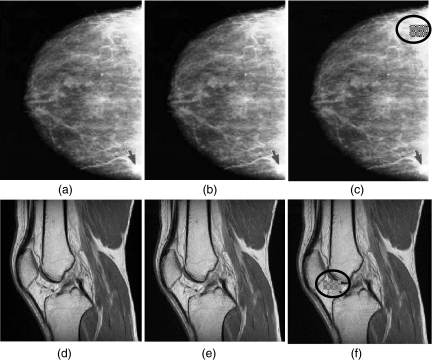
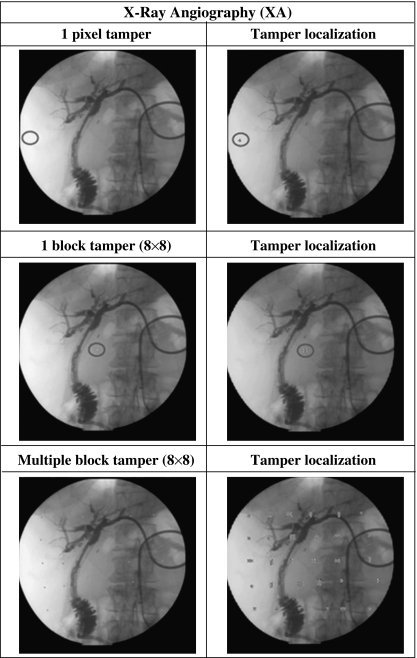
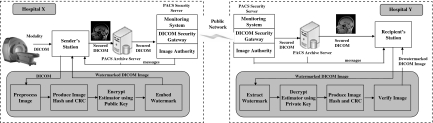
Teleradiology applications and universal availability of patient records using web-based technology are rapidly gaining importance. Consequently, digital medical image security has become an important issue when images and their pertinent patient information are transmitted across public networks, such as the Internet. Health mandates such as the Health Insurance Portability and Accountability Act require healthcare providers to adhere to security measures in order to protect sensitive patient information. This paper presents a fully reversible, dual-layer watermarking scheme with tamper detection capability for medical images. The scheme utilizes concepts of public-key cryptography and reversible data-hiding technique. The scheme was tested using medical images in DICOM format. The results show that the scheme is able to ensure image authenticity and integrity, and to locate tampered regions in the images.
Figures
References
-
- The Health Insurance Portability and Accountability Act (HIPAA), March 2009. [Online]. Available at: http://www.hhs.gov/ocr/privacy/index.html
-
- Digital Imaging and Communications in Medicine (DICOM), part 15: security profiles ed., National Electrical Manufacturers Association (NEMA), 2001, pS 3.15–2001
-
- Coatrieux G, Maitre H, Sankur B, Rolland Y, Collorec R: Relevance of watermarking in medical imaging. Proc IEEE EMBS Information Technology Applications in Biomedicine. Arlington, VA 2000, pp 250–255
-
- Zain JM, Fauzi AM, Aziz AA: Clinical evaluation of watermarked medical images. Proc EMBS 28th Annual International Conference of the IEEE 5459–5462, New York, USA, August 30–Sept. 3, 2006 - PubMed
-
- Wang XY, Feng DG, Lai XJ, Yu HB: Collisions for hash functions MD4, MD5 HAVAL-128 and RIPEMD. Rump session of Crypto’04 and IACR Eprint archive, 2004
MeSH terms
LinkOut - more resources
Full Text Sources
Other Literature Sources
Medical
