. 2010 Aug;20(4):510-8.
doi: 10.1016/j.conb.2010.03.013. Epub 2010 Apr 24.

Neuronal intrinsic barriers for axon regeneration in the adult CNS

Affiliations

Neuronal intrinsic barriers for axon regeneration in the adult CNS

Fang Sun et al. Curr Opin Neurobiol. 2010 Aug.

Abstract

A major reason for the devastating and permanent disabilities after spinal cord and other types of CNS injury is the failure of injured axons to regenerate and to re-build the functional circuits. Thus, a long-standing goal has been to develop strategies that could promote axon regeneration and restore functions. Recent studies revealed that simply removing extracellular inhibitory activities is insufficient for successful axon regeneration in the adult CNS. On the other side, evidence from different species and different models is accumulating to support the notion that diminished intrinsic regenerative ability of mature neurons is a major contributor to regeneration failure. This review will summarize the molecular mechanisms regulating intrinsic axon growth capacity in the adult CNS and discuss potential implications for therapeutic strategies.


Figures

Figure 1
Figure 1
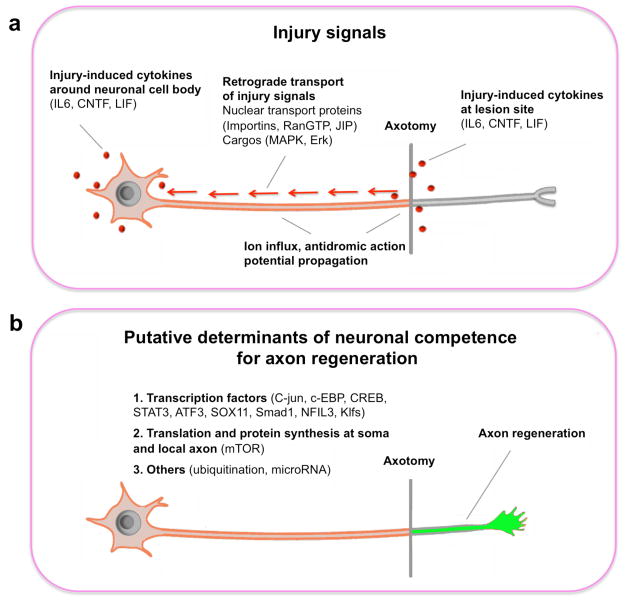
Two aspects of neuronal intrinsic mechanisms for axon regeneration. (a) Schematic of axotomy-triggered retrograde signals. In addition to acute axotomy-induced changes such as ion influx and antidromic action potential propagation, cytokines such as IL-6, CNTF and LIF could be up-regulated at the lesion site and/or around the cell body. Activated signaling components in the axon or at the cell body could be transported to the nucleus by nuclear transport proteins such as importins, RanGTP and JIP. (b) Putative determinants of neuronal competence for regenerative responses. These include the steps required for synthesis and assembly of materials for axon extension: transcription, translation and other post-translational modifications.
Figure 2
Figure 2
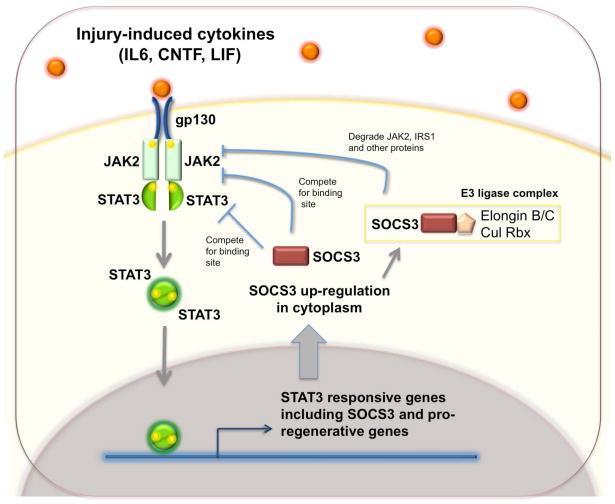
gp130-dependent cytokines promote axon regeneration and SOCS3 act as a critical negative regulator of the signaling pathway. Injury-induced cytokines act on their receptor complexes with a shared component gp130 and activate the JAK-STAT cascade in both PNS and CNS neurons. Phosphorylated STAT-3 is translocated to the nucleus and initiate gene expression for axon regeneration. However, in the adult CNS, the activation of this pathway leads to the up-regulation of SOCS3 which will inhibit JAK2 and STAT3 and in turn inhibit this pathway. Thus, in SOCS3 deleted RGCs, both endogenous and exogenous cytokines such as CNTF promote significant axon regeneration [ 50**].
Figure 3
Figure 3
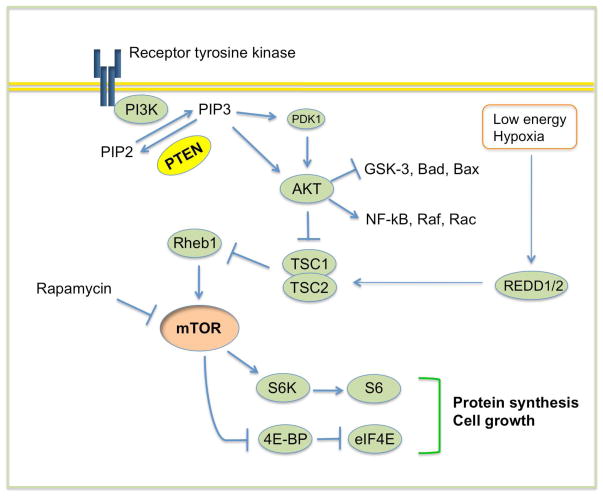
PTEN-regulated signaling pathway. In response to receptor tyrosine kinase activation, PI3K phosphorylates and converts the lipid second messenger phosphatidylinositol (4,5) bisphosphate (PIP2) into phosphatidylinositol (3,4,5) trisphosphate (PIP3), which recruits and activates phosphatidylinositol-dependent kinase 1/2 (PDK1/2). PDK1/2, in turn, phosphorylates and activates Akt. PTEN catalyzes the conversion from PIP3 to PIP2. Thus, inactivation of PTEN results in the accumulation of PIP3 and the activation of Akt. Akt controls a host of signaling molecules, including GSK-3 and TSC1/2. Inactivation of the TSC1/2 complex leads to activation of mTOR, which integrates various cellular signals including nutrient availability to control protein translation, cell growth, and other processes. The ribosomal protein S6 kinase (RP-S6) and the eukaryotic initiation factor 4E (eIF-4E) binding protein 1 (4E-BP1) are the mTOR effector molecules executing these functions. Cellular stresses such as hypoxia and low energy induce expression of Redd1/2, which augments TSC1/2 activity and in turn suppress the mTOR activity.

References

    1. David S, Aguayo AJ. Axonal elongation into peripheral nervous system “bridges” after central nervous system injury in adult rats. Science. 1981;214:931–933. - PubMed
    1. Schwab ME, Bartholdi D. Degeneration and regeneration of axons in the lesioned spinal cord. Physiol Rev. 1996;76:319–370. - PubMed
    1. Filbin MT. Recapitulate development to promote axonal regeneration: good or bad approach? Philos Trans R Soc Lond B Biol Sci. 2006;361:1565–1574. - PMC - PubMed
    1. Fitch MT, Silver J. CNS injury, glial scars, and inflammation: Inhibitory extracellular matrices and regeneration failure. Exp Neurol. 2008;209:294–301. - PMC - PubMed
    1. Yiu G, He Z. Glial inhibition of CNS axon regeneration. Nat Rev Neurosci. 2006;7:617–627. - PMC - PubMed

MeSH terms

Substances