


Dietary macronutrient and energy intake and urinary incontinence in women
- PMID: 20421220
- PMCID: PMC2877472
- DOI: 10.1093/aje/kwq065
Dietary macronutrient and energy intake and urinary incontinence in women
Abstract
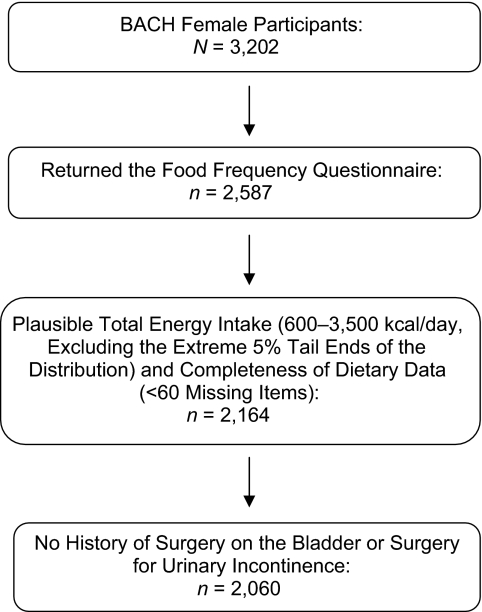
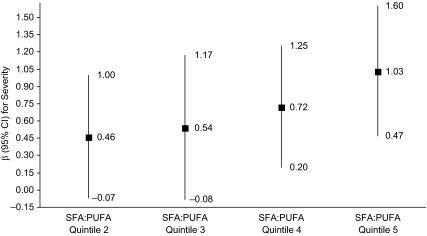
Weight loss involving diet modification improves urinary incontinence (UI) in women, but little is known about dietary correlates of UI. The authors examined intakes of total energy, carbohydrate, protein, and fats in relation to UI in a cross-sectional sample of 2,060 women in the population-based Boston Area Community Health Survey (2002-2005). Data were collected from in-person home interviews and food frequency questionnaires. Logistic regression was used to calculate odds ratios and 95% confidence intervals for the presence of moderate-to-severe UI; a severity index was analyzed in secondary analysis of 597 women with urine leakage. Greater total energy intake was associated with UI (P(trend) = 0.0001; highest quintile vs. lowest: adjusted odds ratio = 2.86, 95% confidence interval: 1.56, 5.23) and increased severity. No associations were observed with intake of carbohydrates, protein, or total fat. However, the ratio of saturated fat intake to polyunsaturated fat intake was positively associated with UI (highest quintile vs. lowest: adjusted odds ratio = 2.48, 95% confidence interval: 1.22, 5.06) and was strongly associated with severity (P(trend) < 0.0001). Results suggest that dietary changes, particularly decreasing saturated fat relative to polyunsaturated fat and decreasing total calories, could independently account for some of the benefits of weight loss in women with UI.
Figures
References
-
- Hu TW, Wagner TH, Bentkover JD, et al. Costs of urinary incontinence and overactive bladder in the United States: a comparative study. Urology. 2004;63(3):461–465. - PubMed
-
- Nygaard I, Thom DH, Calhoun EA. Urinary incontinence in women. In: Litwin MS, Saigal CS, editors. Urologic Diseases in America. Bethesda, MD: National Institute of Diabetes and Digestive and Kidney Diseases; 2007. pp. 157–192. (NIH publication no. 07-5512)
-
- Tennstedt SL, Link CL, Steers WD, et al. Prevalence of and risk factors for urine leakage in a racially and ethnically diverse population of adults: the Boston Area Community Health (BACH) Survey. Am J Epidemiol. 2008;167(4):390–399. - PubMed
