Transcription factor mutations in myelodysplastic/myeloproliferative neoplasms
- PMID: 20421268
- PMCID: PMC2930947
- DOI: 10.3324/haematol.2010.021808
Transcription factor mutations in myelodysplastic/myeloproliferative neoplasms
Abstract
Background: Aberrant activation of tyrosine kinases, caused by either mutation or gene fusion, is of major importance for the development of many hematologic malignancies, particularly myeloproliferative neoplasms. We hypothesized that hitherto unrecognized, cytogenetically cryptic tyrosine kinase fusions may be common in non-classical or atypical myeloproliferative neoplasms and related myelodysplastic/myeloproliferative neoplasms.
Design and methods: To detect genomic copy number changes associated with such fusions, we performed a systematic search in 68 patients using custom designed, targeted, high-resolution array comparative genomic hybridization. Arrays contained 44,000 oligonucleotide probes that targeted 500 genes including all 90 tyrosine kinases plus downstream tyrosine kinase signaling components, other translocation targets, transcription factors, and other factors known to be important for myelopoiesis.
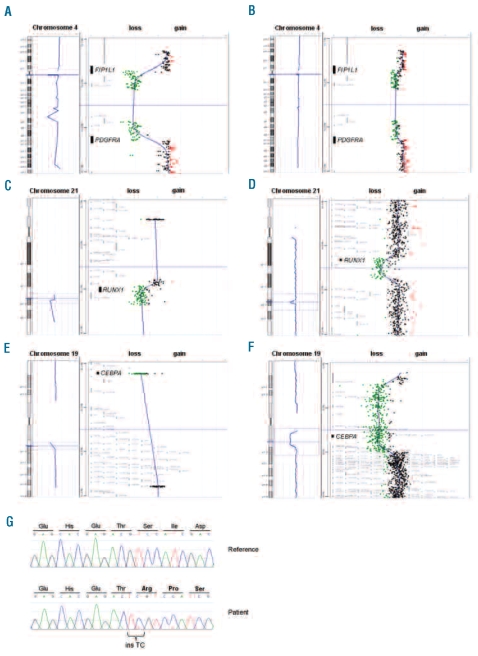
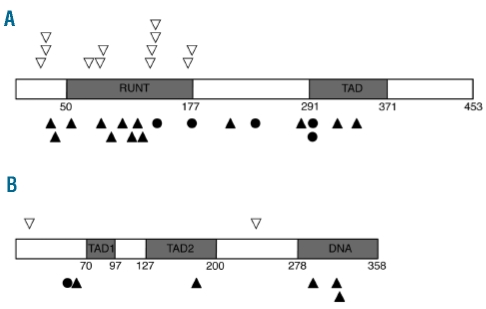
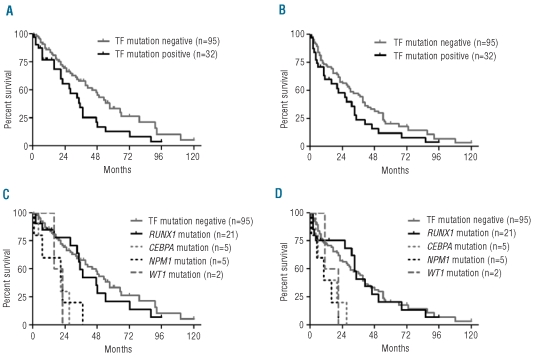
Results: No abnormalities involving tyrosine kinases were detected; however, nine cytogenetically cryptic copy number imbalances were detected in seven patients, including hemizygous deletions of RUNX1 or CEBPA in two cases with atypical chronic myeloid leukemia. Mutation analysis of the remaining alleles revealed non-mutated RUNX1 and a frameshift insertion within CEBPA. A further mutation screen of 187 patients with myelodysplastic/myeloproliferative neoplasms identified RUNX1 mutations in 27 (14%) and CEBPA mutations in seven (4%) patients. Analysis of other transcription factors known to be frequently mutated in acute myeloid leukemia revealed NPM1 mutations in six (3%) and WT1 mutations in two (1%) patients with myelodysplastic/myeloproliferative neoplasms. Univariate analysis indicated that patients with mutations had a shorter overall survival (28 versus 44 months, P=0.019) compared with patients without mutations, with the prognosis for cases with CEBPA, NPM1 or WT1 mutations being particularly poor.
Conclusions: We conclude that mutations of transcription and other nuclear factors are frequent in myelodysplastic/myeloproliferative neoplasms and are generally mutually exclusive. CEBPA, NPM1 or WT1 mutations may be associated with a poor prognosis, an observation that will need to be confirmed by detailed prospective studies.
Figures
References
-
- Campbell PJ, Green AR. The myeloproliferative disorders. N Engl J Med. 2006;355(23):2452–66. - PubMed
-
- Vardiman JW, Thiele J, Arber DA, Brunning RD, Borowitz MJ, Porwit A, et al. The 2008 revision of the World Health Organization (WHO) classification of myeloid neoplasms and acute leukemia: rationale and important changes. Blood. 2009;114(5):937–51. - PubMed
-
- Orazi A, Germing U. The myelodysplastic/myeloproliferative neoplasms: myeloproliferative diseases with dysplastic features. Leukemia. 2008;22(7):1308–19. - PubMed
-
- Jones AV, Kreil S, Zoi K, Waghorn K, Curtis C, Zhang L, et al. Widespread occurrence of the JAK2 V617F mutation in chronic myeloproliferative disorders. Blood. 2005;106(6):2162–8. - PubMed
-
- Hirsch-Ginsberg C, LeMaistre AC, Kantarjian H, Talpaz M, Cork A, Freireich EJ, et al. RAS mutations are rare events in Philadelphia chromosome-negative/bcr gene rearrangement-negative chronic myelogenous leukemia, but are prevalent in chronic myelomonocytic leukemia. Blood. 1990;76(6):1214–9. - PubMed
Publication types
MeSH terms
Substances
LinkOut - more resources
Full Text Sources
Other Literature Sources
Medical
Molecular Biology Databases