


Formulating a historical and demographic model of recent human evolution based on resequencing data from noncoding regions
- PMID: 20421973
- PMCID: PMC2858654
- DOI: 10.1371/journal.pone.0010284
Formulating a historical and demographic model of recent human evolution based on resequencing data from noncoding regions
Abstract
Background: Estimating the historical and demographic parameters that characterize modern human populations is a fundamental part of reconstructing the recent history of our species. In addition, the development of a model of human evolution that can best explain neutral genetic diversity is required to identify confidently regions of the human genome that have been targeted by natural selection.
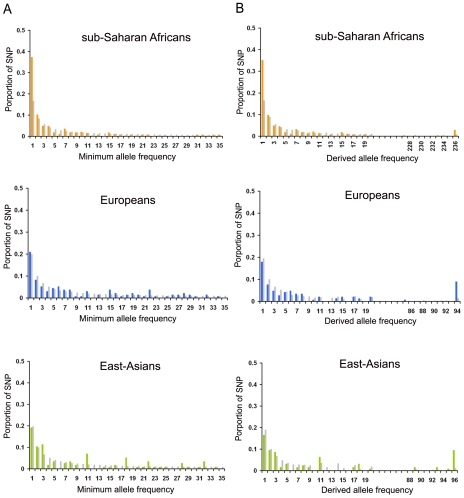
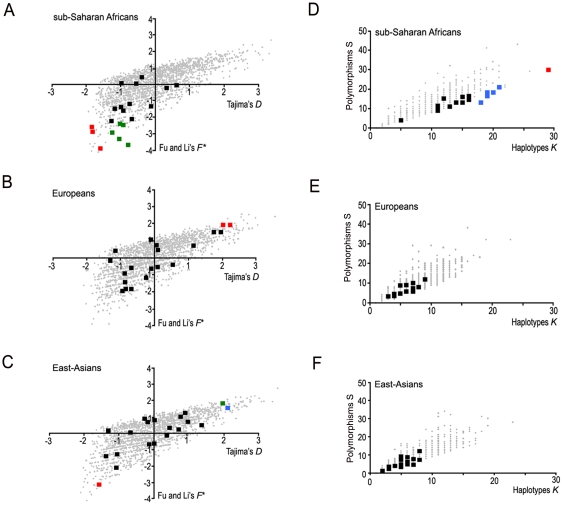
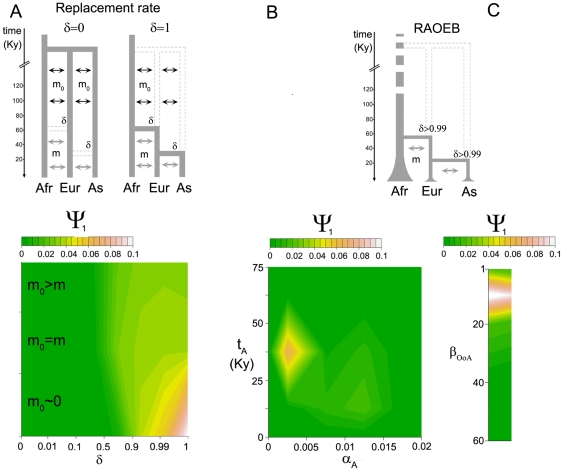
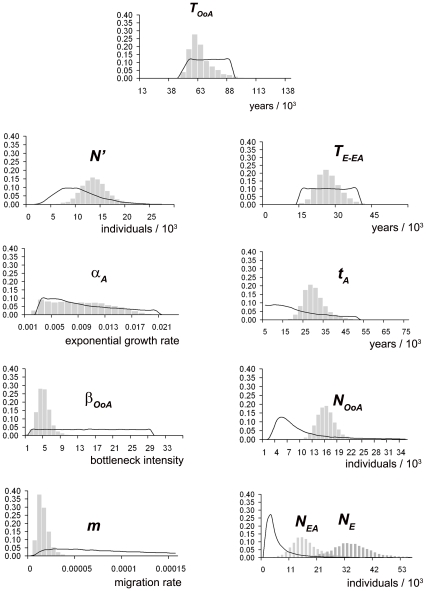
Methodology/principal findings: We have resequenced 20 independent noncoding autosomal regions dispersed throughout the genome in 213 individuals from different continental populations, corresponding to a total of approximately 6 Mb of diploid resequencing data. We used these data to explore and co-estimate an extensive range of historical and demographic parameters with a statistical framework that combines the evaluation of multiple models of human evolution via a best-fit approach, followed by an Approximate Bayesian Computation (ABC) analysis. From a methodological standpoint, evaluating the accuracy of the parameter co-estimation allowed us to identify the most accurate set of statistics to be used for the estimation of each of the different historical and demographic parameters characterizing recent human evolution.
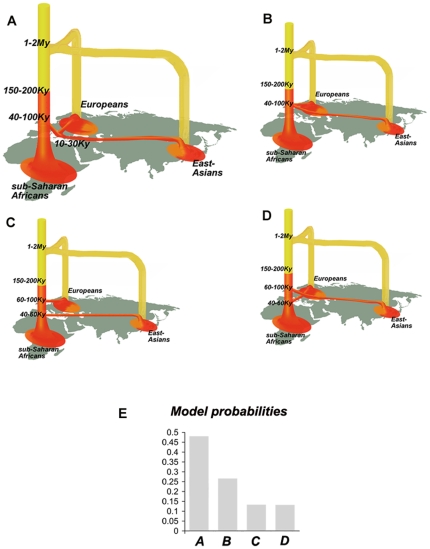
Conclusions/significance: Our results support a model in which modern humans left Africa through a single major dispersal event occurring approximately 60,000 years ago, corresponding to a drastic reduction of approximately 5 times the effective population size of the ancestral African population of approximately 13,800 individuals. Subsequently, the ancestors of modern Europeans and East Asians diverged much later, approximately 22,500 years ago, from the population of ancestral migrants. This late diversification of Eurasians after the African exodus points to the occurrence of a long maturation phase in which the ancestral Eurasian population was not yet diversified.
Conflict of interest statement
Figures
References
-
- Cavalli-Sforza LL, Menozzi P, Piazza A. Princeton: Princeton Univ. Press; 1994. The History and Geography of Human Genes.
-
- Excoffier L. Human demographic history: refining the recent African origin model. Curr Opin Genet Dev. 2002;12:675–682. - PubMed
-
- Garrigan D, Hammer MF. Reconstructing human origins in the genomic era. Nat Rev Genet. 2006;7:669–680. - PubMed
-
- Stringer CB. The emergence of modern humans. Sci Am. 1990;263:98–104. - PubMed
Publication types
MeSH terms
Substances
LinkOut - more resources
Full Text Sources
Other Literature Sources
Miscellaneous
