. 2010 Apr;25(2):125-42.
doi: 10.1089/cbr.2010.0759.

Pretargeted radioimmunotherapy for hematologic and other malignancies

Affiliations

Pretargeted radioimmunotherapy for hematologic and other malignancies

Roland B Walter et al. Cancer Biother Radiopharm. 2010 Apr.

Abstract

Radioimmunotherapy (RIT) has emerged as one of the most promising treatment options, particularly for hematologic malignancies. However, this approach has generally been limited by a suboptimal therapeutic index (target-to-nontarget ratio) and an inability to deliver sufficient radiation doses to tumors selectively. Pretargeted RIT (PRIT) circumvents these limitations by separating the targeting vehicle from the subsequently administered therapeutic radioisotope, which binds to the tumor-localized antibody or is quickly excreted if unbound. A growing number of preclinical proof-of-principle studies demonstrate that PRIT is feasible and safe and provides improved directed radionuclide delivery to malignant cells compared with conventional RIT while sparing normal cells from nonspecific radiotoxicity. Early phase clinical studies corroborate these preclinical findings and suggest better efficacy and lesser toxicities in patients with hematologic and other malignancies. With continued research, PRIT-based treatment strategies promise to become cornerstones to improved outcomes for cancer patients despite their complexities.


Figures
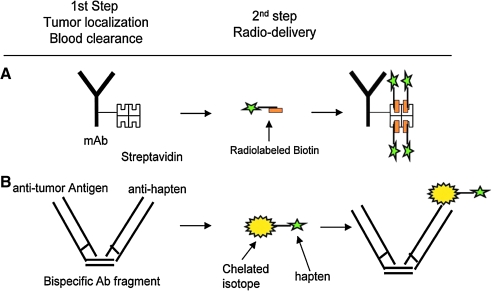
FIG. 1.
FIG. 1.
Examples of pretargeted radioimmunotherapy approaches. (A) Divalent antibody–streptavidin conjugate followed by delivery of radiolabeled biotin; (B) bispecific monovalent antibody–antihapten conjugate followed by injection of a chelated isotope bound to a small, low-molecular-weight hapten. Reproduced with permission from Pagel.
FIG. 2.
FIG. 2.
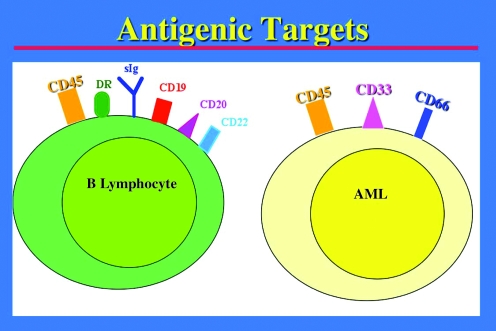
Target antigens for radioimmunotherapy and pretargeted radioimmunotherapy on B-cell lymphocytes and acute myeloid leukemia cells.
FIG. 3.
FIG. 3.
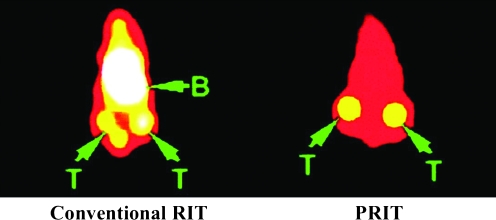
Comparison of CD20-targeting conventional RIT and PRIT in human lymphoma xenografts. Gamma camera images of Ramos xenograft-bearing athymic mice injected with either directly 111In-labeled anti-CD20 antibody (1F5; at left) or pretargeted 1F5–streptavidin conjugate followed 24 hours later by a clearing agent and then by 111In-1,4,7,10-tetraazacyclododecane-N,N′,N′′,N′′′-tetraacetic-biotin (at right). Arrows indicate radioactivity in tumors (T) and blood pool (B) at 24 hours after injection of 111In-reagents. Bladder activity is also seen in the conventional RIT mouse. Reproduced with permission from Subbiah et al. RIT, radioimmunotherapy; PRIT, pretargeted RIT.
FIG. 4.
FIG. 4.
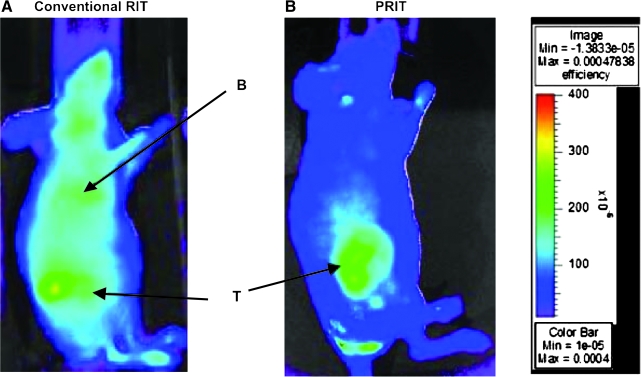
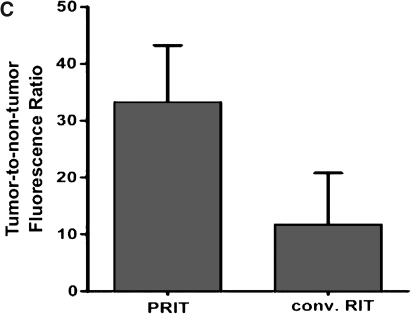
Fluorescent images of HEL xenograft-bearing athymic mice treated with either conventional RIT or PRIT. Mice were injected with either (A) 1.4 nmol anti-human CD45 antibody directly labeled with fluorophore or (B) pretargeted anti-human CD45 antibody–streptavidin conjugate (1.4 nmol) followed 22 hours later by a clearing agent and then by 100 mg R-phycoerythrin-biotin. Images are shown at same camera intensity settings. Images of mice are shown at 12 hours after injection of the fluorophore. Arrows indicate fluorophore in tumor (T) and blood pool (B). (C) Tumor–to–whole-body fluorescence ratios at 8 hours after injection in conventional RIT and PRIT mice. Reproduced with permission from Pagel et al. PRIT, pretargeted radioimmunotherapy.
FIG. 4.
FIG. 4.
Fluorescent images of HEL xenograft-bearing athymic mice treated with either conventional RIT or PRIT. Mice were injected with either (A) 1.4 nmol anti-human CD45 antibody directly labeled with fluorophore or (B) pretargeted anti-human CD45 antibody–streptavidin conjugate (1.4 nmol) followed 22 hours later by a clearing agent and then by 100 mg R-phycoerythrin-biotin. Images are shown at same camera intensity settings. Images of mice are shown at 12 hours after injection of the fluorophore. Arrows indicate fluorophore in tumor (T) and blood pool (B). (C) Tumor–to–whole-body fluorescence ratios at 8 hours after injection in conventional RIT and PRIT mice. Reproduced with permission from Pagel et al. PRIT, pretargeted radioimmunotherapy.
None
None
None

References

    1. Park SI. Press OW. Radioimmunotherapy for treatment of B-cell lymphomas and other hematologic malignancies. Curr Opin Hematol. 2007;14:632. - PubMed
    1. DeNardo GL. DeNardo SJ. Balhorn R. Systemic radiotherapy can cure lymphoma: A paradigm for other malignancies? Cancer Biother Radiopharm. 2008;23:383. - PMC - PubMed
    1. Green DJ. Pagel JM. Pantelias A, et al. Pretargeted radioimmunotherapy for B-cell lymphomas. Clin Cancer Res. 2007;13:5598s. - PubMed
    1. Strand SE. Zanzonico P. Johnson TK. Pharmacokinetic modeling. Med Phys. 1993;20:515. - PubMed
    1. Chinol M. Grana C. Gennari R, et al. Pretargeted radio of cancer. In: Abrams PG, editor; Fritzberg AR, editor. Radioimmunotherapy of Cancer. New York: Marcel Dekker; 2000. p. 169.

Publication types

MeSH terms

LinkOut - more resources