. 2010 Jun 18;285(25):19316-23.
doi: 10.1074/jbc.M110.130716. Epub 2010 Apr 27.

Structure-function studies of the SLC17 transporter sialin identify crucial residues and substrate-induced conformational changes

Affiliations

Structure-function studies of the SLC17 transporter sialin identify crucial residues and substrate-induced conformational changes

Pascal Courville et al. J Biol Chem. .

Abstract

Salla disease and infantile sialic acid storage disorder are human diseases caused by loss of function of sialin, a lysosomal transporter that mediates H(+)-coupled symport of acidic sugars N-acetylneuraminic acid and glucuronic acid out of lysosomes. Along with the closely related vesicular glutamate transporters, sialin belongs to the SLC17 transporter family. Despite their critical role in health and disease, these proteins remain poorly understood both structurally and mechanistically. Here, we use substituted cysteine accessibility screening and radiotracer flux assays to evaluate experimentally a computationally generated three-dimensional structure model of sialin. According to this model, sialin consists of 12 transmembrane helices (TMs) with an overall architecture similar to that of the distantly related glycerol 3-phosphate transporter GlpT. We show that TM4 in sialin lines a large aqueous cavity that forms a part of the substrate permeation pathway and demonstrate substrate-induced alterations in accessibility of substituted cysteine residues in TM4. In addition, we demonstrate that one mutant, F179C, has a dramatically different effect on the apparent affinity and transport rate for N-acetylneuraminic acid and glucuronic acid, suggesting that it may be directly involved in substrate recognition and/or translocation. These findings offer a basis for further defining the transport mechanism of sialin and other SLC17 family members.


Figures
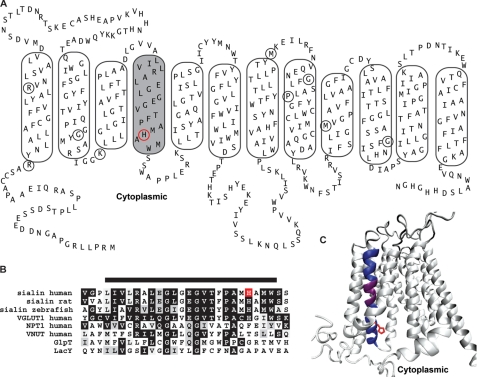
FIGURE 1.
FIGURE 1.
Conserved α-helical structure is predicted to form TM4 in sialin. A, PredictProtein-derived topology model for rat and human sialin sequences with manual adjustments. Putative TMs are outlined with TM4 shaded. Circled residues correspond to those mutated in the lysosomal free sialic acid storage disorders. B, alignment of TM4 and the surrounding residues in sialin of indicated species and human isoforms of VGLUT1, the Na+-dependent phosphate transporter, and VNUT, and the bacterial transporters GlpT and LacY. Bar above the sequence indicates residues predicted to form TM4. C, three-dimensional model of sialin based on crystal structure of GlpT. TM4 is colored dark blue with the conserved GXXXG motif in purple. His-183, a TM4 residue affected by a disease-associated mutation (H183R), is depicted in red in A (circle), B (box), and C (side chain).
FIGURE 2.
FIGURE 2.
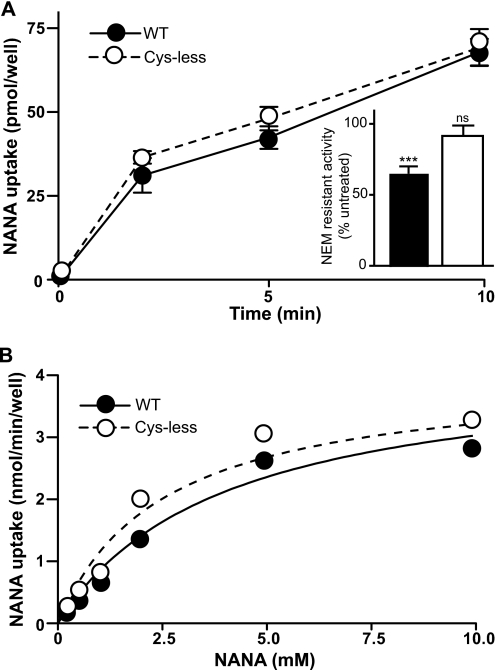
Wild-type and Cys-less sialin exhibit similar transport kinetics. A, time course of 3H-NANA uptake (30 nm final concentration) by wild-type (WT) sialin- (filled circles, solid line) and Cys-less sialin- (open circles, dashed line) transfected cells. NEM treatment (2 mm, pH 7.5 for 5 min at 23 °C) inhibits NANA uptake (30 nm final concentration, measured at 5 min) into cells transfected with the wild-type protein, but not Cys-less-transfected cells (inset). B, wild-type- and Cys-less sialin-transfected cells exhibit saturable NANA uptake. Measurement of NANA uptake at 2 min in the presence of increasing substrate concentrations reveals KmNANA values of 4 ± 2 and 5 ± 2 mm for wild-type and Cys-less sialin, respectively, with a VmNANA of ∼5 nmol/min per well for both. ***, p < 0.0001; ns, no significance.
FIGURE 3.
FIGURE 3.
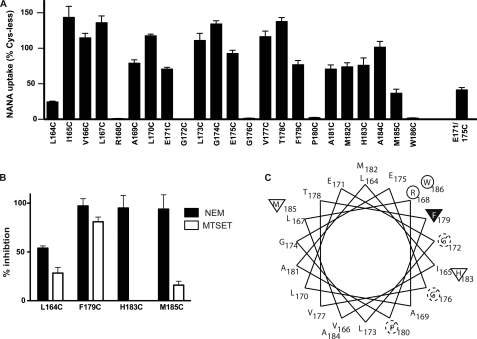
Effects of Cys substitution and subsequent thiol-reactive reagent treatment on residues in TM4. A, NANA transport activity (relative to Cys-less sialin) for each TM4 monocysteine substitution mutant. Transport of 30 nm 3H-NANA was measured after 5 min at pH 5.5. B, inhibition of monocysteine substitution mutants after NEM (filled bars) or MTSET (open bars) pretreatment. Only monocysteine substitution mutants for which NEM inhibited activity by greater than 15% are shown. The effects on the other mutants are presented in supplemental Fig. 2. Cells were pretreated in presence of 2 mm NEM at pH 7.5 or 2 mm MTSET at pH 5.5 for 5 min and transport then measured as in A. C, helical wheel plot of TM4. Circles indicate residues where cysteine substitution was associated with loss of >95% measurable transport. Dashed lines indicate residues where substitution led to markedly decreased expression (see supplemental Fig. 1). Triangles indicate positions where cysteine substitution led to NEM-sensitive transport with the filled triangle at Phe-179 indicating that substitution led to inhibition by MTSET as well as NEM.
FIGURE 4.
FIGURE 4.
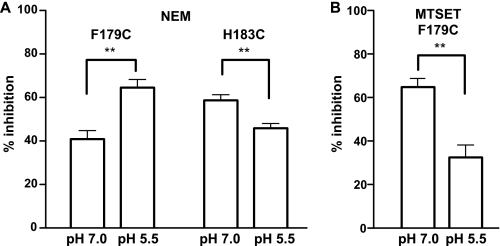
Modulation of thiol-reactive reagent-dependent inhibition by pH. A, effect of NEM incubation (1 mm for 2 min) on activity of F179C and H183C incubated at pH 7.0 and pH 5.5 in absence of substrate. B, effects of MTSET incubation (0.2 mm for 2 min) at pH 7.0 (left) and pH 5.5 (right) in the absence of substrate. For all experiments, pretreatment was for a total of 10 min: the first 8 min at the indicate pH alone and the final 2 min at the same pH with NEM or MTSET. For transport measurements, the concentration of NANA was 30 nm, and the reaction was terminated at 5 min. **, p < 0.01.
FIGURE 5.
FIGURE 5.
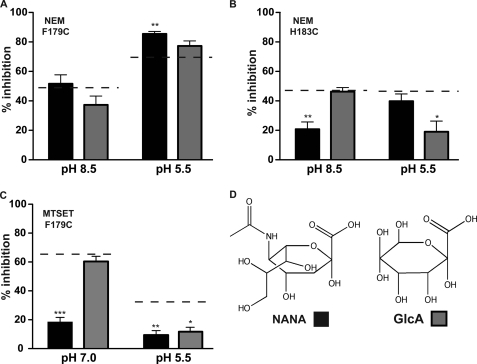
Modulation of thiol-reactive reagent-dependent inhibition by substrates. A, inhibition of F179C activity by NEM preincubation at pH 8.5 and 5.5 in the presence of NANA (20 mm; black bars) or GlcUA (20 mm; gray bars). Dashed line indicates the level of inhibition in absence of substrate. B, inhibition of H183C activity by NEM as described in A. C, inhibition of F179C by MTEST as described in A. D, structure of NANA and GlcUA (GlcA). Control values were determined for the indicated mutants in the absence of pretreatment. For all experiments, pretreatment was for a total of 10 min: the first 8 min with substrate alone and the final 2 min with substrate and MTSET. For transport measurements the concentration of NANA was 30 nm, and the reaction was terminated at 5 min. *, p < 0.05; **, p < 0.01; ***, p < 0.0001.
FIGURE 6.
FIGURE 6.
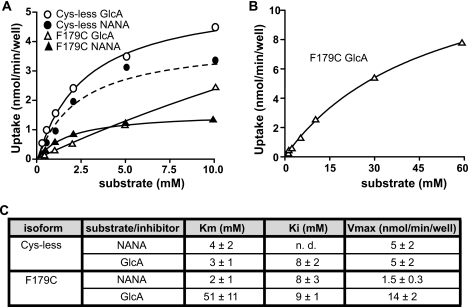
F179C mutation increases the Km but not the Ki value for GlcUA. A, concentration-dependent uptake of NANA (filled symbols) and GlcUA (GlcA; open symbols) by Cys-less (circles) and F179C (triangles) sialin. Values for NANA uptake by Cys-less sialin are also presented in Fig. 2. B, broad range plot of F179C-mediated uptake of GlcUA. C, summary of Km and Ki and Vmax measurements for Cys-less and F179C-mediated transport of NANA and GlcUA. Km and Vmax values were calculated from Michaelis-Menten plots, and Ki values were calculated from IC50 plots using the Cheng-Prusoff equation. For all experiments, uptake was measured for 2 min. Km, Vmax, and Ki values were calculated from four independent experiments and are presented as the mean ± S.E.

References

    1. Verheijen F. W., Verbeek E., Aula N., Beerens C. E., Havelaar A. C., Joosse M., Peltonen L., Aula P., Galjaard H., van der Spek P. J., Mancini G. M. (1999) Nat. Genet. 23, 462–465 - PubMed
    1. Wreden C. C., Wlizla M., Reimer R. J. (2005) J. Biol. Chem. 280, 1408–1416 - PubMed
    1. Morin P., Sagné C., Gasnier B. (2004) EMBO J. 23, 4560–4570 - PMC - PubMed
    1. Miyaji T., Echigo N., Hiasa M., Senoh S., Omote H., Moriyama Y. (2008) Proc. Natl. Acad. Sci. U.S.A. 105, 11720–11724 - PMC - PubMed
    1. Reimer R. J., Edwards R. H. (2004) Pflugers Arch. 447, 629–635 - PubMed

Publication types