


Dietary phylloquinone and menaquinones intakes and risk of type 2 diabetes
- PMID: 20424220
- PMCID: PMC2909045
- DOI: 10.2337/dc09-2302
Dietary phylloquinone and menaquinones intakes and risk of type 2 diabetes
Abstract
Objective: To investigate whether dietary phylloquinone and menaquinones intakes are related to risk of type 2 diabetes.
Research design and methods: We used data from a prospective cohort study in 38,094 Dutch men and women, aged 20-70 years. Dietary phylloquinone and menaquinones intakes were assessed using a validated food frequency questionnaire. Diabetes case patients were ascertained mainly via self-report and verified against medical records.
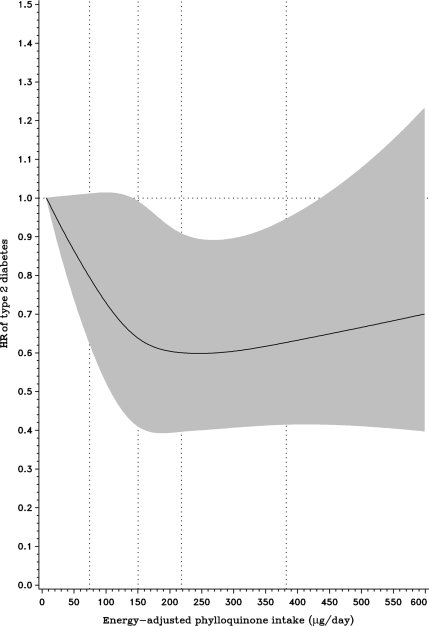
Results: During 10.3 years of follow-up, 918 incident cases of diabetes were documented. In a multivariate model adjusting for diabetes risk factors and dietary factors, phylloquinone intake tended to be associated (P = 0.08) with a reduced risk of type 2 diabetes with a hazard ratio (HR) of 0.81 (95% CI 0.66-0.99) for the highest versus the lowest quartile. For menaquinones intake, a linear, inverse association (P = 0.038) with risk of type 2 diabetes was observed with an HR of 0.93 (0.87-1.00) for each 10-microg increment in the multivariate model.
Conclusions: This study shows that both phylloquinone and menaquinones intakes may be associated with a reduced risk of type 2 diabetes.
Figures
References
-
- Bolton-Smith C, Price RJ, Fenton ST, Harrington DJ, Shearer MJ: Compilation of a provisional UK database for the phylloquinone (vitamin K1) content of foods. Br J Nutr 2000;83:389–399 - PubMed
-
- Schurgers LJ, Vermeer C: Determination of phylloquinone and menaquinones in food. Effect of food matrix on circulating vitamin K concentrations Haemostasis 2000;30:298–307 - PubMed
-
- Cranenburg EC, Schurgers LJ, Vermeer C., Vitamin K: The coagulation vitamin that became omnipotent. Thromb Haemost 2007;98:120–125 - PubMed
Publication types
MeSH terms
Substances
LinkOut - more resources
Full Text Sources
Medical
