Review
. 2010 Jun;12(3):170-5.
doi: 10.1007/s11906-010-0105-7.

Angiotensin-converting enzyme 2: central regulator for cardiovascular function

Affiliations
Review

Angiotensin-converting enzyme 2: central regulator for cardiovascular function

Huijing Xia et al. Curr Hypertens Rep. 2010 Jun.

Abstract

Angiotensin-converting enzyme 2 (ACE2) is a new component of the renin-angiotensin system (RAS). Accumulating evidence shows that ACE2 provides protective effects in peripheral tissues and has great potential for the treatment of RAS-related diseases. The role of ACE2 in the central nervous system is not well established. However, in recent years, much more progress has been made on the studies of this carboxypeptidase in the central regulation of blood pressure and cardiovascular function in general. It has been shown that brain ACE2 interacts with the other components of the RAS (ACE, angiotensin II, and angiotensin II type 1 receptor), protects baroreflex and autonomic function, stimulates nitric oxide release, reduces oxidative stress, and prevents the development of or attenuates hypertension. These data support the critical role of ACE2 in the central regulation of cardiovascular function. This review summarizes recently published data on the central effects of ACE2 in the regulation of cardiovascular function.


Figures
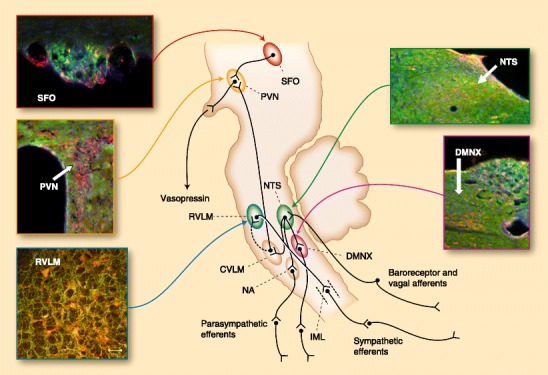
Fig. 1
Fig. 1
Angiotensin-converting enzyme 2 (ACE2) expression in the mouse brain. ACE2 is widely expressed throughout the mouse brain, including in key brain regions involved in the regulation of blood pressure and body fluid homeostasis. This shows examples of ACE2 expression (red) in the subfornical organ (SFO), the neurons of the paraventricular nucleus (PVN), the nucleus of tractus solitarii (NTS), the dorsal motor nucleus of the vagus (DMNX), and the rostral ventrolateral medulla (RVLM). Green: MAP2 (neuronal marker); blue: DAPI (nuclei marker). CVLM—caudal ventrolateral medulla; IML—intermediolateral cell column; NA—nucleus ambiguus

References

    1. Paul M, Poyan Mehr A, Kreutz R. Physiology of local renin-angiotensin systems. Physiol Rev. 2006;86:747–803. doi: 10.1152/physrev.00036.2005. - DOI - PubMed
    1. Tipnis SR, Hooper NM, Hyde R, et al. A human homolog of angiotensin-converting enzyme. Cloning and functional expression as a captopril-insensitive carboxypeptidase. J Biol Chem. 2000;275:33238–33243. doi: 10.1074/jbc.M002615200. - DOI - PubMed
    1. Donoghue M, Hsieh F, Baronas E, et al. A novel angiotensin-converting enzyme-related carboxypeptidase (ACE2) converts angiotensin I to angiotensin 1-9. Circ Res. 2000;87:E1–E9. - PubMed
    1. Vickers C, Hales P, Kaushik V, et al. Hydrolysis of biological peptides by human angiotensin-converting enzyme-related carboxypeptidase. J Biol Chem. 2002;277:14838–14843. doi: 10.1074/jbc.M200581200. - DOI - PubMed
    1. Ferrario CM, Trask AJ, Jessup JA. Advances in the biochemical and functional roles of angiotensin converting enzyme 2 and angiotensin-(1-7) in the regulation of cardiovascular function. Am J Physiol Heart Circ Physiol. 2005;289:H2281–H2290. doi: 10.1152/ajpheart.00618.2005. - DOI - PMC - PubMed

Publication types

MeSH terms

LinkOut - more resources
