


Review
doi: 10.1007/s11894-010-0108-1.
Etiology of esophageal atresia and tracheoesophageal fistula: "mind the gap"
Affiliations
- PMID: 20425471
- PMCID: PMC2874026
- DOI: 10.1007/s11894-010-0108-1
Item in Clipboard
Review
Etiology of esophageal atresia and tracheoesophageal fistula: "mind the gap"
Curr Gastroenterol Rep.
2010 Jun.
Abstract
Esophageal atresia and tracheoesophageal fistula (EA/TEF) are major congenital malformations affecting 1:3500 live births. Current research efforts are focused on understanding the etiology of these defects. We describe well-known animal models, human syndromes, and associations involving EA/TEF, indicating its etiologically heterogeneous nature. Recent advances in genotyping technology and in knowledge of human genetic variation will improve clinical counseling on etiologic factors. This review provides a clinical summary of environmental and genetic factors involved in EA/TEF.
Figures
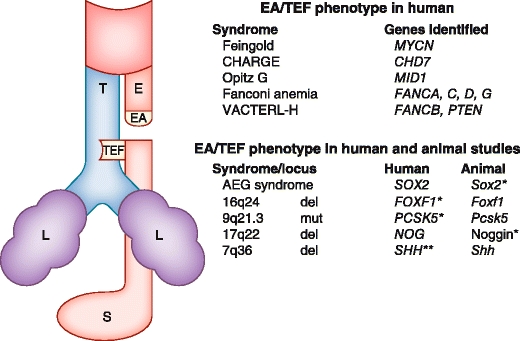
Schematic representation of the commonest type of EA/TEF and genetic syndromes and genes involved. The text boxes list the genetic syndromes and genes most frequently found to be involved in EA/TEF. EA —esophageal atresia; TEF —tracheoesophageal fistula; *—lung phenotype present; **—deletion in a single case; L—lung; E—esophagus; T—trachea; S—stomach; del—deletion; mut—mutation. AEG syndrome—Anophthalmia/optic nerve hypoplasia, Esophageal atresia, and/or Genital anomalies; CHARGE syndrome—Coloboma, Heart anomalies, choanal Atresia, growth and/or mental Retardation, Genital and Ear anomalies; VACTERL-H association—vertebral, anal, cardiovascular, tracheal, esophageal, renal, and limb abnormalities occurring together, with hydrocephaly
References
-
- Gross RE. Surgery of Infancy and Childhood. Philadelphia: WB Saunders; 1953. p. 76.
Publication types
MeSH terms
LinkOut - more resources
Full Text Sources
Other Literature Sources
Medical
Miscellaneous
