Review
. 2010 Mar;7(1):1-8.
doi: 10.1007/s11897-010-0004-x.

Galectin-3 in cardiac remodeling and heart failure

Affiliations
Review

Galectin-3 in cardiac remodeling and heart failure

Rudolf A de Boer et al. Curr Heart Fail Rep. 2010 Mar.

Erratum in

  • Curr Heart Fail Rep. 2012 Sep;9(3):163

Abstract

Galectin-3 is a member of the galectin family, which consists of animal lectins that bind beta-galactosides. Recently, a role for galectin-3 in the pathophysiology of heart failure has been suggested. It was observed that galectin-3 is specifically upregulated in decompensated heart failure compared with compensated heart failure in animal models of heart failure. This has been associated with activation of fibroblasts and macrophages, which are a hallmark of cardiac remodeling. Therefore, galectin-3 may be a culprit biomarker in heart failure. Initial clinical observations indicate that galectin-3 may be a useful biomarker for decompensated heart failure, with incremental value over well-used "pressure-dependent" biomarkers, such as B-type natriuretic peptide. Future studies should focus on galectin-3 biology to better address the usefulness of galectin-3 as a biomarker and probe the usefulness of anti-galectin-3 therapy in treating heart failure.


Figures
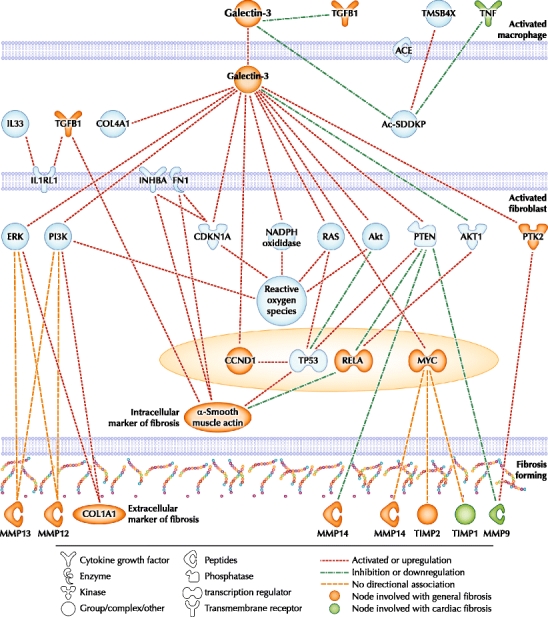
Fig. 1
Fig. 1
Galectin-3 pathways. The network represents molecular relationships among different gene products. Node shapes indicate the functional class of the gene product, whereas node colors indicate a role in general fibrosis (orange) or cardiac fibrosis (green). Edge colors indicate upregulation or activation (red), downregulation or inhibition (green), or involvement without clear directionality (yellow). All relationships are supported by references from the Ingenuity Pathway Knowledge Base or key reference included in the review by de Boer et al. [•]. ACE angiotensin-converting enzyme; Ac-SDKP N-acetyl-Ser-Asp-Lys-Pro; AKT1 RAC-α serine/threonine-protein kinase; CCND1 cyclin D1; CDKN1A cyclin-dependent kinase inhibitor 1A; COL1A1 collagen, type I, α-1; COL4A1 collagen α-1(IV); ERK extracellular signal-regulated kinase; FN1 fibronectin; IL1RL1 interleukin 1 receptor-like 1; IL33 interleukin 33; INHBA inhibin β A; MMP matrix metalloproteinase; MYC v-myc myelocytomatosis viral oncogene homolog (avian); NADPH nicotinamide adenine dinucleotide phosphate; PI3K phosphoinositide 3-kinase; PTEN phosphatase and tensin homolog; PTK2 protein tyrosine kinase 2; TGFB1 transforming growth factor β-1; TIMP tissue inhibitor of metalloproteinases; TMSB4X thymosin β-4; TNF tumor necrosis factor; TP53 tumor protein p53; RELA V-rel reticuloendotheliosis viral oncogene homolog A, nuclear factor of κ light polypeptide gene enhancer in B-cells 3, p65 (avian). (From de Boer et al. [•], with permission.)

References

    1. Barondes SH, Cooper DNW, Gitt MA, Leffler H. Galectins: structure and function of a large family of animal lectins. J Biol Chem. 1994;269:20807–20810. - PubMed
    1. Cooper DN. Galectinomics: finding themes in complexity. Biochim Biophys Acta. 2002;1572:209–231. - PubMed
    1. Wang JL, Laing JG, Anderson RL. Lectins in the cell nucleus. Glycobiology. 1991;3:243–252. doi: 10.1093/glycob/1.3.243. - DOI - PubMed
    1. Yang RY, Rabinovich GA, Liu FT. Galectins: structure, function and therapeutic potential. Expert Rev Mol Med. 2008;13:e17–e39. doi: 10.1017/S1462399408000719. - DOI - PubMed
    1. Elola MT, Wolfenstein-Todel C, Troncoso MF, et al. Galectins: matricellular glycan-binding proteins linking cell adhesion, migration, and survival. Cell Mol Life Sci. 2007;64:1679–1700. doi: 10.1007/s00018-007-7044-8. - DOI - PMC - PubMed

Publication types
