


Pathogenesis of allergic airway inflammation
- PMID: 20425513
- PMCID: PMC2894992
- DOI: 10.1007/s11882-009-0081-7
Pathogenesis of allergic airway inflammation
Abstract
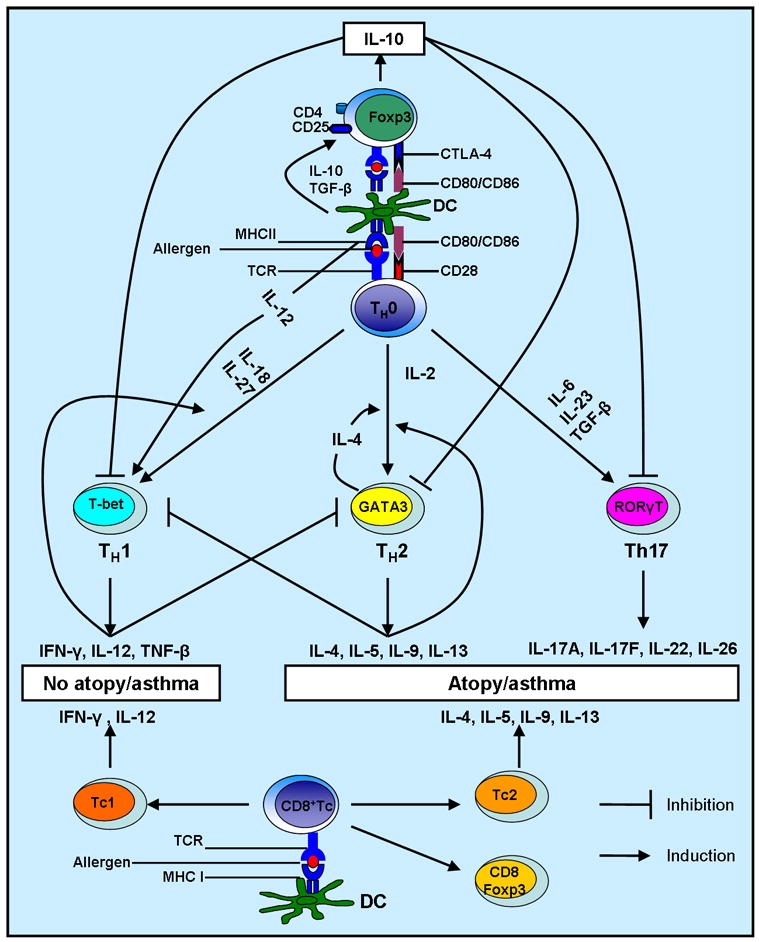
Advances have been made in defining the mechanisms for the control of allergic airway inflammation in response to inhaled antigens. Several genes, including ADAM33, DPP10, PHF11, GPRA, TIM-1, PDE4D, OPN3, and ORMDL3, have been implicated in the pathogenesis and susceptibility to atopy and asthma. Growing evidence associates asthma with a systemic propensity for allergic T-helper type 2 cytokines. Disordered coagulation and fibrinolysis also exacerbate asthma symptoms. Balance among functionally distinct dendritic cell subsets contributes to the outcome of T-cell-mediated immunity. Allergen-specific T-regulatory cells play a pivotal role in the development of tolerance to allergens and immune suppression. The major emphasis on immunotherapy for asthma during the past decade has been to direct the immune response to a type 1 response, or immune tolerance. In this review, we discuss the current information on the pathogenesis of allergic airway inflammation and potential immunotherapy, which could be beneficial in the treatment of airway inflammation, allergy, and asthma.
Figures
References
-
- Broide DH. Molecular and cellular mechanisms of allergic disease. J Allergy Clin Immunol. 2001;108:S65–71. - PubMed
-
- Vignola AM, Kips J, Bousquet J. Tissue remodeling as a feature of persistent asthma. J Allergy Clin Immunol. 2000;105:1041–1053. - PubMed
-
- Akdis M, Trautmann A, Klunker SI, et al. T helper (Th) 2 predominance in atopic diseases is due to preferential apoptosis of circulating memory/effector Th1 cells. Faseb J. 2003;17:1026–1035. - PubMed
-
- Akkoc T, de Koning PJ, Ruckert B, et al. Increased activation-induced cell death of high IFN-gamma-producing T(H)1 cells as a mechanism of T(H)2 predominance in atopic diseases. J Allergy Clin Immunol. 2008;121:652–658. e651. This study reveals one of the mechanisms underlying the counteractive effect of Th1 and Th2 responses. - PubMed
-
- Louten J, Boniface K, de Waal Malefyt R. Development and function of TH17 cells in health and disease. J Allergy Clin Immunol. 2009;123:1004–1011. This article comprehensively reviews the available information for Th17 cells. - PubMed
Publication types
MeSH terms
Substances
Grants and funding
LinkOut - more resources
Full Text Sources
Medical
Miscellaneous
