


Reproductive hormones and obesity: 9 years of observation from the Study of Women's Health Across the Nation
- PMID: 20427327
- PMCID: PMC2915490
- DOI: 10.1093/aje/kwq049
Reproductive hormones and obesity: 9 years of observation from the Study of Women's Health Across the Nation
Abstract
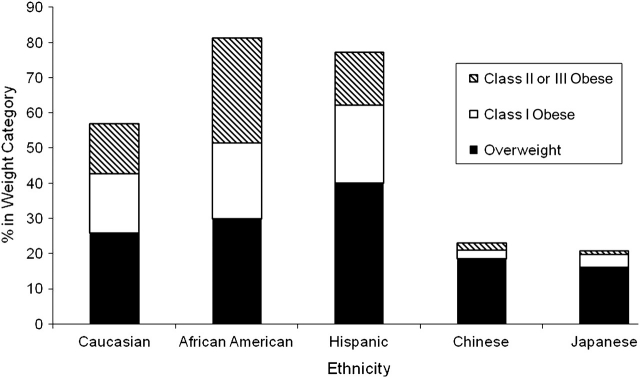
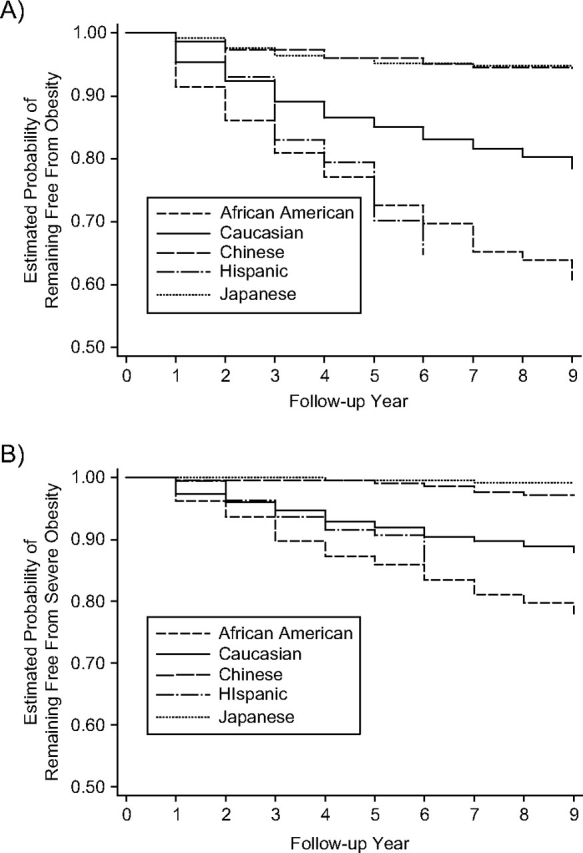
The effect of change in reproductive hormones and menopause on incident obesity (body mass index > or =30 kg/m(2)) and severe obesity (body mass index > or =35 kg/m(2)) was evaluated over 9 years in 3,260 US women recruited in the multiethnic Study of Women's Health Across the Nation in 1996-1997. After 9 years, cumulative incidences of obesity and severe obesity reached 21.8% and 12.3%, respectively. In multivariate analysis, hormone changes, chronic health conditions, lower physical activity, race/ethnicity, and age were significantly associated with incident obesity and/or severe obesity. The odds of incident severe obesity increased with surgical menopause (odds ratio (OR) = 5.07, 95% confidence interval (CI): 2.29, 11.20; P < 0.001) and initiation of hormone therapy prior to 12 months of amenorrhea (OR = 2.94, 95% CI: 1.14, 7.58; P = 0.03). Predictors of obesity included an increase in free androgen index (OR = 1.37, 95% CI: 1.12, 1.68; P = 0.002) and a decrease in sex hormone-binding globulin (OR = 0.60, 95% CI: 0.45, 0.80; P = 0.0005). Similar results were found for severe obesity. Obesity rates varied by race, but no hormone-by-race interactions were observed. These longitudinal data demonstrate that higher androgens, lower sex hormone-binding globulin, surgical menopause, and early hormone therapy use predict incident obesity and/or severe obesity in a multiracial cohort of women transitioning into menopause.
Figures
References
-
- Flegal KM, Carroll MD, Ogden CL, et al. Prevalence and trends in obesity among US adults, 1999–2000. JAMA. 2002;288(14):1723–1727. - PubMed
-
- Ogden CL, Flegal KM, Carroll MD, et al. Prevalence and trends in overweight among US children and adolescents, 1999–2000. JAMA. 2002;288(14):1728–1732. - PubMed
-
- Kurth T, Gaziano JM, Berger K, et al. Body mass index and the risk of stroke in men. Arch Intern Med. 2002;162(22):2557–2562. - PubMed
-
- Dey DK, Rothenberg E, Sundh V, et al. Waist circumference, body mass index, and risk for stroke in older people: a 15 year longitudinal population study of 70-year-olds. J Am Geriatr Soc. 2002;50(9):1510–1518. - PubMed
-
- Wilson PW, D'Agostino RB, Sullivan L, et al. Overweight and obesity as determinants of cardiovascular risk: the Framingham experience. Arch Intern Med. 2002;162(16):1867–1872. - PubMed
Publication types
MeSH terms
Substances
Grants and funding
- AG012553/AG/NIA NIH HHS/United States
- AG012554/AG/NIA NIH HHS/United States
- AG012539/AG/NIA NIH HHS/United States
- AG012531/AG/NIA NIH HHS/United States
- U01 AG012495/AG/NIA NIH HHS/United States
- U01 AG012505/AG/NIA NIH HHS/United States
- AG012535/AG/NIA NIH HHS/United States
- AG012546/AG/NIA NIH HHS/United States
- NR004061/NR/NINR NIH HHS/United States
- U01 AG012554/AG/NIA NIH HHS/United States
- U01 AG012535/AG/NIA NIH HHS/United States
- U01 AG012553/AG/NIA NIH HHS/United States
- U01 NR004061/NR/NINR NIH HHS/United States
- U01 AG012539/AG/NIA NIH HHS/United States
- AG012495/AG/NIA NIH HHS/United States
- U01 AG012546/AG/NIA NIH HHS/United States
- U01 AG012531/AG/NIA NIH HHS/United States
- AG012505/AG/NIA NIH HHS/United States
LinkOut - more resources
Full Text Sources
Medical
