. 2010 Jul;84(13):6590-7.
doi: 10.1128/JVI.00035-10. Epub 2010 Apr 28.

Human immunodeficiency virus type 1 nucleocapsid p1 confers ESCRT pathway dependence

Affiliations

Human immunodeficiency virus type 1 nucleocapsid p1 confers ESCRT pathway dependence

Elena Popova et al. J Virol. 2010 Jul.

Abstract

To facilitate the release of infectious progeny virions, human immunodeficiency virus type 1 (HIV-1) exploits the Endosomal Sorting Complex Required for Transport (ESCRT) pathway by engaging Tsg101 and ALIX through late assembly (L) domains in the C-terminal p6 domain of Gag. However, the L domains in p6 are known to be dispensable for efficient particle production by certain HIV-1 Gag constructs that have the nucleocapsid (NC) domain replaced by a foreign dimerization domain to substitute for the assembly function of NC. We now show that one such L domain-independent HIV-1 Gag construct (termed Z(WT)) that has NC-p1-p6 replaced by a leucine zipper domain is resistant to dominant-negative inhibitors of the ESCRT pathway that block HIV-1 particle production. However, Z(WT) became dependent on the presence of an L domain when NC-p1-p6 was restored to its C terminus. Furthermore, when the NC domain was replaced by a leucine zipper, the p1-p6 region, but not p6 alone, conferred sensitivity to inhibition of the ESCRT pathway. In an authentic HIV-1 Gag context, the effect of an inhibitor of the ESCRT pathway on particle production could be alleviated by deleting a portion of the NC domain together with p1. Together, these results indicate that the ESCRT pathway dependence of HIV-1 budding is determined, at least in part, by the NC-p1 region of Gag.


Figures
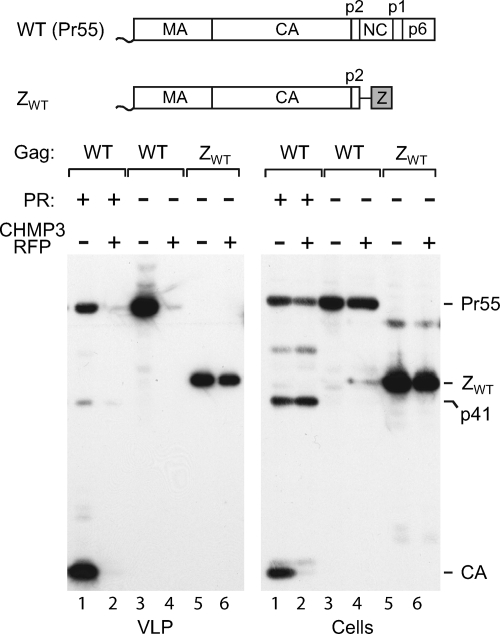
FIG. 1.
FIG. 1.
Replacement of NC-p1-p6 by the GCN4 leucine zipper confers resistance to dominant-negative CHMP3. 293T cells were transfected with 1.5 μg of WT HIV-1 proviral DNA, of a PR-defective HIV-1 provirus, or of the ZWT proviral construct, along with 0.5 μg of a vector expressing RFP alone or CHMP3-RFP. VLP pellets and the cell lysates were analyzed by Western blotting with anti-CA serum. The GCN4 zipper (Z) domain is indicated by a gray box.
FIG. 2.
FIG. 2.
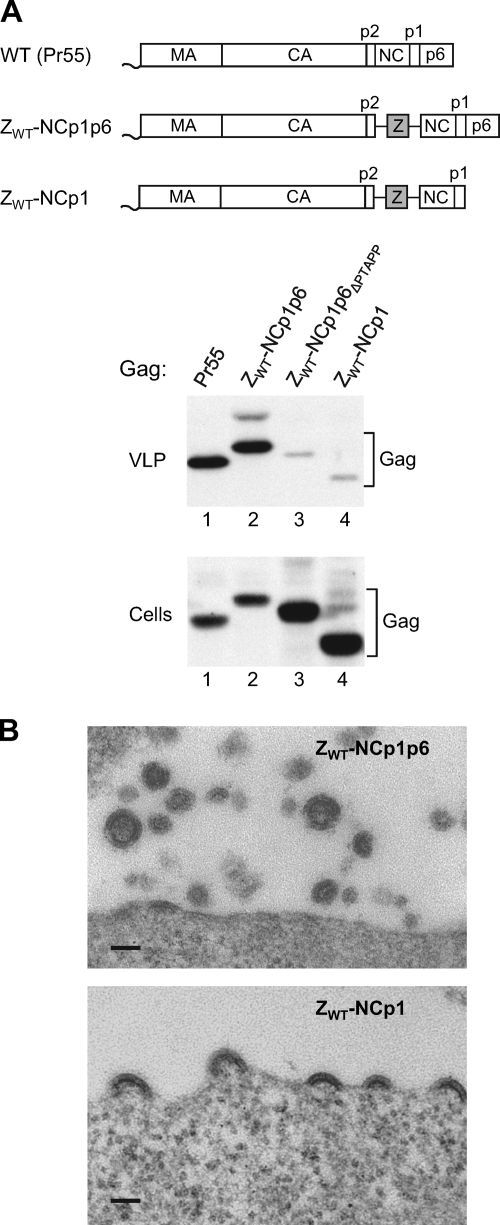
The chimeric ZWT Gag construct exhibits L domain dependence when NC-p1 is fused to its C terminus. (A) 293T cells were transfected with a PR-defective HIV-1 provirus expressing WT Pr55gag or with the indicated Gag constructs. VLP pellets and the cell lysates were analyzed by Western blotting with anti-CA serum. (B) Thin sections of 293T cells transiently expressing the ZWT-NCp1p6 or ZWT-NCp1 proviral construct were examined by transmission electron microscopy. Scale bars, 100 nm.
FIG. 3.
FIG. 3.
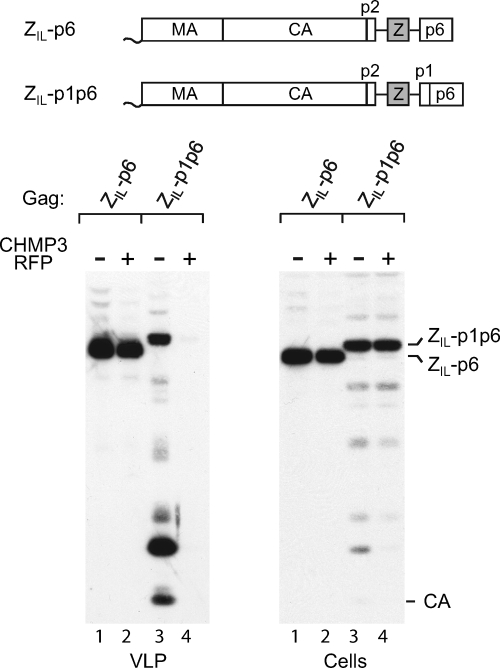
The addition of p1-p6 but not of p6 alone to a chimeric Gag construct confers ESCRT pathway dependence. 293T cells were transfected with 1.5 μg of the indicated Gag constructs together with 0.5 μg of a vector expressing RFP alone or CHMP3-RFP. VLP pellets and the cell lysates were analyzed by Western blotting with anti-CA serum.
FIG. 4.
FIG. 4.
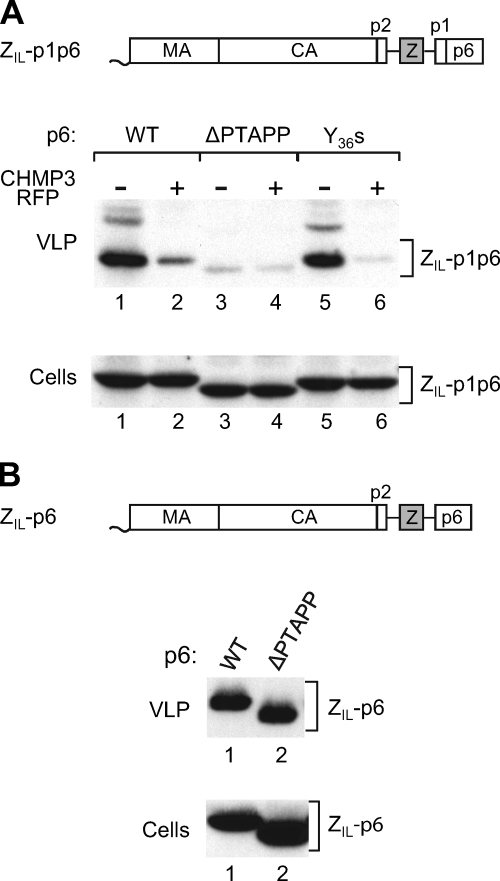
The addition of p1-p6 but not of p6 alone to a chimeric Gag construct confers L domain dependence. (A) Effect of deleting the Tsg101 or the ALIX binding site from a chimeric Gag construct containing p1. 293T cells were transfected with 1.5 μg of WT ZIL-p1p6 or the indicated mutants, along with 0.5 μg of a vector expressing RFP alone or CHMP3-RFP. VLP pellets and the cell lysates were analyzed by Western blotting with anti-CA serum. (B) Effect of deleting the Tsg101 binding site from a chimeric Gag construct lacking p1. 293T cells were transfected with 1.5 μg of WT ZIL-p6 or a ΔPTAPP version.
FIG. 5.
FIG. 5.
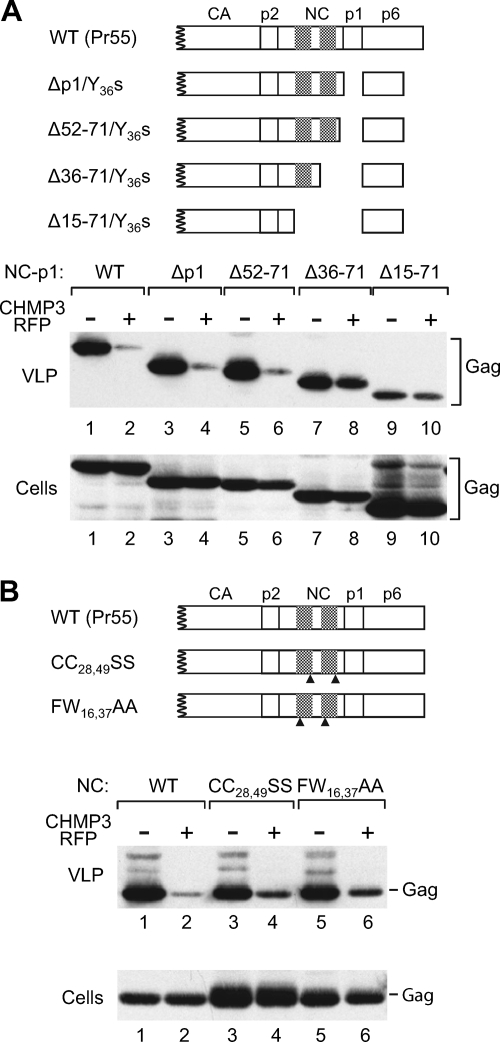
The removal of NC-p1 sequences from authentic HIV-1 Gag alleviates the effect of dominant-negative CHMP3 on particle production. (A) 293T cells were transfected with 1.5 μg of a PR-defective HIV-1 provirus expressing WT Pr55gag or with the indicated NC-p1 deletion mutants, along with a vector expressing RFP alone or CHMP3-RFP. VLP pellets and the cell lysates were analyzed by Western blotting with anti-CA serum. (B) Effect of CHMP3-RFP on the indicated NC zinc finger mutants. Cross-hatched boxes indicate the positions of the zinc fingers in NC, and arrowheads indicate the positions of residues that were substituted. Western blotting was performed with 183-H12-5C anti-HIV CA antibody.

References

    1. Accola, M. A., B. Strack, and H. G. Göttlinger. 2000. Efficient particle production by minimal gag constructs which retain the carboxy-terminal domain of human immunodeficiency virus type 1 capsid-p2 and a late assembly domain. J. Virol. 74:5395-5402. - PMC - PubMed
    1. Bajorek, M., H. L. Schubert, J. McCullough, C. Langelier, D. M. Eckert, W. M. Stubblefield, N. T. Uter, D. G. Myszka, C. P. Hill, and W. I. Sundquist. 2009. Structural basis for ESCRT-III protein autoinhibition. Nat. Struct. Mol. Biol. 16:754-762. - PMC - PubMed
    1. Bieniasz, P. D. 2009. The cell biology of HIV-1 virion genesis. Cell Host Microbe 5:550-558. - PMC - PubMed
    1. Bouamr, F., J. A. Melillo, M. Q. Wang, K. Nagashima, M. de Los Santos, A. Rein, and S. P. Goff. 2003. PPPYVEPTAP motif is the late domain of human T-cell leukemia virus type 1 Gag and mediates its functional interaction with cellular proteins Nedd4 and Tsg101. J. Virol. 77:11882-11895. - PMC - PubMed
    1. Bowzard, J. B., R. P. Bennett, N. K. Krishna, S. M. Ernst, A. Rein, and J. W. Wills. 1998. Importance of basic residues in the nucleocapsid sequence for retrovirus Gag assembly and complementation rescue. J. Virol. 72:9034-9044. - PMC - PubMed

Publication types

MeSH terms

Substances