. 2010 Apr 28;30(17):5855-65.
doi: 10.1523/JNEUROSCI.2688-09.2010.

The transcription factor Mef2 is required for normal circadian behavior in Drosophila

Affiliations

The transcription factor Mef2 is required for normal circadian behavior in Drosophila

Florence J Blanchard et al. J Neurosci. .

Abstract

The transcription factor Mef2 has well established roles in muscle development in Drosophila and in the differentiation of many cell types in mammals, including neurons. Here, we describe a role for Mef2 in the Drosophila pacemaker neurons that regulate circadian behavioral rhythms. We found that Mef2 is normally produced in all adult clock neurons and that Mef2 overexpression in clock neurons leads to long period and complex rhythms of adult locomotor behavior. Knocking down Mef2 expression via RNAi or expressing a repressor form of Mef2 caused flies to lose circadian behavioral rhythms. These behavioral changes are correlated with altered molecular clocks in pacemaker neurons: Mef2 overexpression causes the oscillations in individual pacemaker neurons to become desynchronized, while Mef2 knockdown strongly dampens molecular rhythms. Thus, a normal level of Mef2 activity is required in clock neurons to maintain robust and accurate circadian behavioral rhythms.


Figures
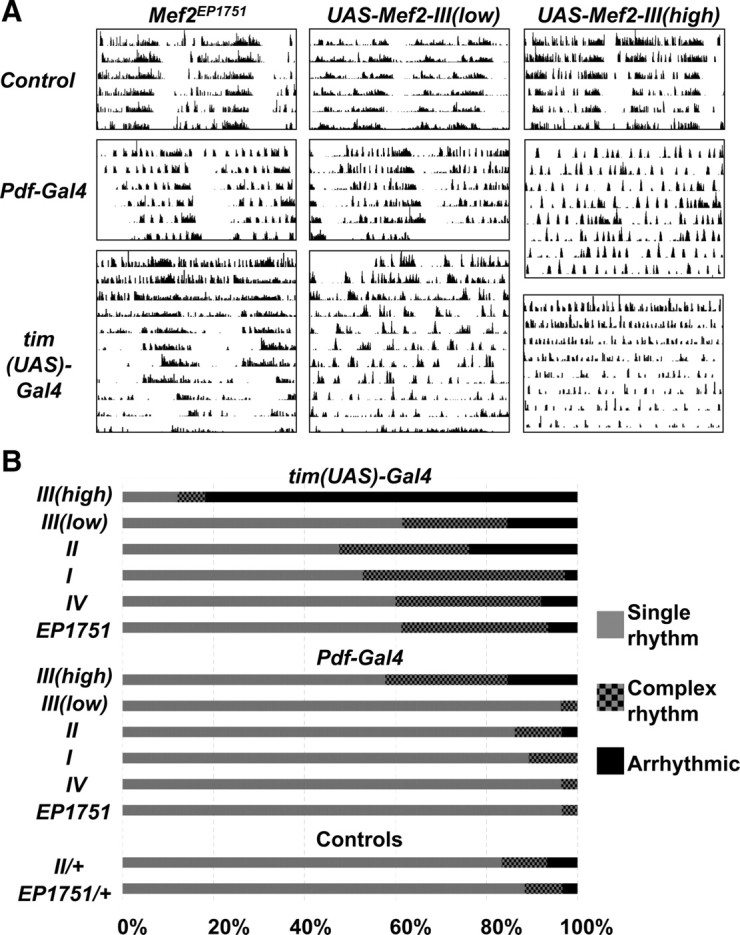
Figure 1.
Figure 1.
Overexpressing Mef2 in clock neurons disrupts normal circadian locomotor activity. A, Representative double-plotted actograms in DD from Mef2EP1751 flies (left column), UAS-Mef2 III(low) flies (center column), and UAS-Mef2 III(high) flies (right column). Actograms are shown for these flies crossed to y w flies (top row), Pdf-Gal4 (center row) and tim(UAS)-Gal4 flies (bottom row). B, Graph shows percentage of flies exhibiting either a single rhythm (gray), complex rhythms (checked) or arrhythmicity (black). A complex rhythm is defined as a rhythm exhibiting more than one significant period above the significance level at 95% confidence when analyzed with Lomb–Scargle analysis. Single rhythm and arrhythmicity are defined by the presence or the absence of a peak above the significance level respectively. I, II, and IV refer to UAS-Mef2 constructs for isoforms A, B, and D, respectively. III(low) and III(high) refer to two different UAS-Mef2 transgenes for Mef2 isoform C that express low and high levels of Mef2 protein respectively.
Figure 2.
Figure 2.
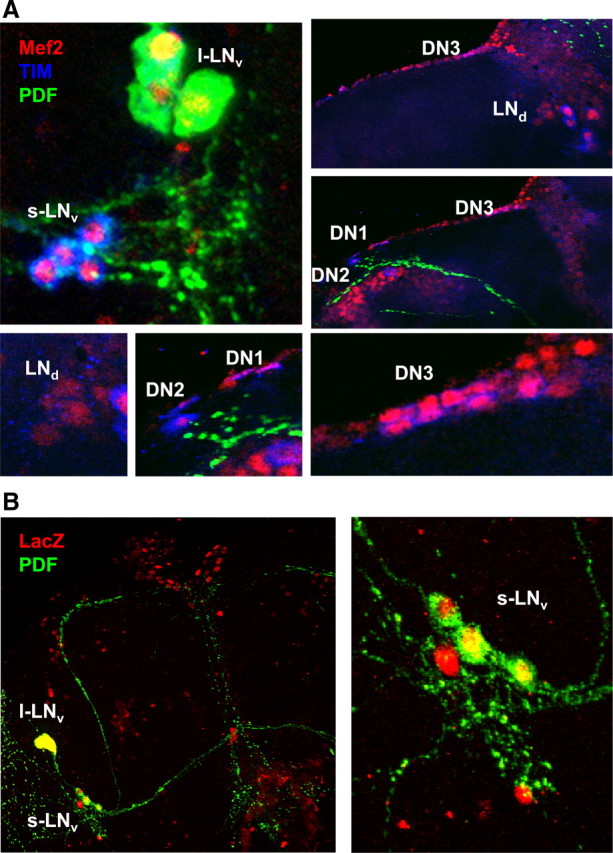
Mef2 is normally expressed in clock neurons. A, Whole-mount brains from y w flies at ZT17 stained with antibodies to Mef2 (red), TIM (blue, mainly cytoplasmic at ZT17) and PDF (green). Mef2 is detectable in the nucleus of all clock neurons groups at ZT17. B, Whole-mount brains from flies with Mef2-Gal4 and UAS-nLacZ transgenes stained with antibodies to LacZ (red) and PDF (green). The right-hand panel shows a close-up of the s-LNvs in the left panel.
Figure 3.
Figure 3.
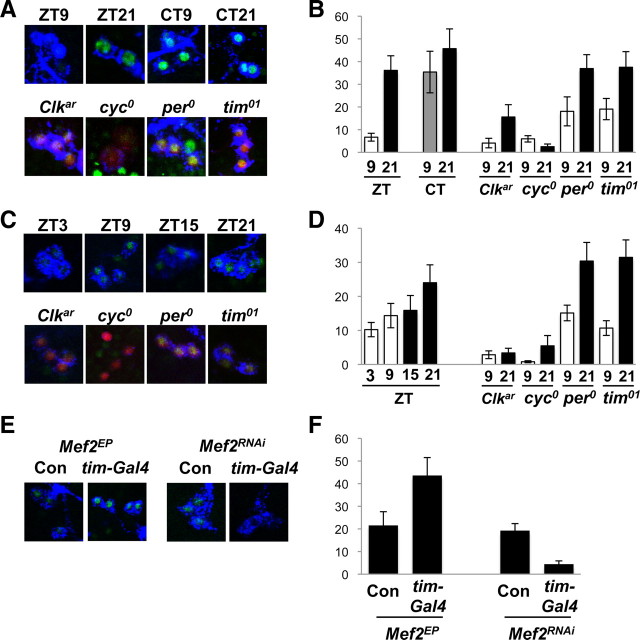
Mef2 expression in LNvs is regulated by light and by clock genes. A, B, Representative images (A) and quantification (B) of Mef2 levels in adult s-LNvs. y w control brains were stained with antibodies to Mef2 (green) and PDF (blue) at ZT9 or ZT21 in LD and CT9 or CT21 on the second day of DD. Clkar, cyc0, per0 and tim01 brains were also stained with antibodies to Mef2 at ZT9 and ZT21. The clock mutant images are from ZT21. A Pdf-RFP transgene was included to help mark LNvs in clock mutants and the red channel was used to record RFP fluorescence since endogenous PDF levels are low in Clkar and cyc0 mutants. The strongly Mef2-staining cells visible in cyc0 mutants are not LNvs. Mef2 levels in adult s-LNvs were higher at ZT21 than at ZT9 (p < 0.0001) but not different between CT9 and CT21 (p = 0.42). Mef2 levels at ZT21 are higher in per0 and tim01 mutants than in Clkar and cyc0 mutants (p < 0.01). C, D, Representative images (C) and quantification (D) of Mef2 levels in larval LNs. y w (control) and clock mutant brains were stained as in A. The clock mutant images are from ZT21. The strongly Mef2+ cells visible in cyc0 mutants are not LNvs. Mef2 levels at ZT21 are higher than ZT3 (p < 0.01). Mef2 levels are higher in per0 and tim01 mutants than in Clkar and cyc0 mutants (p < 0.002) and show time-dependency in per0 and tim01 mutants (p < 0.05). E, F, Representative images (E) and quantification (F) of Mef2 levels in larval LNs at ZT21. tim(UAS)-Gal4/Mef2EP1751 had higher Mef2 levels than Mef2EP1751/+ controls (Con, p < 0.05). tim(UAS)-Gal4/+; UAS-Mef2RNAi/ UAS-Dcr-2 larvae had lower Mef2 levels than UAS-Mef2RNAi/+ control larvae (p < 0.0005).
Figure 4.
Figure 4.
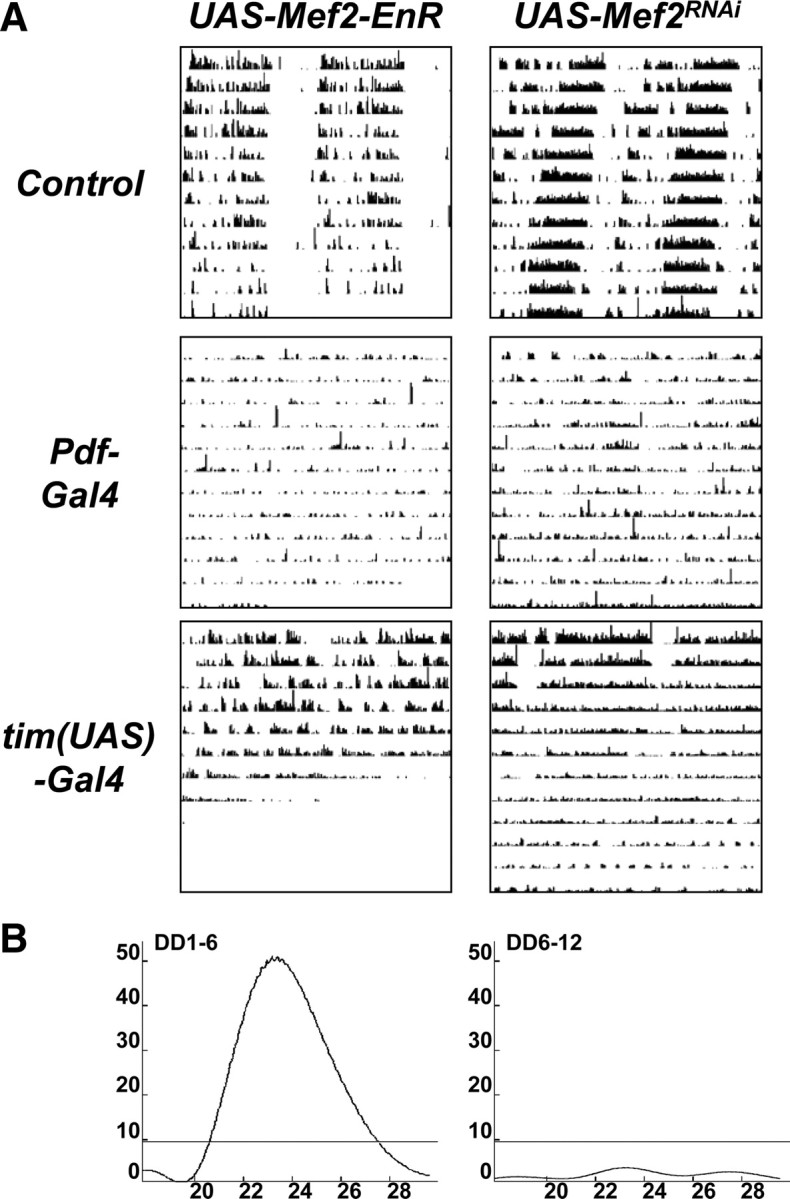
Expression of a Mef2 repressor or knocking down Mef2 expression in clock neurons disrupts circadian behavioral rhythms. A, Representative double-plotted actograms from UAS-Mef2-EnR (left panels) and UAS-Mef2RNAi (right panels) flies in DD crossed to either y w control flies (top row), Pdf-Gal4 (center panel) and tim(UAS)-Gal4 flies (bottom panels). The Pdf-Gal4 line crossed to UAS-Mef2-EnR had two copies of the Pdf0.5-Gal4 driver. The Pdf-Gal4 and tim(UAS)-Gal4 flies crossed to UAS-Mef2RNAi flies also had a UAS-Dcr-2 transgene. B, Representative Lomb–Scargle periodograms for tim(UAS)-Gal4/+; UAS-Dcr-2/UAS-Mef2RNAi flies from day 1 to 6 (left) and from day 6 to 12 (right) show the decrease in power of the rhythm in the second half of the assay.
Figure 5.
Figure 5.
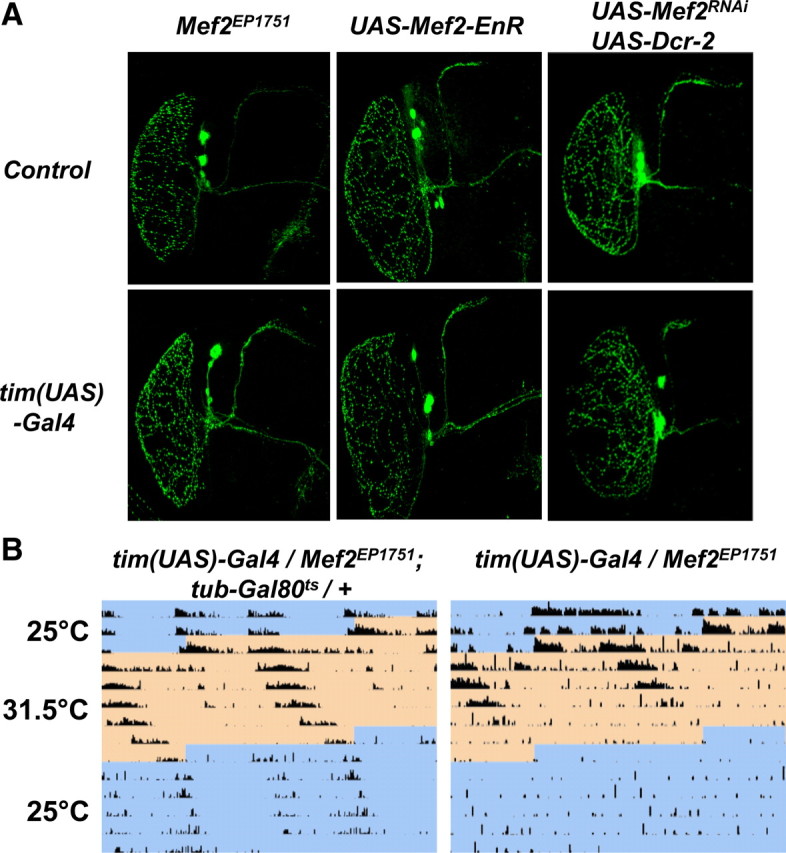
A, Mef2 is not required for the normal development of LNvs. Comparison of LNvs labeled with an antibody against PDF for Mef2EP1751 flies (left column), UAS-Mef2-EnR flies (center) and UAS-Mef2RNAi and UAS-Dcr-2 flies (right column) crossed to either y w (top row) or tim(UAS)-Gal4 (bottom row). B, Circadian phenotypes can be induced when Mef2 overexpression is restricted to adult clock neurons. Representative actograms of tim(UAS)-Gal4/Mef2EP1751 flies either with a tubulin-Gal80ts transgene (left) or without this transgene (right). Flies were maintained at 25°C until after eclosion and for the first 2.5 d in DD (shown in blue on the actogram), before shifting to the restrictive temperature for Gal80ts (31.5°C, shown in orange) for 6 d before returning to 25°C for 5 d. These results are representative of 15 flies assayed with or without the tubulin-Gal80ts transgene respectively. Average periods for tim(UAS)-Gal4/Mef2EP1751; tubulin-Gal80ts/+ flies were 26.0 ± 0.8 h and 24.6 ± 0.6 h for the last 4 d at 31.5°C and the next 4 d at 25°C respectively. Average periods for tim(UAS)-Gal4/Mef2EP1751 flies were 26.1 ± 0.7 h for the last 4 d at 31.5°C. On returning to 25°C, the average power of rhythms was higher for tim(UAS)-Gal4/Mef2EP1751; tubulin-Gal80ts/+ flies than for tim(UAS)-Gal4/Mef2EP1751 flies (p < 0.004), making period estimates for the latter very unreliable.
Figure 6.
Figure 6.
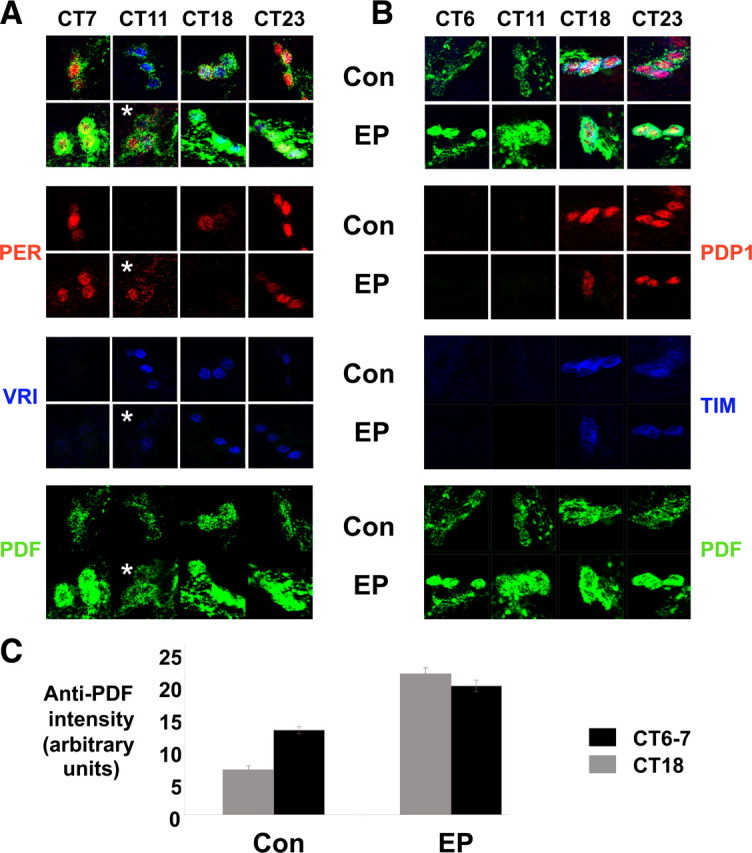
Molecular clock oscillations in s-LNvs of flies overexpressing Mef2 on day 2 in DD. A, B, Time series immunocytochemistry on whole mount brains from either Mef2EP1751/+ control flies (labeled Con) or tim(UAS)-Gal4/Mef2EP1751 flies (EP) showing s-LNvs stained with antibodies to PER (red), VRI (blue) and PDF (green) in A or PDP1 (red), TIM (blue), and PDF (green) in B. The asterisk indicates one image taken from an independent experiment from a different day. These images are representative of at least 10 brains stained in each experiment. Each experiment was performed 3 times with very similar results. C, Quantification of anti-PDF staining in s-LNv cell bodies performed at CT6 or CT7 and CT18.
Figure 7.
Figure 7.
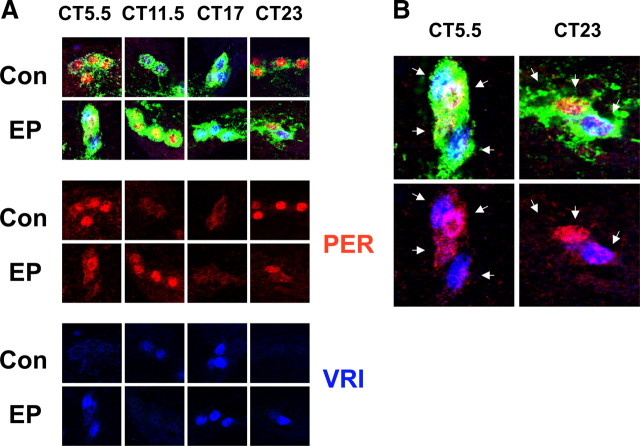
Desynchronized molecular clock oscillations in s-LNvs of flies overexpressing Mef2 on day 8 in DD. Time series immunocytochemistry on whole mount brains from either Mef2EP1751/+ control flies (labeled Con) or tim(UAS)-Gal4/Mef2EP1751 flies (EP). Images show s-LNvs stained with antibodies to PER (red), VRI (blue) and PDF (green). A shows stainings across 4 time points from both genotypes. B shows higher-power magnification of s-LNvs from tim(UAS)-Gal4/Mef2EP1751 flies at CT5.5 (left panels) and CT23 (right panels). The top panels show staining for PER, VRI and PDF, while the green PDF channel has been removed from these same images for the bottom panels. Arrowheads point to the same individual s-LNvs on the top and bottom. Across all time points, desynchrony within an s-LNv group was detected in 18/54 tim(UAS)-Gal4/Mef2EP1751 brains, versus 2/43 control brains. These images are representative of at least 10 brains stained in each experiment. Each experiment was performed 3 times with very similar results.
Figure 8.
Figure 8.
Knocking down Mef2 in clock neurons dampens molecular clock oscillations in s-LNvs. A, B, Time series immunocytochemistry on whole mount brains from either UAS-Mef2RNAi/+ control flies (labeled Con) or tim(UAS)-Gal4/+; UAS-Mef2RNAi/UAS-Dcr-2-2 flies (RNAi). Images show s-LNvs stained with antibodies to PER (red), VRI (blue) and PDF (green). Time series are shown from either the second day (DD2 in A) or the eighth day in DD (DD8, B). These images are representative of at least 10 brains stained in each experiment. Each experiment was performed 3 times with very similar results.

References

    1. Arnold MA, Kim Y, Czubryt MP, Phan D, McAnally J, Qi X, Shelton JM, Richardson JA, Bassel-Duby R, Olson EN. MEF2C transcription factor controls chondrocyte hypertrophy and bone development. Dev Cell. 2007;12:377–389. - PubMed
    1. Berni J, Beckwith EJ, Fernández MP, Ceriani MF. The axon-guidance roundabout gene alters the pace of the Drosophila circadian clock. Eur J Neurosci. 2008;27:396–407. - PubMed
    1. Blau J, Young MW. Cycling vrille expression is required for a functional Drosophila clock. Cell. 1999;99:661–671. - PubMed
    1. Bour BA, O'Brien MA, Lockwood WL, Goldstein ES, Bodmer R, Taghert PH, Abmayr SM, Nguyen HT. Drosophila MEF2, a transcription factor that is essential for myogenesis. Genes Dev. 1995;9:730–741. - PubMed
    1. Chung BY, Kilman VL, Keath JR, Pitman JL, Allada R. The GABA(A) receptor RDL acts in peptidergic PDF neurons to promote sleep in Drosophila. Curr Biol. 2009;10:386–390. - PMC - PubMed

Publication types

MeSH terms

Substances

LinkOut - more resources