


Fortification of orange juice with vitamin D(2) or vitamin D(3) is as effective as an oral supplement in maintaining vitamin D status in adults
- PMID: 20427729
- PMCID: PMC2869510
- DOI: 10.3945/ajcn.2009.27972
Fortification of orange juice with vitamin D(2) or vitamin D(3) is as effective as an oral supplement in maintaining vitamin D status in adults
Abstract
Background: Vitamin D has been added to calcium-fortified orange juice. It is unknown whether vitamin D is as bioavailable from orange juice as it is from supplements.
Objectives: The objective was to compare the bioavailability of vitamin D(2) and vitamin D(3) from orange juice with that from vitamin D(2) and vitamin D(3) supplements. A secondary aim was to determine which form of vitamin D is more bioavailable in orange juice.
Design: A randomized, placebo-controlled, double-blind study was conducted in healthy adults aged 18-84 y (15-20/group) who received 1000 IU vitamin D(3), 1000 IU vitamin D(2), or placebo in orange juice or capsule for 11 wk at the end of winter.
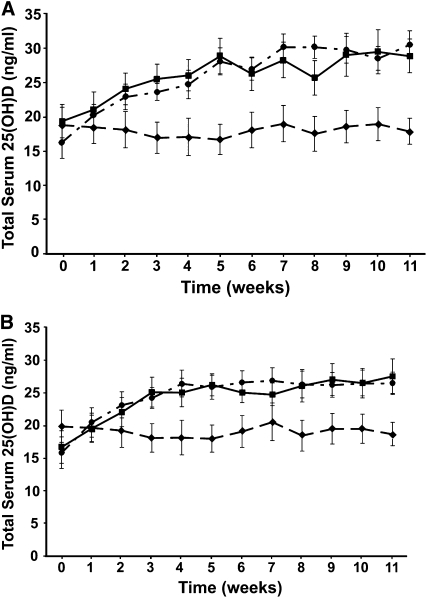
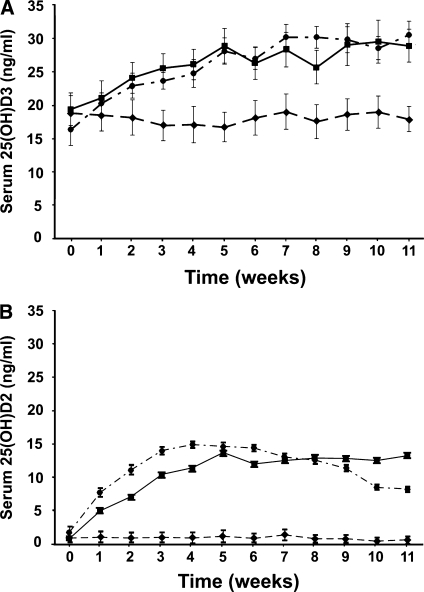
Results: A total of 64% of subjects began the study deficient in vitamin D (ie, 25-hydroxyvitamin D [25(OH)D]) concentrations <20 ng/mL). Analysis of the area under the curve showed no significant difference in serum 25(OH)D between subjects who consumed vitamin D-fortified orange juice and those who consumed vitamin D supplements (P = 0.084). No significant difference in serum 25(OH)D(3) was observed between subjects who consumed vitamin D(3)-fortified orange juice and vitamin D(3) capsules (P > 0.1). Similarly, no significant difference in serum 25(OH)D(2) was observed between subjects who consumed vitamin D(2)-fortified orange juice and vitamin D(2) capsules (P > 0.1). No significant overall difference in parathyroid hormone concentrations was observed between the groups (P = 0.82).
Conclusion: Vitamin D(2) and vitamin D(3) are equally bioavailable in orange juice and capsules.
Figures
Comment in
-
Vitamin D2 and vitamin D3 comparisons: fundamentally flawed study methodology.Am J Clin Nutr. 2010 Oct;92(4):999; author reply 999-1000. doi: 10.3945/ajcn.2010.30099. Epub 2010 Sep 1. Am J Clin Nutr. 2010. PMID: 20810978 No abstract available.
References
-
- Holick MF. Vitamin D deficiency. N Engl J Med 2007;357:266–81 - PubMed
-
- Holick MF. High prevalence of vitamin D inadequacy and implications for health. Mayo Clin Proc 2006;81:353–73 - PubMed
-
- Holick MF, Siris ES, Binkley N, et al. Prevalence of vitamin D inadequacy among postmenapausal North American women receiving osteoporosis therapy. J Clin Endocrinol Metab 2005;90:3215–24 - PubMed
-
- Chapuy MC, Preziosi P, Maamer M, et al. Prevalence of vitamin D insufficiency in an adult normal population. Osteoporos Int 1997;7:439–43 - PubMed
Publication types
MeSH terms
Substances
Grants and funding
LinkOut - more resources
Full Text Sources
Other Literature Sources
Medical
