Review
. 2010 Aug;17(8):939-48.
doi: 10.1038/gt.2010.47. Epub 2010 Apr 29.

Large animal models of hematopoietic stem cell gene therapy

Affiliations
Review

Large animal models of hematopoietic stem cell gene therapy

G D Trobridge et al. Gene Ther. 2010 Aug.

Abstract

Large animal models have been instrumental in advancing hematopoietic stem cell (HSC) gene therapy. Here we review the advantages of large animal models, their contributions to the field of HSC gene therapy and recent progress in this field. Several properties of human HSCs including their purification, their cell-cycle characteristics, their response to cytokines and the proliferative demands placed on them after transplantation are more similar in large animal models than in mice. Progress in the development and use of retroviral vectors and ex vivo transduction protocols over the last decade has led to efficient gene transfer in both dogs and nonhuman primates. Importantly, the approaches developed in these models have translated well to the clinic. Large animals continue to be useful to evaluate the efficacy and safety of gene therapy, and dogs with hematopoietic diseases have now been cured by HSC gene therapy. Nonhuman primates allow evaluation of aspects of transplantation as well as disease-specific approaches such as AIDS (acquired immunodeficiency syndrome) gene therapy that can not be modeled well in the dog. Finally, large animal models have been used to evaluate the genotoxicity of viral vectors by comparing integration sites in hematopoietic repopulating cells and monitoring clonality after transplantation.


Figures

Figure 1
Figure 1
The competitive repopulation assay using fluorescent reporter genes in the dog model. a) The ex vivo transduction is divided into two experimental arms with equivalent numbers of CD34+ cells. A vector expressing enhanced green fluorescent protein (EGFP) is used for one experimental arm, and a different vector different expressing enhanced yellow fluorescent protein (EYFP) is used for the other experimental arm. The two experimental arms can differ in a number of ways including vector type, vector envelope pseudotype, ex vivo transduction protocol, source of CD34+ cells, or route of infusion. By directly comparing one of these variables in the same dog, inter-animal variability is eliminated, and the best approach can be determined with a small number of animals. b) The use of EG/YFP fluorescent reporter genes allows easy and accurate evaluation of transgene expression by flow cytometry. c) Transgene expression can be evaluated long-term in both myeloid and lymphoid lineages.
Figure 2
Figure 2
Efficient long-term HSC gene transfer in the canine model using gamma-, lenti- and foamy retroviral vectors. Transgene expression was detected by flow cytometry for EG/YFP. MLV-based gammaretroviral vector gene transfer (top panel), HIV-based lentiviral vector gene transfer (middle panel), and foamy virus vector gene transfer (bottom panel) to canine myeloid and lymphoid cells.
Figure 3
Figure 3
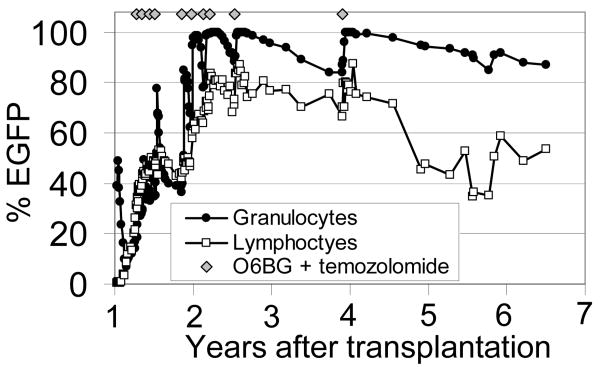
Efficient and stable MGMTP140K-mediated in vivo selection in the dog model. A gammaretroviral vector expressing the P140K mutant MGMT mediates efficient selection after treatment with temozolomide and O6BG. Treatments were well tolerated, and resulted in chemoprotection. This research was originally published in Blood. Brian C. Beard, Reeteka Sud, Kirsten A. Keyser, Christina Ironside, Tobias Neff, Sabine Gerull, Grant D. Trobridge and Hans-Peter Kiem. Long-term polyclonal and multilineage engraftment of methylguanine methyltransferase P140K gene-modified dog hematopoietic cells in primary and secondary recipients. Blood. 2009; Vol. 113, pp. 5094-5103. © the American Society of Hematology.
Figure 4
Figure 4
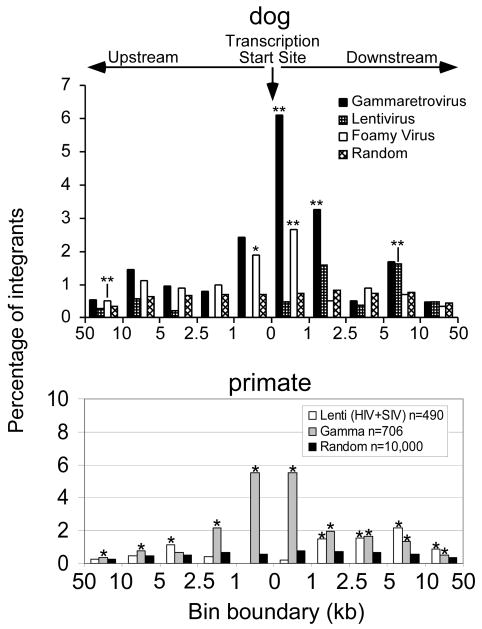
Retroviral integration site profiles in dog and nonhuman primate long term repopulating sites. The top panel shows the location of integration sites relative to the transcription start sites of Refseq genes for 114 gamma-, 327 lenti- and 341 foamy retroviral intergrants in dog long-term repopulating cells. The bottom panel shows MLV-based gammaretroviral integration sites and lentiviral integration sites (HIV and SIV) in nonhuman primate repopulating cells. Asterisks mark significant differences from a random data set, * is p<0.01 and ** is p<0.001. Frequencies are normalized as the percentage of total integrants per kilobase. This research was originally published in Human Gene Therapy. Brian C. Beard, Kirsten A. Keyser, Grant D. Trobridge, Laura J. Peterson, Daniel G. Miller, Michael Jacobs, Rajinder Kaul, Hans-Peter Kiem. Unique integration profiles in a canine model of long-term repopulating cells transduced with gammaretrovirus, lentivirus, or foamy virus. Human Gene Therapy. 2007; Vol. 18, pp. 423-434, and in Molecular Therapy. Brian C. Beard, David Dickerson, Kate Beebe, Christina Gooch, James Fletcher, Tulin Okbinoglu, Daniel G Miller, Michael A Jacobs, Rajinder Kaul, Hans-Peter Kiem, and Grant D. Trobridge. 2007; Vol. 15 pp. 1356–1365.

References

    1. Lorenz E, Uphoff D, Reid TR, Shelton E. Modification of irradiation injury in mice and guinea pigs by bone marrow injections. J Natl Cancer Inst. 1951;12:197–201. - PubMed
    1. Dick JE, Magli MC, Huszar D, Phillips RA, Bernstein A. Introduction of a selectable gene into primitive stem cells capable of long-term reconstitution of the hemopoietic system of W/Wv mice. Cell. 1985;42:71–79. - PubMed
    1. Williams DA, Lemischka IR, Nathan DG, Mulligan RC. Introduction of new genetic material into pluripotent haematopoietic stem cells of the mouse. Nature. 1984;310:476–480. - PubMed
    1. Keller G, Paige C, Gilboa E, Wagner EF. Expression of a foreign gene in myeloid and lymphoid cells derived from multipotent haematopoietic precursors. Nature. 1985;318:149–154. - PubMed
    1. Stead RB, Kwok WW, Storb R, Miller AD. Canine model for gene therapy: Inefficient gene expression in dogs reconstituted with autologous marrow infected with retroviral vectors. Blood. 1988;71:742–747. - PubMed

Publication types