Comparative Study
. 2010 Apr 23;5(4):e10323.
doi: 10.1371/journal.pone.0010323.

Full genome characterisation of bluetongue virus serotype 6 from the Netherlands 2008 and comparison to other field and vaccine strains

Affiliations
Comparative Study

Full genome characterisation of bluetongue virus serotype 6 from the Netherlands 2008 and comparison to other field and vaccine strains

Sushila Maan et al. PLoS One. .

Abstract

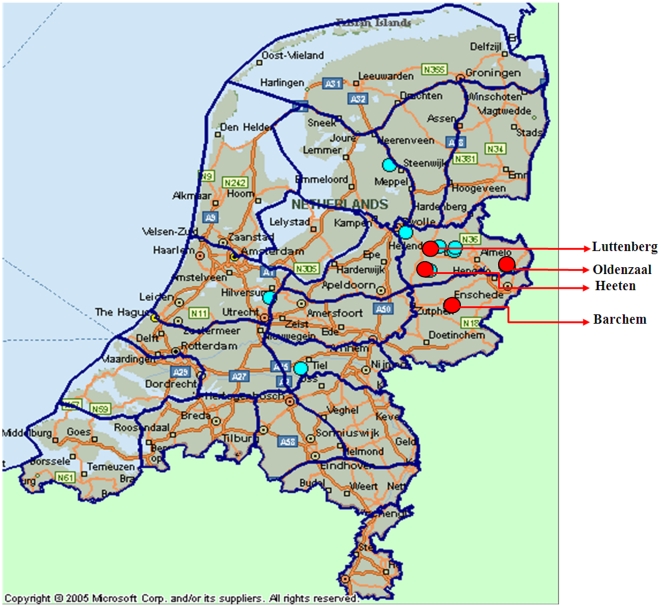
In mid September 2008, clinical signs of bluetongue (particularly coronitis) were observed in cows on three different farms in eastern Netherlands (Luttenberg, Heeten, and Barchem), two of which had been vaccinated with an inactivated BTV-8 vaccine (during May-June 2008). Bluetongue virus (BTV) infection was also detected on a fourth farm (Oldenzaal) in the same area while testing for export. BTV RNA was subsequently identified by real time RT-PCR targeting genome-segment (Seg-) 10, in blood samples from each farm. The virus was isolated from the Heeten sample (IAH "dsRNA virus reference collection" [dsRNA-VRC] isolate number NET2008/05) and typed as BTV-6 by RT-PCR targeting Seg-2. Sequencing confirmed the virus type, showing an identical Seg-2 sequence to that of the South African BTV-6 live-vaccine-strain. Although most of the other genome segments also showed very high levels of identity to the BTV-6 vaccine (99.7 to 100%), Seg-10 showed greatest identity (98.4%) to the BTV-2 vaccine (RSAvvv2/02), indicating that NET2008/05 had acquired a different Seg-10 by reassortment. Although Seg-7 from NET2008/05 was also most closely related to the BTV-6 vaccine (99.7/100% nt/aa identity), the Seg-7 sequence derived from the blood sample of the same animal (NET2008/06) was identical to that of the Netherlands BTV-8 (NET2006/04 and NET2007/01). This indicates that the blood contained two different Seg-7 sequences, one of which (from the BTV-6 vaccine) was selected during virus isolation in cell-culture. The predominance of the BTV-8 Seg-7 in the blood sample suggests that the virus was in the process of reassorting with the northern field strain of BTV-8. Two genome segments of the virus showed significant differences from the BTV-6 vaccine, indicating that they had been acquired by reassortment event with BTV-8, and another unknown parental-strain. However, the route by which BTV-6 and BTV-8 entered northern Europe was not established.


Conflict of interest statement

Competing Interests: The authors have declared that no competing interests exist.

Figures

Figure 1
Figure 1. Map of geographical location of the BTV-6 affected farms in east of the Netherlands.
The positions of the four farms originally sampled (Heeten, Barchem, Luttenberg and Oldenzaal) are indicated by red dots. Other farms where BTV-6 was detected are indicated by blue dots.
Figure 2
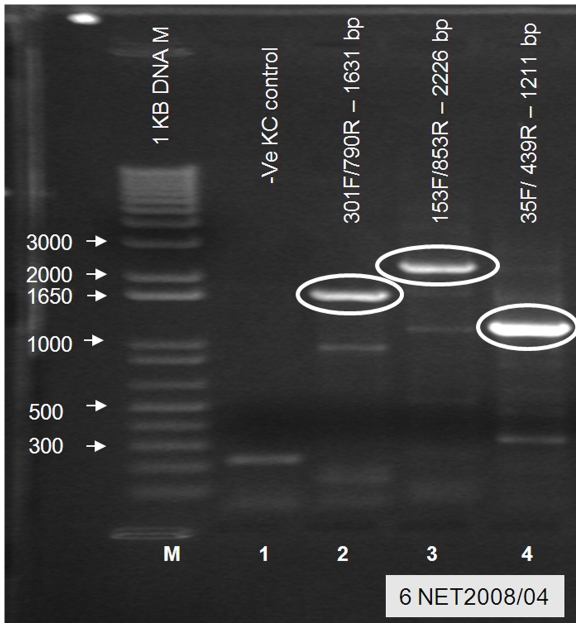
Figure 2. Electrophoretic analysis of cDNA products generated from Seg-2 of NET2008/04 using nucleotype ‘C’ and BTV-6 specific primer pairs.
PCR amplicons were generated from cDNA of BTV-6 isolate NET2008/04 with one nucleotype ‘C’ (lane 2) and two type 6 specific primer pairs (lanes 3 and 4 – Table 1). No specific amplification was seen with these primers from mock KC cells (Lane 1). Lane M: 1 kb marker.
Figure 3
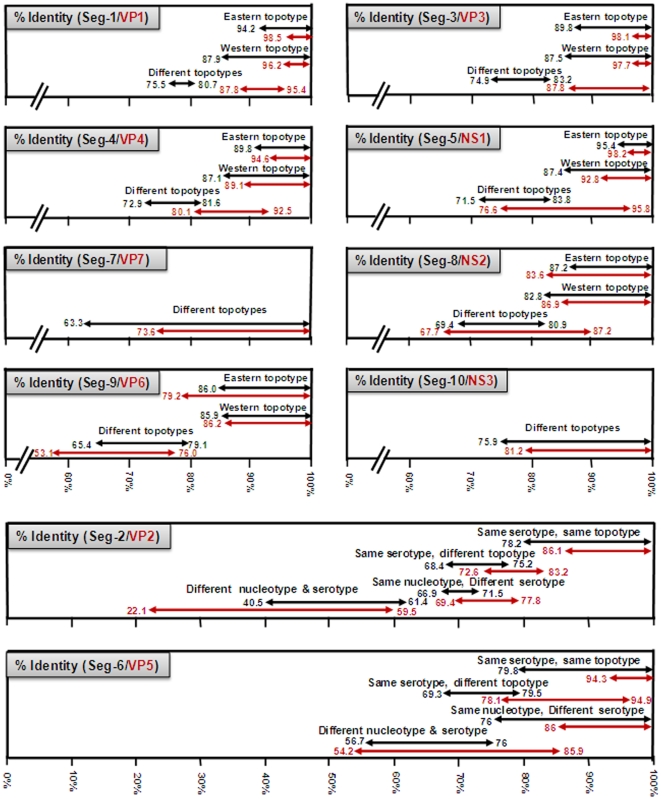
Figure 3. A graphical representation of the levels of nucleotide and amino acid sequence identities detected in different genome segments and proteins, within and between different BTV serotypes and topotypes.
Estimates of the levels of identity in each genome segment/protein, between different BTV strains are based on multiple datasets for widely distributed isolates, as described previously by Maan et al. , , and listed in tables 3 and S1. The values presented here show the levels of identity detected within the ‘major’ eastern and western topotypes for each genome segment (black) and protein (red). The levels of identity that are shown between different topotypes, include data for all genome segments of BTV-25 (Toggenburg orbivirus), as well as Seg-3 of BTV-15 Australia (Ac. No. AY322427) and Seg-5 of BTV-20 Australia (Ac. No. X56735), as representatives of distinct topotypes.
Figure 4
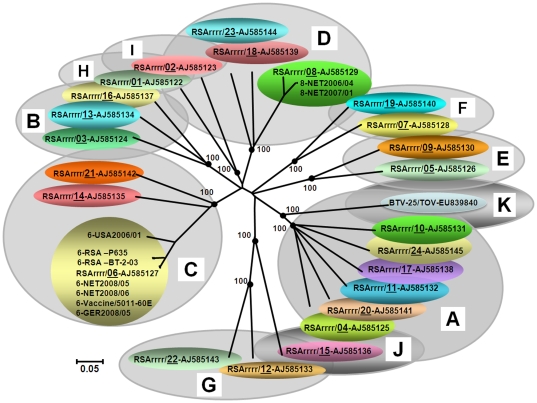
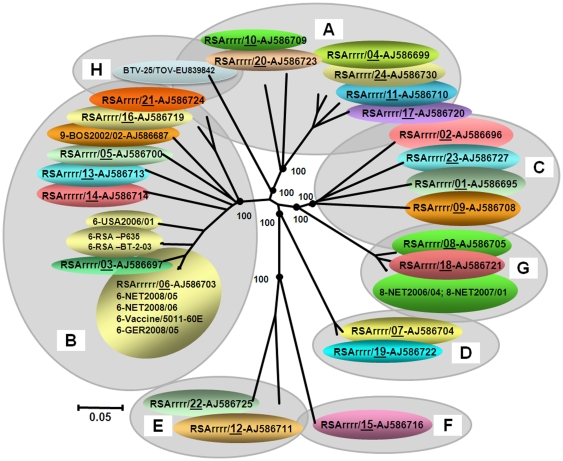
Figure 4. Neighbour-joining tree showing relationships between Seg-2 of NET2008/05 with other BTV-6 isolates and the twenty-five reference strains of different BTV serotypes.
The tree was constructed using distance matrices, generated using the p-distance determination algorithm in MEGA 4.1 (500 bootstrap replicates) . The ten evolutionary branching points are indicated by black dots on the tree (along with their bootstrap values), which correlate with the eleven ‘Seg-2 nucleotypes’ designated A–K. BTV-25 (Toggenburg orbivirus [TOV]) forms a new 11th Seg-2 nucleotype (K). Members of the same Seg-2 nucleotype, are characterised by >66.9% identity in their Seg-2 nucleotide sequences, while members of different nucleotypes show <61.4% identity in Seg-2 , (see Figure 3). The trees shown in Figures 4- 7 were drawn using same parameters.
Figure 5
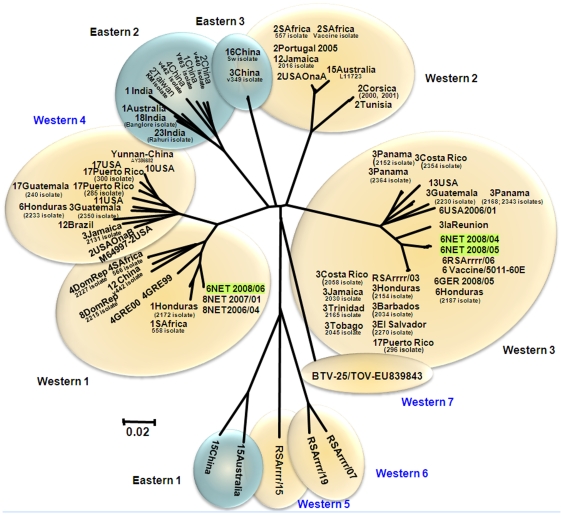
Figure 5. Neighbour-joining tree showing relationships between Seg-6 of NET2008/05 with other BTV-6 isolates and the twenty-five reference strains of different BTV serotypes.
The seven evolutionary branching points are indicated by black dots on the tree (along with their bootstrap values), dividing the sequences into eight ‘Seg-6 nucleotypes’ designated ‘A–H’. In previous studies , six Seg-6 nucleotypes were identified, however the additional analyses described here indicate that the previous ‘nucleotype C’ should be subdivided (into nucleotypes ‘C’ and ‘G’). BTV-25 (Toggenburg orbivirus [TOV]) forms a new 8th Seg-6 nucleotype (H). Members of the same nucleotype show >76% nt identity in Seg-6, while members of different nucleotypes show <76% nt identity (see Figure 3).
Figure 6
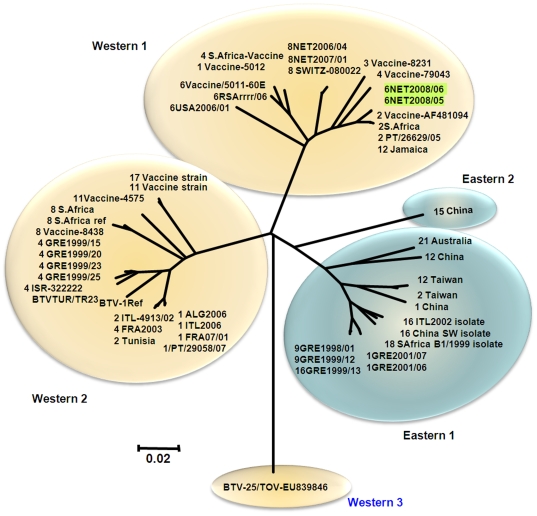
Figure 6. Neighbour-joining tree showing relationships between Seg-7 of NET2008/05 with other BTV-6 isolates and other BTV strains from different serotypes from around the world.
Figure 7
Figure 7. Neighbour-joining tree showing relationships between Seg-10 from BTV-6 NET2008/05 with multiple other BTV-6 isolates and other BTV strains of different serotypes from around the world.

References

    1. Mertens PPC, Maan S, Samuel A, Attoui H. Fauquet CM, Mayo MA, Maniloff J, Desselberger U, Ball LA, editors. Orbivirus Reoviridae. . 2005. pp. 466–483. Virus Taxonomy VIIIth Report of the ICTV Elsevier/Academic Press London.
    1. Fernandez-Pacheco P, Fernandez-Pinero J, Aguero M, Jiminez-Clavero MA. Bluetongue virus serotype 1 in wild mouflons in Spain. Vet Rec. 2008;162:659–660. - PubMed
    1. Mauroy A, Guyot H, De Clercq K, Cassart D, Thiry E, et al. Bluetongue in captive yaks. Emerg Infect Dis. 2008;14:675–676. - PMC - PubMed
    1. Barzilai E, Tadmor A. Multiplication of bluetongue virus in goats following experimental infection. Refu Vet. 1971;28:11–20.
    1. Henrich M, Reinacher M, Hamann HP. Lethal bluetongue virus infection in an alpaca. Vet Rec. 2007;161:764. - PubMed

Publication types