


Overshoot measured physiologically and psychophysically in the same human ears
- PMID: 20430072
- PMCID: PMC2923227
- DOI: 10.1016/j.heares.2010.04.007
Overshoot measured physiologically and psychophysically in the same human ears
Erratum in
- Hear Res. 2011 Oct;280(1-2):246
Abstract
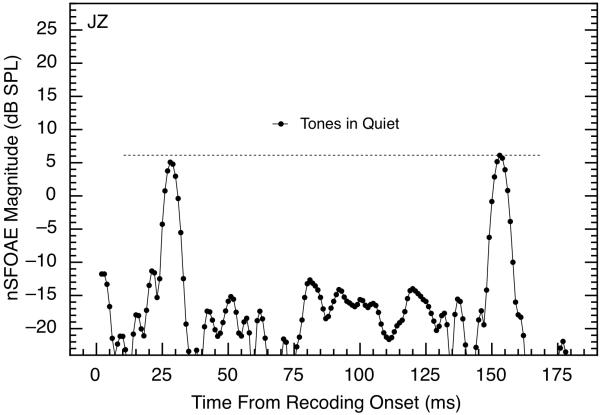
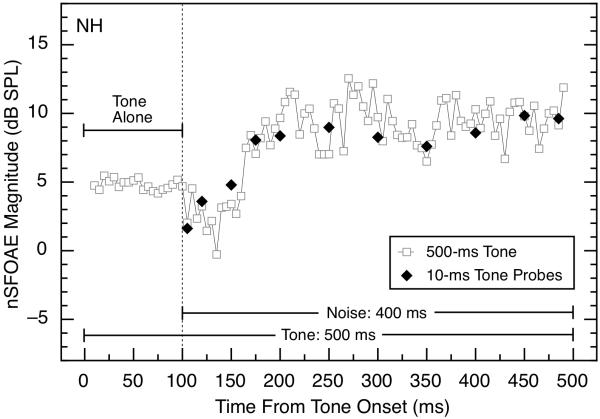
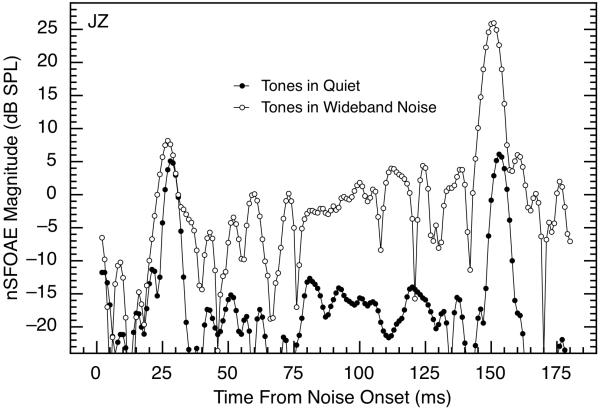
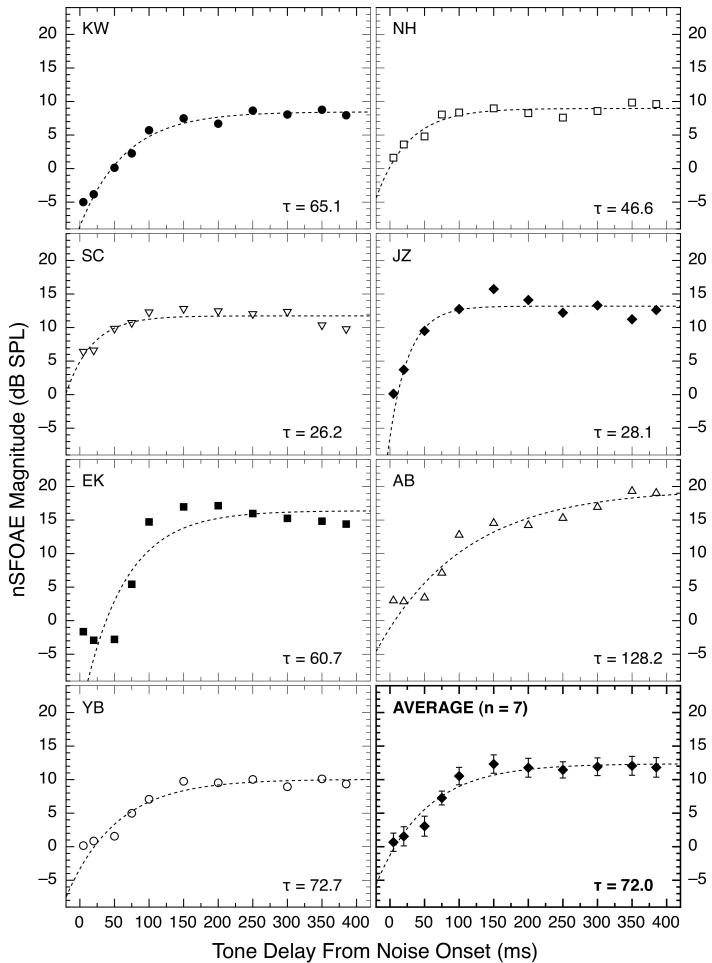
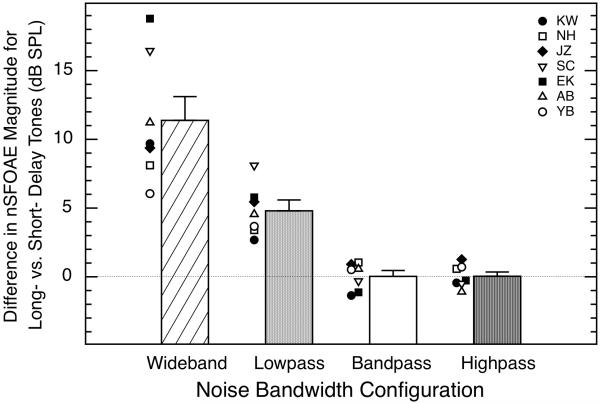
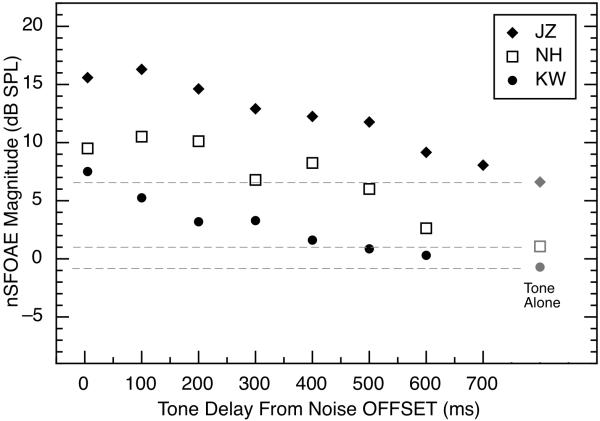
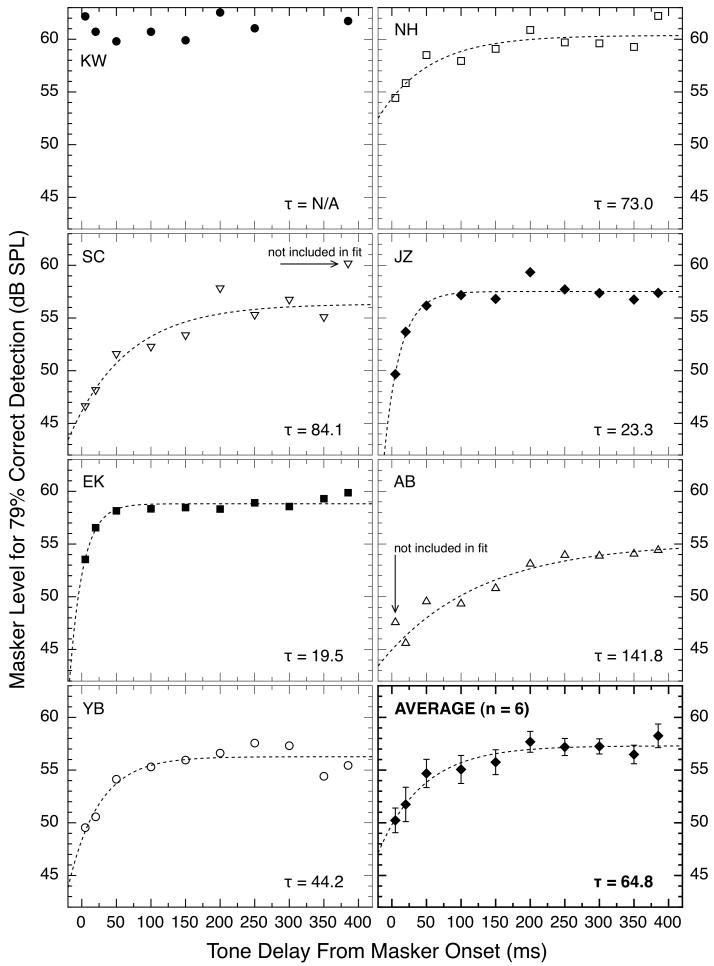
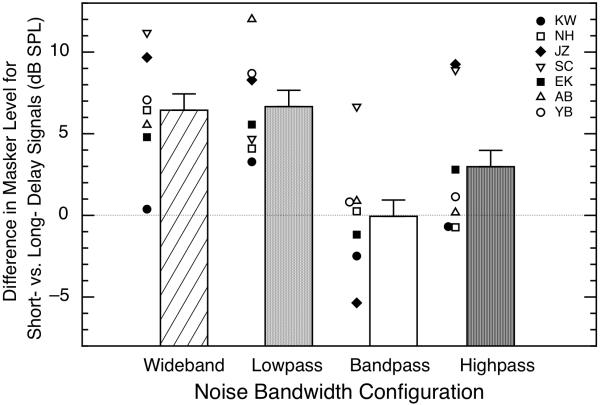
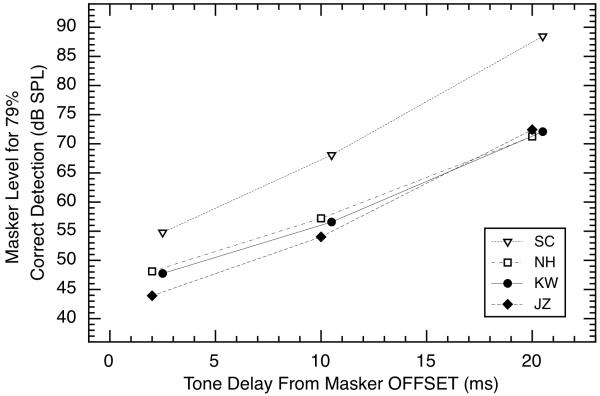
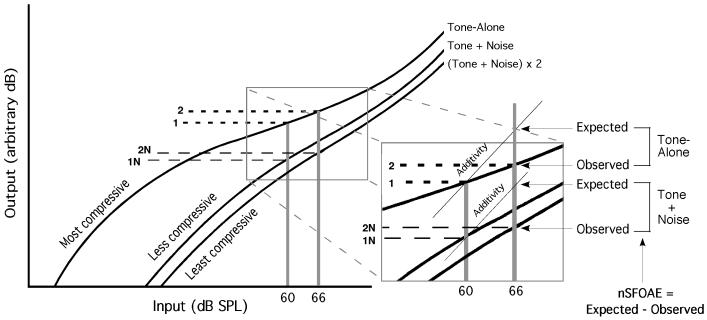
A nonlinear version of the stimulus-frequency otoacoustic emission (SFOAE) was measured using stimulus waveforms similar to those used for behavioral overshoot. Behaviorally, the seven listeners were as much as 11 dB worse at detecting a brief tonal signal (4.0 kHz, 10 ms in duration) when it occurred soon after the onset of a wideband masking noise (0.1-6.0 kHz; 400 ms in duration) than when it was delayed by about 200 ms, and the nonlinear SFOAE measure exhibited a similar effect. When either lowpass (0.1-3.8 kHz) or bandpass noise (3.8-4.2 kHz) was used instead of the wideband noise, the physiological and behavioral measures again were similar. When a highpass noise (4.2-6.0 kHz) was used, the physiological and behavioral measures both showed no overshoot-like effect for five of the subjects. The physiological response to the tone decayed slowly after the termination of the noise, much like the time course of resetting for behavioral overshoot. One subject exhibited no overshoot behaviorally even though his cochlear responses were like those of the other subjects. Overall, the evidence suggests that some basic characteristics of overshoot are obligatory consequences of cochlear function, as modulated by the olivocochlear efferent system.
Copyright (c) 2010 Elsevier B.V. All rights reserved.
Figures
References
-
- Bacon SP. Effect of masker level on overshoot. J. Acoust. Soc. Am. 1990;88:698–702. - PubMed
-
- Bacon SP, Liu L. Effects of ipsilateral and contralateral precursors on overshoot. J. Acoust. Soc. Am. 2000;108:1811–1818. - PubMed
-
- Bacon SP, Takahashi GA. Overshoot in normal-hearing and hearing-impaired subjects. J. Acoust. Soc. Am. 1992;91:2865–2871. - PubMed
-
- Bacon SP, Repovsch-Duffey JL, Liu L. Effects of signal delay on auditory filter shapes derived from psychophysical tuning curves and notched-noise data obtained in simultaneous masking. J. Acoust. Soc. Am. 2002;112:227–237. - PubMed
-
- Backus BC, Guinan JJ., Jr. Time-course of the human medial olivocochlear reflex. J. Acoust. Soc. Am. 2006;119:2889–2904. - PubMed
Publication types
MeSH terms
Grants and funding
LinkOut - more resources
Full Text Sources
Miscellaneous
