Relationship between Psychological Factors and Quality of Life in Subtypes of Gastroesophageal Reflux Disease
- PMID: 20431758
- PMCID: PMC2852738
- DOI: 10.5009/gnl.2009.3.4.259
Relationship between Psychological Factors and Quality of Life in Subtypes of Gastroesophageal Reflux Disease
Abstract
Background/aims: Quality of life (QoL) is consistently decreased in gastroesophageal reflux disease (GERD), but the relationship between QoL and psychological factors in GERD has not yet been clearly defined. The present study investigated the relationship between the psychological factors of two subtypes of GERD and QoL.
Methods: A cohort of 769 participants underwent upper endoscopic evaluation in the health-promotion center of St. Paul's Hospital. The severity of GERD symptoms, psychological factors, and QoL were analyzed using the Visual Analogue Scale, the Hospital Anxiety and Depression Scale, and the abbreviated version of the World Health Organization Quality of Life instrument, respectively.
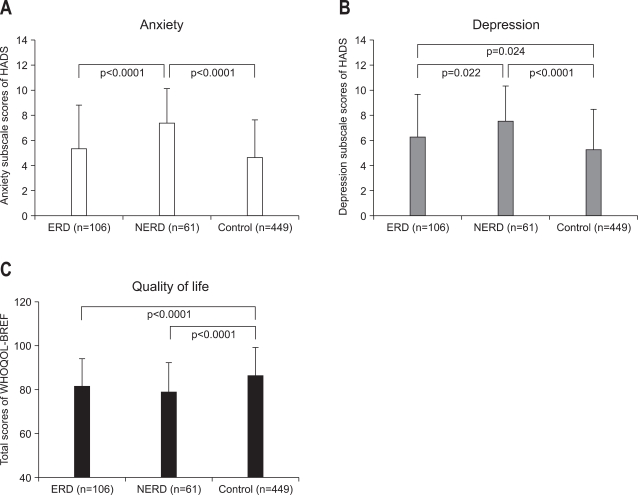
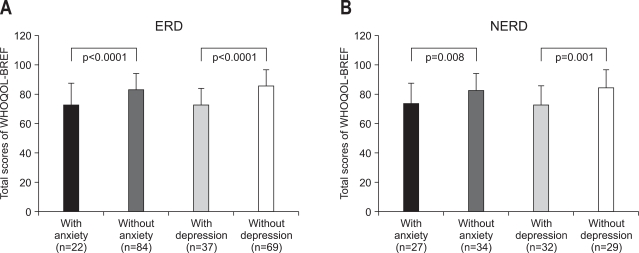
Results: Among the total of 769 participants, 153 participants were included in the exclusion criteria. Erosive reflux disease (ERD) and nonerosive reflux disease (NERD) were present in 106 (14%) and 61 (8%) of the participants, respectively, and 449 (58%) acted as controls. In each GERD group, the QoL had no correlatioion with the symptom severity. The scores for anxiety and depression were highest in the NERD group, and QoL scores were lower in both the ERD and NERD groups than in the control group. Anxiety and depression resulted in QoL scores being lower in both the ERD and NERD groups than in the nonanxiety and nondepressed groups, respectively.
Conclusions: This study provides evidence that the QoL associated with the ERD and NERD subtypes may be more related to psychological factors than to symptom severity.
Keywords: Anxiety; Depression; Gastroesophageal reflux; Psychology; Quality of life.
Figures
References
-
- Agreus L, Svardsudd K, Talley NJ, Jones MP, Tibblin G. Natural history of gastroesophageal reflux disease and functional abdominal disorders: a population-based study. Am J Gastroenterol. 2001;96:2905–2914. - PubMed
-
- Locke GR, 3rd, Talley NJ, Fett SL, Zinsmeister AR, Melton LJ., 3rd Prevalence and clinical spectrum of gastroesophageal reflux: a population-based study in Olmsted County, Minnesota. Gastroenterology. 1997;112:1448–1456. - PubMed
-
- Wong WM, Lai KC, Lam KF, et al. Prevalence, clinical spectrum and health care utilization of gastro-oesophageal reflux disease in a Chinese population: a population-based study. Aliment Pharmacol Ther. 2003;18:595–604. - PubMed
-
- Yang SY, Lee OY, Bak YT, et al. Prevalence of gastroesophageal reflux disease symptoms and uninvestigated dyspepsia in Korea: a population-based study. Dig Dis Sci. 2008;53:188–193. - PubMed
-
- Goh KL. Changing epidemiology of gastroesophageal reflux disease in the Asian-Pacific region: an overview. J Gastroenterol Hepatol. 2004;19(Suppl 3):S22–S25. - PubMed
LinkOut - more resources
Full Text Sources