. 2010 Nov 12;213(1):42-9.
doi: 10.1016/j.bbr.2010.04.028. Epub 2010 Apr 28.

Chronic metals ingestion by prairie voles produces sex-specific deficits in social behavior: an animal model of autism

Affiliations

Chronic metals ingestion by prairie voles produces sex-specific deficits in social behavior: an animal model of autism

J Thomas Curtis et al. Behav Brain Res. .

Abstract

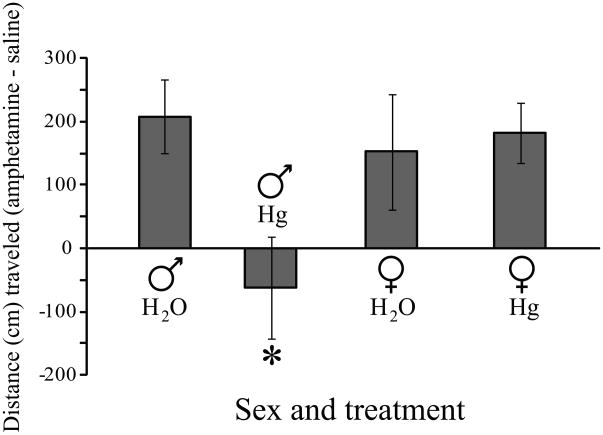
We examined the effects of chronic metals ingestion on social behavior in the normally highly social prairie vole to test the hypothesis that metals may interact with central dopamine systems to produce the social withdrawal characteristic of autism. Relative to water-treated controls, 10 weeks of chronic ingestion of either Hg(++) or Cd(++) via drinking water significantly reduced social contact by male voles when they were given a choice between isolation or contact with an unfamiliar same-sex conspecific. The effects of metals ingestion were specific to males: no effects of metals exposure were seen in females. Metals ingestion did not alter behavior of males allowed to choose between isolation or their familiar cage-mates, rather than strangers. We also examined the possibility that metals ingestion affects central dopamine functioning by testing the voles' locomotor responses to peripheral administration of amphetamine. As with the social behavior, we found a sex-specific effect of metals on amphetamine responses. Males that consumed Hg(++) did not increase their locomotor activity in response to amphetamine, whereas similarly treated females and males that ingested only water significantly increased their locomotor activities. Thus, an ecologically relevant stimulus, metals ingestion, produced two of the hallmark characteristics of autism - social avoidance and a male-oriented bias. These results suggest that metals exposure may contribute to the development of autism, possibly by interacting with central dopamine function, and support the use of prairie voles as a model organism in which to study autism.


Figures

Fig 1
Fig 1
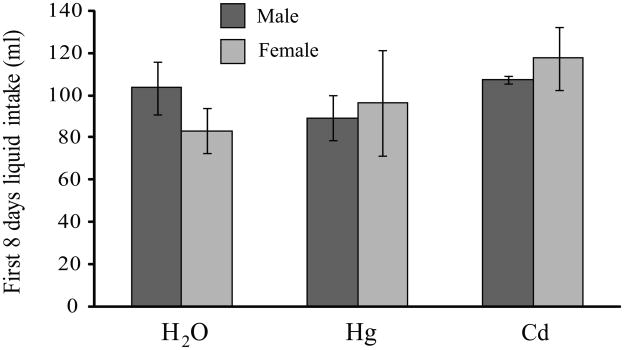
The presence of 60ppm HgCl2 or CdCl2 in drinking water did not affect the amount of liquid ingested by prairie voles. Cumulative liquid intakes during the first 8 days of access did not differ between animals that received water only or a metals solution as their sole drinking water source, nor were there any sex differences in total liquid ingested. Dark bars indicate male totals, lighter bars indicate female totals.
Fig 2
Fig 2
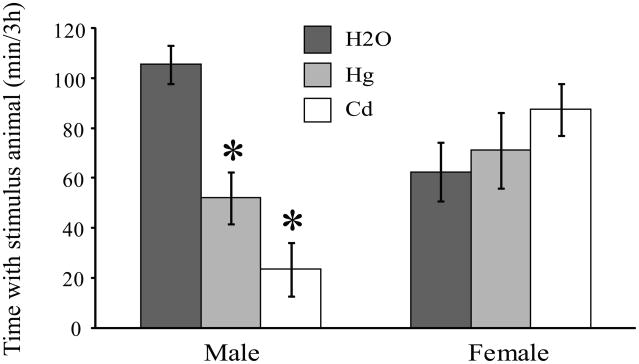
Chronic ingestion of metals altered social behavior in male prairie voles. Male prairie voles that consumed either Hg++ or Cd++ in their drinking water spent significantly less time in contact with an unfamiliar, same-sex conspecific than did males that received only unadulterated water. Social contact did not differ between males that received Hg++ or Cd++. In contrast, metals ingestion did not alter the amounts of time females spent in contact with a same-sex stranger. * p < 0.002.
Fig 3
Fig 3
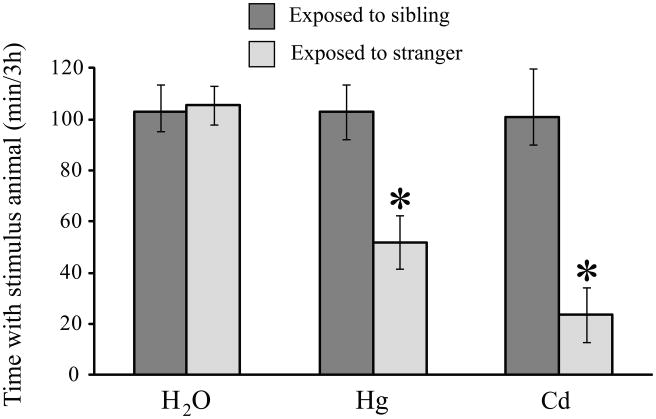
Male prairie voles only displayed reduced social contact when the stimulus animal was an unfamiliar animal. Males that were given a choice between isolation and contact with another vole displayed no effects of metals ingestion if the stimulus animal was the subject’s same-sex cagemate. In contrast, metals-treated males that were exposed to strangers displayed reduced amounts of social contact relative to water-treated controls. Data for stranger-exposed males are the same data as were used in Fig 2 and are presented here to provide a point of comparison. * p < 0.002.
Fig 4
Fig 4
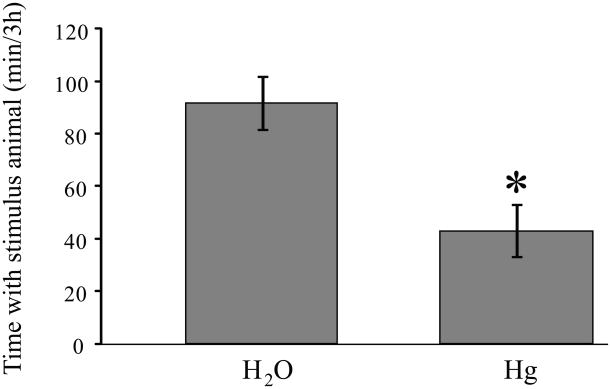
Male prairie voles that received Hg++ in their drinking water for four weeks displayed reduced time spent with the unfamiliar same-sex conspecific, relative to males that received water only. The magnitude of the decrease was similar to that seen from males that received metals for 10 weeks. * p < 0.002.
Fig 5
Fig 5
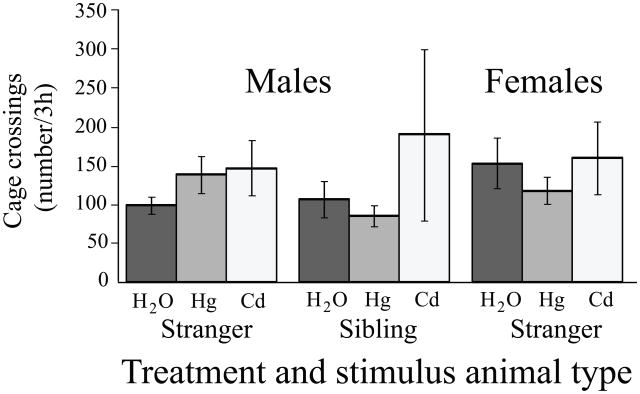
Unstimulated locomotor activity was unchanged by metals treatment. Regardless of animals’ sex, metal ingested, or stimulus animal used in the behavioral testing, animals that received metals in their drinking water did not differ from water-treated controls in their locomotor activity during the social choice testing.
Fig 6
Fig 6
Metals ingestion altered locomotor activity in response to amphetamine administration. Male prairie voles that experienced chronic exposure to Hg++ in their drinking water did not display an increase in locomotor activity when given an intraperitoneal injection of 0.5mg/kg of amphetamine over that seen after control injections. In contrast, males that received only water traveled a greater distance in an open-field arena after amphetamine than they did after control injections. Locomotor responses of Hg++-treated males to amphetamine also differed from those of similarly treated females. There were no treatment effects between water-treated and metals-treated females. * p < 0.02 relative to control males or to Hg++-treated females.

References

    1. Adams JB, Romdalvik J, Ramanujam VMS, Legator MS. Mercury, lead, and zinc in baby teeth of children with autism versus controls. J Toxicol Env Heal A. 2007;70:1046–1051. - PubMed
    1. Andersen SL, Teicher MH. Sex differences in dopamine receptors and their relevance to ADHD. Neurosci Biobehav R. 2000;24:137–141. - PubMed
    1. Aragona BJ, Detwiler JA, Wang ZX. Amphetamine reward in the monogamous prairie vole. Neurosci Lett. 2007;418:190–194. - PMC - PubMed
    1. Aragona BJ, Liu Y, Curtis JT, Stephan FK, Wang Z. A critical role for nucleus accumbens dopamine in partner-preference formation in male prairie voles. J Neurosci. 2003;23:3483–90. - PMC - PubMed
    1. Aragona BJ, Liu Y, Yu YJ, Curtis JT, Detwiler JM, Insel TR, Wang Z. Nucleus accumbens dopamine differentially mediates the formation and maintenance of monogamous pair bonds. Nat Neurosci. 2006;9:133–9. - PubMed

Publication types

MeSH terms