. 2010 Apr;22(4):1118-28.
doi: 10.1105/tpc.109.066605. Epub 2010 Apr 30.

DAY NEUTRAL FLOWERING represses CONSTANS to prevent Arabidopsis flowering early in short days

Affiliations

DAY NEUTRAL FLOWERING represses CONSTANS to prevent Arabidopsis flowering early in short days

Karl Morris et al. Plant Cell. 2010 Apr.

Abstract

The photoperiodic response in Arabidopsis thaliana requires the precise regulation of CONSTANS (CO) expression in relation to the light period during the day. In short days (SDs) levels of CO expression are normally low during the light period, and this results in delayed flowering compared with long days (LDs) when CO expression rises to high levels before the end of the light period. We identified a novel flowering time gene called DAY NEUTRAL FLOWERING (DNF) that acts in the same flowering pathway as CO. DNF is a membrane-bound E3 ligase that represses CO expression and plays an important role in maintaining low levels of CO expression in SDs. The effect of DNF on the rhythm of CO expression is essential for the photoperiodic response of Arabidopsis, enabling it to have a different flowering response in LDs and SDs.


Figures
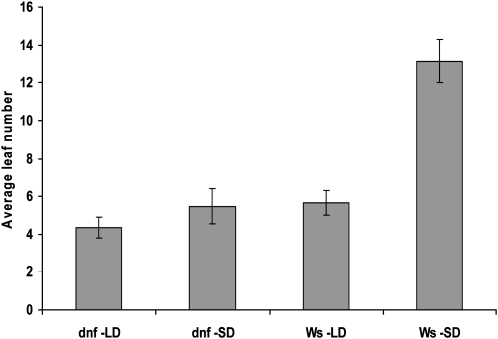
Figure 1.
Figure 1.
Flowering Times in LDs and SDs. Average leaf number at flowering of Ws and dnf mutant plants in LDs (16 h light/8 h dark) and SDs (8 h light/16 h dark). Error bars show sd; n = 20 plants.
Figure 2.
Figure 2.
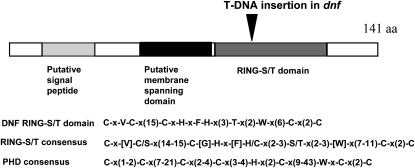
Predicted Domains of the DNF Protein. Schematic of the DNF protein showing predicted domains and the site of the T-DNA insertion in the dnf mutant. The amino acid sequence of the DNF RING-S/T domain is illustrated together with the consensus sequences for RING-S/T and PHD domains.
Figure 3.
Figure 3.
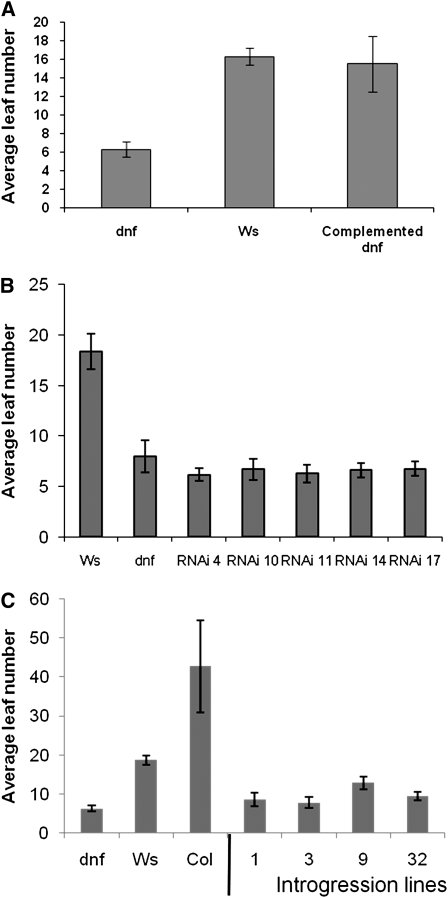
Flowering Time of a Complemented dnf Mutant Line, DNF RNAi Plants, and Col Introgression Lines in 8-h SDs. (A) Flowering times of Ws, the dnf mutant, and a homozygous complemented mutant line (dnf mutant expressing the DNF transgene driven by DNF promoter sequences). (B) Flowering times of several independent DNF RNAi lines (RNAi of the DNF gene in Ws) compared with the original dnf mutant and Ws plants. (C) Leaf number at flowering of homozygous progeny from selfed plants derived from four rounds of backcrossing of the dnf mutant into Col. Flowering times of Ws, dnf, and Col are also shown. Error bars show sd; n = 12 to 15 plants.
Figure 4.
Figure 4.
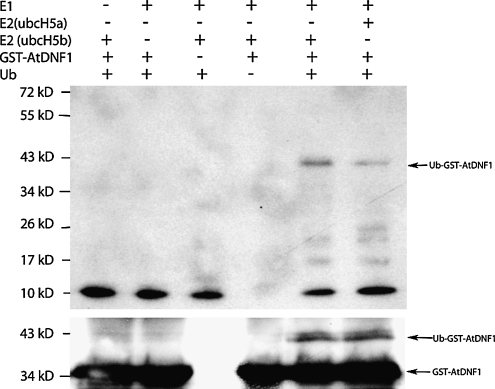
E3 Ubiquitin Ligase Activity of DNF. GST-DNF was expressed and purified from E. coli and tested for ubiquitination activity in the presence of yeast E1, human E2 (Hubc5b or Hubc5a), and ubiquitin. The immunoblots were probed with anti-Ub antibodies (top panel) to detect ubiquitinated E. coli proteins. Anti-GST antibodies (bottom panel) were used to detect GST-DNF.
Figure 5.
Figure 5.
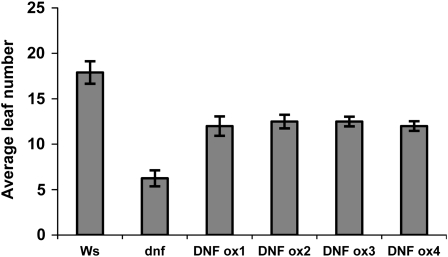
Flowering Times of DNF Overexpressers in SD. Flowering time of 35S:DNF overexpressing lines compared with Ws and the dnf mutant in 8-h SDs. Error bars show sd; n = 12 plants.
Figure 6.
Figure 6.
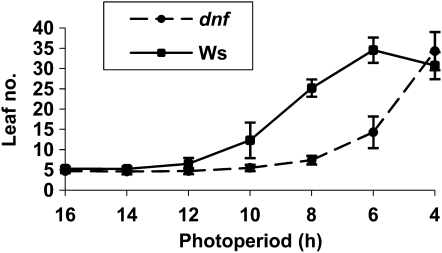
Critical Photoperiod of dnf and Ws. Average leaf number at flowering of Ws and dnf mutant plants grown in photoperiods of different lengths ranging from 4 to 16 h of light. Error bars show sd; n = 12 plants.
Figure 7.
Figure 7.
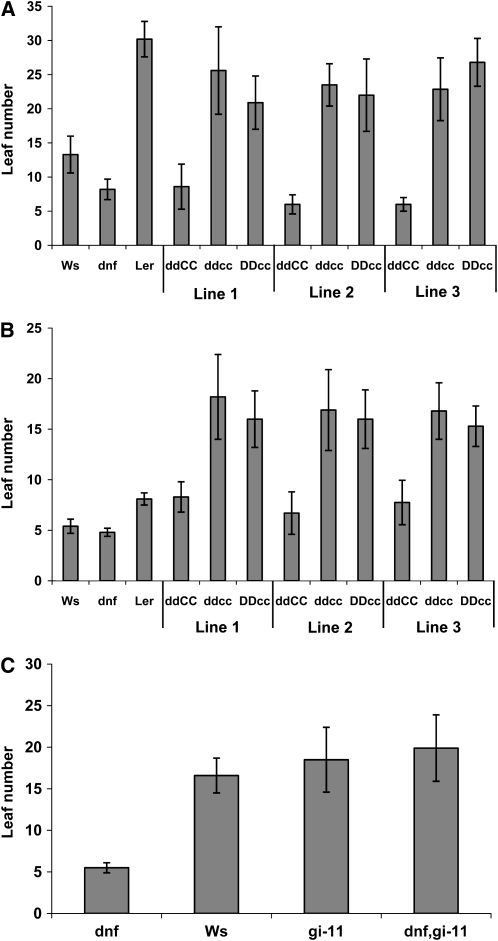
Flowering Times of Double Mutants. (A) and (B) Average leaf number at flowering in SDs (A) and LDs (B) of three different homozygous dnf co-2 double mutant lines (ddcc) compared with their siblings that carry the wild-type DNF allele but are still homozygous for the co-2 mutation (DDcc), and those carrying the wild-type CO allele but homozygous for the dnf mutation (ddCC). Flowering times of Ws, the dnf mutant, and Ler are also shown for comparison. Error bars show sd; n = 15-20 plants. (C) Average leaf number at flowering of Ws, dnf, gi-11, and dnf gi-11 double mutant plants in SDs. Error bars show sd; n = 10 plants.
Figure 8.
Figure 8.
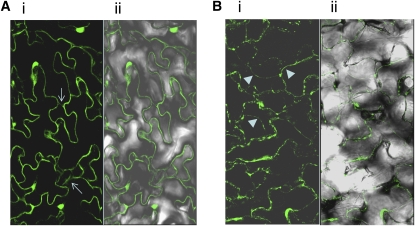
Intracellular Localization of DNF Protein. Localization of DNF-GFP fusion protein in leaf epidermal cells of 35S-DNF-GFP plants before (A) and after plasmolysis (B). Panel (i), GFP fluorescence; panel (ii), GFP with transmitted light. Arrows in panel (Ai) indicate possible internal endomembrane structures within the cell containing the DNF:GFP protein. Arrowheads in panel (Bi) show where the plasma membrane has separated from the cell wall.
Figure 9.
Figure 9.
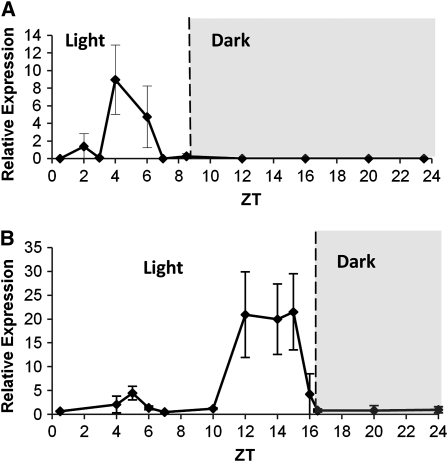
Expression Pattern of DNF. (A) Expression of DNF in wild-type plants in 8-h SDs. (B) Expression of DNF in wild-type plants in 16-h LDs. Expression levels were determined by quantitative RT-PCR and are normalized to β-Actin. Data points represent an average of two experimental replicates each with three technical replicates. Error bars represent sd.
Figure 10.
Figure 10.
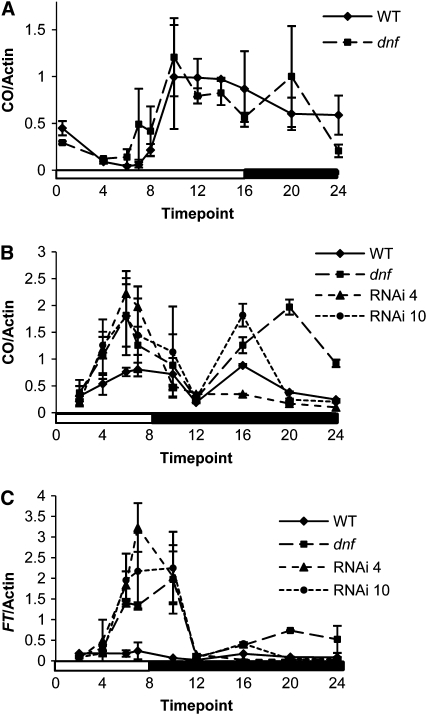
Expression of CO and FT in the dnf Mutant. (A) Expression of CO in Ws and the dnf mutant in 16-h LDs. (B) Expression of CO in Ws, dnf, and DNF RNAi lines 4 and 10 in 8-h SDs. (C) Expression of FT in Ws, dnf, and DNF RNAi lines 4 and 10 in 8-h SDs. Expression levels were determined by quantitative RT-PCR and are normalized to β-Actin, but as different standard curves were used for the LD and SD analysis, the levels between experiments cannot be compared. White and black bars represent light and dark periods, respectively. Data points represent an average of two experimental replicates each with three technical replicates. Error bars represent sd.

References

    1. Becker D., Kemper E., Schell J., Masterson R. (1992). New plant binary vectors with selectable markers located proximal to the left T-DNA border. Plant Mol. Biol. 20: 1195–1197 - PubMed
    1. Bienz M. (2006). The PHD finger, a nuclear protein-interaction domain. Trends Biochem. Sci. 31: 35–40 - PubMed
    1. Chen M., Ni M. (2006). RFI2, a RING-domain zinc finger protein, negatively regulates CONSTANS expression and photoperiodic flowering. Plant J. 46: 823–833 - PubMed
    1. Clough S.J., Bent A.F. (1998). Floral dip: A simplified method for Agrobacterium-mediated transformation of Arabidopsis thaliana. Plant J. 16: 735–743 - PubMed
    1. Corbesier L., Vincent C., Jang S., Fornara F., Fan Q., Searle I., Giakountis A., Farrona S., Gissot L., Turnbull C., Coupland G. (2007). FT protein movement contributes to long-distance signaling in floral induction of Arabidopsis. Science 316: 1030–1033 - PubMed

Publication types

MeSH terms