. 2010 Jun 2;29(11):1830-9.
doi: 10.1038/emboj.2010.82. Epub 2010 Apr 30.

The nuclear export receptor XPO-1 supports primary miRNA processing in C. elegans and Drosophila

Affiliations

The nuclear export receptor XPO-1 supports primary miRNA processing in C. elegans and Drosophila

Ingo Büssing et al. EMBO J. .

Abstract

MicroRNA (miRNA) biogenesis proceeds from a primary transcript (pri-miRNA) through the pre-miRNA into the mature miRNA. Here, we identify a role of the Caenorhabditis elegans nuclear export receptor XPO-1 and the cap-binding proteins CBP-20/NCBP-2 and CBP-80/NCBP-1 in this process. The RNA-mediated interference of any of these genes causes retarded heterochronic phenotypes similar to those observed for animals with mutations in the let-7 miRNA or core miRNA machinery genes. Moreover, pre- and mature miRNAs become depleted, whereas primary miRNA transcripts accumulate. An involvement of XPO-1 in miRNA biogenesis is conserved in Drosophila, in which knockdown of Embargoed/XPO-1 or its chemical inhibition through leptomycin B causes pri-miRNA accumulation. Our findings demonstrate that XPO-1/Emb promotes the pri-miRNA-to-pre-miRNA processing and we propose that this function involves intranuclear transport and/or nuclear export of primary miRNAs.


Conflict of interest statement

The authors declare that they have no conflict of interest.

Figures

Figure 1
Figure 1
RNAi against xpo-1, ncbp-1/cbp-80, or ncbp-2/cbp-20 causes animals to die by vulval bursting. Unlike (A) the healthy control animals, (B) alg-1(RNAi) and (C) xpo-1(RNAi) adults have protruding vulvae and often die by bursting through the vulva. (D) This phenotype is also penetrant on depletion of cbp-20 or cbp-80, whereas RNAi against xpo-3 or phax-1 has no effect (independent experiments n⩾2, each n⩾165 animals). ‘Control' in this and subsequent figures denotes animals that were fed bacteria carrying the insertless L4440 parental RNAi vector. Error bars=s.e.m. Scale bars are 20 μm.
Figure 2
Figure 2
xpo-1(RNAi), ncbp-1/cbp-80(RNAi), and ncbp-2/cbp-20(RNAi) cause alae defects. (A) Control animals display strong and complete alae (arrows), whereas (BF) alae in animals treated with RNAi as indicated are broken or absent altogether (brackets indicate alae breaks; for (F), independent experiments n⩾3, each n⩾22 animals for control, xpo-1(RNAi), cbp-20(RNAi) and cbp-80(RNAi); for alg-1(RNAi) one experiment with 34 animals). Residual alae in the mutant animals (arrows) are much weaker than in the control. Error bars=s.e.m. Scale bars are 20 μm.
Figure 3
Figure 3
Depletion of xpo-1, cbp-20, or cbp-80 causes a widespread decrease in mature miRNA, but not in mature mirtron levels. (AD) Northern blots using total RNA from synchronized late L4 stage animals exposed to RNAi as indicated. Oligonucleotides complementary to the indicated mature miRNAs or tRNAGly(TCC) were used. To facilitate a comparison, two different amounts of total RNA were loaded in (B) as indicated. (D) The accumulation of the mirtron mir-62 is not affected by the depletion of xpo-1 and cbp-80 (same membrane as in (C), re-probed and tRNA shown again for comparison). Numbers represent the quantification by phosphoimager, normalized to tRNAGly levels.
Figure 4
Figure 4
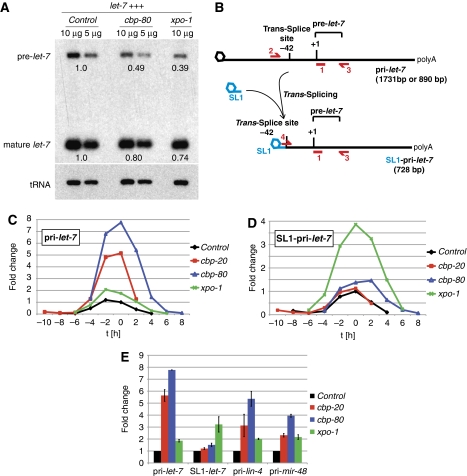
Depletion of XPO-1 or CBC reduces pre-let-7 levels and increases pri-miRNA accumulation. (A) Pre-let-7 levels are reduced in let-7-overexpressing animals (let-7+++) exposed to xpo-1(RNAi) or cbp-80(RNAi). Total amounts of RNA were loaded as indicated. (B) Schematic representation (not to scale) of the primary (pri-let-7) and trans-spliced SL1-pri-let-7 transcripts. The positions of oligonucleotides used for RT–qPCR and Northern blot are highlighted in red. Mature and pre-let-7 are detected by probe (1); pri-let-7 by primers (2) and (3); SL1-pri-let-7 by primers (3) and (4). (C) The levels of pri–let-7 and (D) SL1-pri-let-7 change dynamically during the L4 stage and are elevated in the xpo-1(RNAi), cbp-80(RNAi), and cbp-20(RNAi) animals. Time (x-axis) is relative to the peak of lin-42 mRNA levels in L4, which we defined as t=0 h (see Supplementary data). Pri- and SL1-pri-let-7-levels were arbitrarily set to 1 in the control RNAi strain at t=0 h. The experiment was performed in biological duplicate, a representative example is shown. (E) Pri-let-7, SL1-pri-let-7, pri-lin-4, and pri-mir-48 levels were determined in biological duplicates for the time points of peak lin-42 expression. The average fold change, compared with the RNAi control, is shown. Error bars indicate actual measurements.
Figure 5
Figure 5
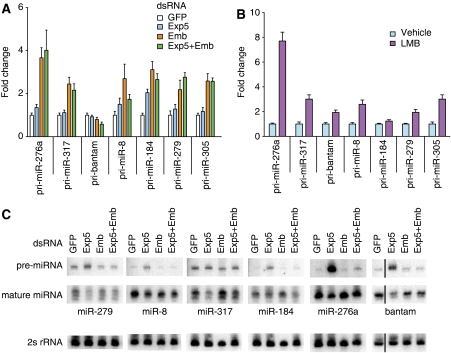
Accumulation of pri-miRNAs on depletion of Emb/Crm1 activity in Drosophila. (A) Depletion of Emb by RNAi increases the accumulation of several pri-miRNAs. Fold changes are relative to the cells soaked with control dsRNA (GFP) and normalized against pre-rp49. Knockdown efficiencies are depicted in Supplementary Figure S6. (B) Inhibition of Emb activity by LMB (25 ng/ml) confirms the increased accumulation of pri-miRNAs. Abundance of pri-miRNAs was analysed after 2-h treatment. (C) Northern blots using total RNA from cells exposed to dsRNA as indicated. The accumulation of pre-miRNAs on depletion of Exp5 is suppressed when Emb is depleted simultaneously. For bantam, non-adjacent lanes of a single autoradiograph are shown.

References

    1. Bethke A, Fielenbach N, Wang Z, Mangelsdorf DJ, Antebi A (2009) Nuclear hormone receptor regulation of microRNAs controls developmental progression. Science 324: 95–98 - PMC - PubMed
    1. Bohnsack MT, Czaplinski K, Gorlich D (2004) Exportin 5 is a RanGTP-dependent dsRNA-binding protein that mediates nuclear export of pre-miRNAs. RNA 10: 185–191 - PMC - PubMed
    1. Boulon S, Verheggen C, Jady BE, Girard C, Pescia C, Paul C, Ospina JK, Kiss T, Matera AG, Bordonné R, Bertrand E (2004) PHAX and CRM1 are required sequentially to transport U3 snoRNA to nucleoli. Mol Cell 16: 777–787 - PubMed
    1. Bracht J, Hunter S, Eachus R, Weeks P, Pasquinelli AE (2004) Trans-splicing and polyadenylation of let-7 microRNA primary transcripts. RNA 10: 1586–1594 - PMC - PubMed
    1. Cai X, Hagedorn CH, Cullen BR (2004) Human microRNAs are processed from capped, polyadenylated transcripts that can also function as mRNAs. RNA 10: 1957–1966 - PMC - PubMed

Publication types

MeSH terms

LinkOut - more resources