


Role of noninvasive ventilation in weaning from mechanical ventilation in patients of chronic obstructive pulmonary disease: an Indian experience
- PMID: 20436689
- PMCID: PMC2856148
- DOI: 10.4103/0972-5229.60173
Role of noninvasive ventilation in weaning from mechanical ventilation in patients of chronic obstructive pulmonary disease: an Indian experience
Abstract
Background: Endotracheal intubation and mechanical ventilation (MV) are often needed in patients of chronic obstructive pulmonary disease (COPD) with acute hypercapnic respiratory failure. The rate of weaning failure is high and prolonged MV increases intubation associated complications.
Objective: To evaluate the role of Noninvasive ventilation (NIV) in weaning patients of chronic obstructive pulmonary disease (COPD) from MV, after T piece trial failure.
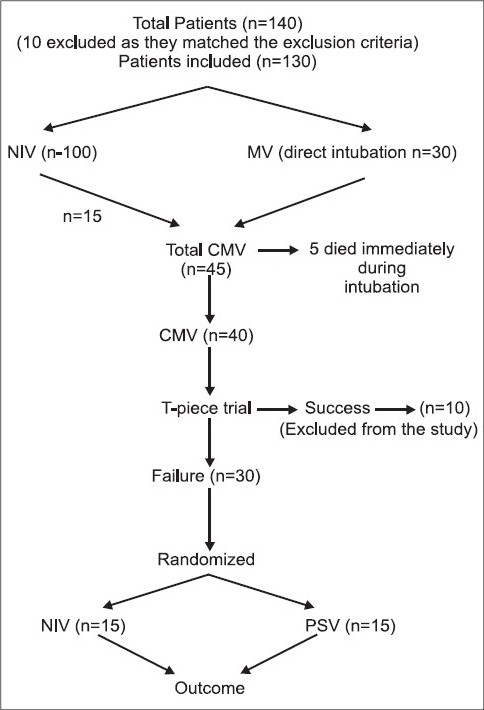
Design: A prospective, randomized, controlled study was conducted in a tertiary care centre. 30 patients of acute exacerbation of COPD with acute on chronic hypercapnic respiratory failure, who were mechanically ventilated, were included in the study A T-piece weaning trial was attempted once the patients achieved satisfactory clinical and biochemical parameters. After T-piece failure, defined as pH < 7.35, PaCO(2) >50 mmHg, PaO(2) <50 mmHg, HR >100/min, RR >35, patients were randomized to receive either NIV or PSV.
Results: Demography, severity of disease and clinical profiles were similar in both groups. No significant difference between the two groups in duration of MV (6.20 +/- 5.20 days vs. 7.47 +/- 6.38 days, P > 0.05), duration of weaning (35.17 +/- 16.98 and 47.05 +/- 20.98 hours, P > 0.05) or duration of ICU stay (8.47 +/- 4.79 and 10.80 +/- 5.28 days, P > 0.05) in Gp I and Gp II, respectively. Five patients developed VAP in the PSV group, where as only one patient had pneumonia in the NIV group. Lesser number of deaths in the NIV group at discharge from ICU (3 vs. 5 patients, respectively) and at 30 days (5 vs. 9 patients, respectively), it did not achieve statistical significance (P > 0.05).
Conclusion: NIV is as useful as PSV in weaning and can be better in weaning failure especially in COPD for earlier weaning, decrease ICU stay, complications and mortality.
Keywords: Chronic obstructive pulmonary disease; mechanical ventilation; noninvasive ventilation; respiratory failure; weaning.
Conflict of interest statement
References
-
- Macintyre NR. Weaning mechanical ventilatory support. In: Macintyre NR, Brasnon RD, editors. Mechnical ventilation. Philadelphia: Saunders; 2001. pp. 348–57.
-
- Pingleton SK. Complications associated with mechanical ventilation. In: Tobin MJ, editor. Principles and practice of mechanical ventilation. New York: McGraw Hill; 1994. pp. 775–92.
-
- Estebon, Frutos F, Jokin MJ. A comparison of four methods of weaning from mechanical ventilation. N Engl J Med. 1995;332:345–50. - PubMed
-
- Brochard L, Romos A, Beniso Comparison of these methods of gradual withdrawl from ventilatory support during weaning from mechanical ventilation. Am J Respir Crit Care Med. 1994;150:896–903. - PubMed
-
- Elliott MW. Noninvasive ventilation in acute exacerbation of COPD. In: Simmonds AK, editor. Noninvasive respiratory support. 2nd ed. London: Arnold; 2001. pp. 30–46.
LinkOut - more resources
Full Text Sources