. 2011 May;35(5):655-60.
doi: 10.1007/s00264-010-1020-x. Epub 2010 May 2.

Mid-term results of 155 patients treated with a collum femoris preserving (CFP) short stem prosthesis

Affiliations

Mid-term results of 155 patients treated with a collum femoris preserving (CFP) short stem prosthesis

Daniel Briem et al. Int Orthop. 2011 May.

Abstract

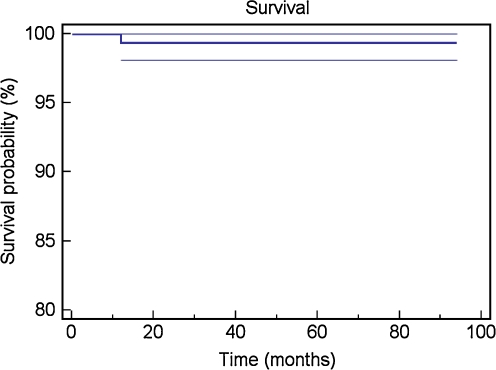
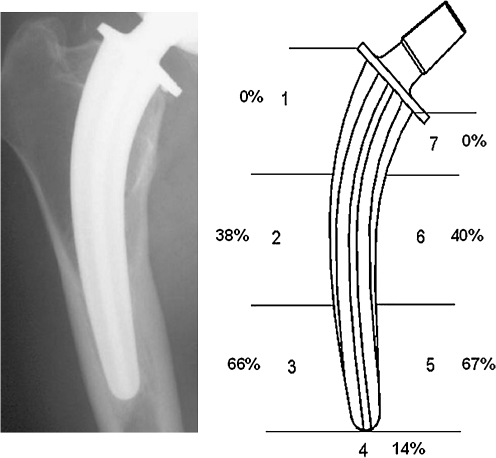
Short stem prostheses that preserve the femoral neck are becoming more and more popular. The CFP (collum femoris preserving) has been introduced especially for the treatment of younger patients. However, information about remodelling, complications and learning curve are thus far rare. We present a retrospective study of 155 patients (average age 59.3 ± 9.9 years) who underwent total hip replacement with the CFP prosthesis. Follow-up was obtained 74.3 ± 9.4 months postoperatively. The Harris hip score revealed excellent and good results in 96%. One stem had to be exchanged due to aseptic loosening revealing a survival rate of 99% and 100% for stem and cup, respectively. Radiological analysis showed typical patterns of remodelling with appearance of cortical thickening predominantly in the distal part of the prosthesis. Implant related revision rate was <1%, with further complication rate independent of the surgeon's individual experience. With regard to outcome, survivorship and complication rate, the medium-term results of the CFP prosthesis are promising.


Figures
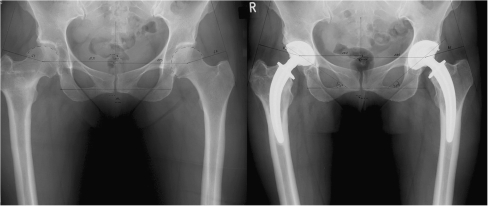
Fig. 1
Fig. 1
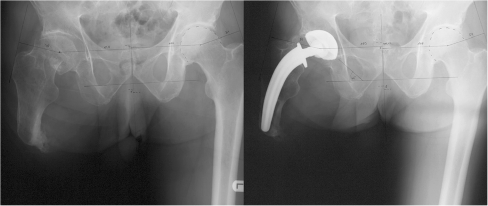
Radiographs of a 58-year-old female patient with dysplasia arthrosis of the right hip and correction osteotomy in adolescence: preoperative (left) and 79 months after surgery (right)
Fig. 2
Fig. 2
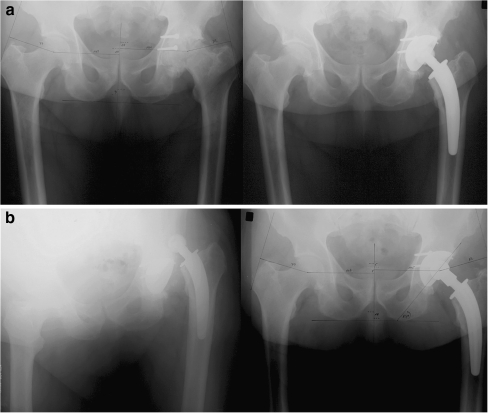
Hip replacement after acetabular fracture care (a) with early postoperative luxation (b, left hand side) due to relatively deep femoral neck osteotomy leading to revision and exchange of the head component (medium to extra long, b, right hand side)
Fig. 3
Fig. 3
Kaplan-Meier survival curve including 95% confidence interval with time and probability of survivorship regarding the CFP (collum femoris preserving) stem
Fig. 4
Fig. 4
Occurrence of osteosclerotic femoral bone transformation distributed along Gruen zones
Fig. 5
Fig. 5
Implantation of the CFP (collum femoris preserving) prosthesis in a 58-year-old male patient with femoral neck fracture 36 years after traumatic thigh amputation

References

    1. Pipino F, Molfetta L. Femoral neck preservation in total hip replacement. Ital J Orthop Traumatol. 1993;19(1):5–12. - PubMed
    1. Stukenborg-Colsman C. Femoral neck prostheses. Orthopaede. 2007;36:347–352. doi: 10.1007/s00132-007-1070-y. - DOI - PubMed
    1. Decking R, Rokahr C, Zurstegge M, Simon U, Decking J. Maintenance of bone mineral density after implantation of a femoral neck hip prosthesis. BMC Musculoskelet Disord. 2008;9:17–24. doi: 10.1186/1471-2474-9-17. - DOI - PMC - PubMed
    1. Stea S, Bordini B, Clerico M, Petropulacos K, Toni A. First hip arthroplasty register in Italy: 55,000 cases and 7 year follow-up. Int Orthop. 2009;33(2):339–346. doi: 10.1007/s00264-007-0465-z. - DOI - PMC - PubMed
    1. Gill IR, Gill K, Jayasekera N, Miller J (2008) Medium term results of the collum femoris preserving hydroxyapatite coated total hip replacement. Hip Int 18(2):75–80 - PubMed

Publication types

MeSH terms