


Perceptual cues in nonverbal vocal expressions of emotion
- PMID: 20437296
- PMCID: PMC4178283
- DOI: 10.1080/17470211003721642
Perceptual cues in nonverbal vocal expressions of emotion
Abstract
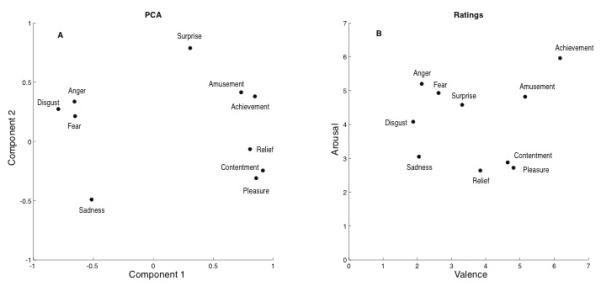
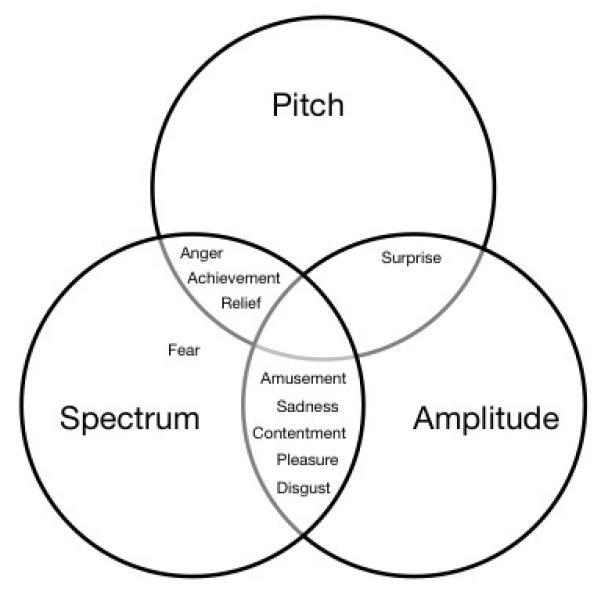
Work on facial expressions of emotions (Calder, Burton, Miller, Young, & Akamatsu, [2001]) and emotionally inflected speech (Banse & Scherer, [1996]) has successfully delineated some of the physical properties that underlie emotion recognition. To identify the acoustic cues used in the perception of nonverbal emotional expressions like laugher and screams, an investigation was conducted into vocal expressions of emotion, using nonverbal vocal analogues of the "basic" emotions (anger, fear, disgust, sadness, and surprise; Ekman & Friesen, [1971]; Scott et al., [1997]), and of positive affective states (Ekman, [1992], [2003]; Sauter & Scott, [2007]). First, the emotional stimuli were categorized and rated to establish that listeners could identify and rate the sounds reliably and to provide confusion matrices. A principal components analysis of the rating data yielded two underlying dimensions, correlating with the perceived valence and arousal of the sounds. Second, acoustic properties of the amplitude, pitch, and spectral profile of the stimuli were measured. A discriminant analysis procedure established that these acoustic measures provided sufficient discrimination between expressions of emotional categories to permit accurate statistical classification. Multiple linear regressions with participants' subjective ratings of the acoustic stimuli showed that all classes of emotional ratings could be predicted by some combination of acoustic measures and that most emotion ratings were predicted by different constellations of acoustic features. The results demonstrate that, similarly to affective signals in facial expressions and emotionally inflected speech, the perceived emotional character of affective vocalizations can be predicted on the basis of their physical features.
Figures
References
-
- Atkinson AP, Tunstall ML, Dittrich WH. Evidence for distinct contributions of form and motion information to the recognition of emotions from body gestures. Cognition. 2007;104:59–72. - PubMed
-
- Atkinson AP, Dittrich WH, Gemmell AJ, Young AW. Emotion perception from dynamic and static body expressions in point-light and full-light displays. Perception. 2004;33:717–46. - PubMed
-
- Bachorowski JA. Vocal expression and perception of emotion. Current Directions in Psychological Science. 1999;8:53–57.
-
- Bachorowski JA, Braaten EB. Emotional intensity: Measurement and theoretical implications. Personality and Individual Differences. 1994;17:191–199.
-
- Bachorowski JA, Owren MJ. Vocal expression of emotion: Acoustic properties of speech are associated with emotional intensity and context. Psychological Science. 1995;6:219–224.
Publication types
MeSH terms
Grants and funding
LinkOut - more resources
Full Text Sources
