Compassion: an evolutionary analysis and empirical review
- PMID: 20438142
- PMCID: PMC2864937
- DOI: 10.1037/a0018807
Compassion: an evolutionary analysis and empirical review
Abstract
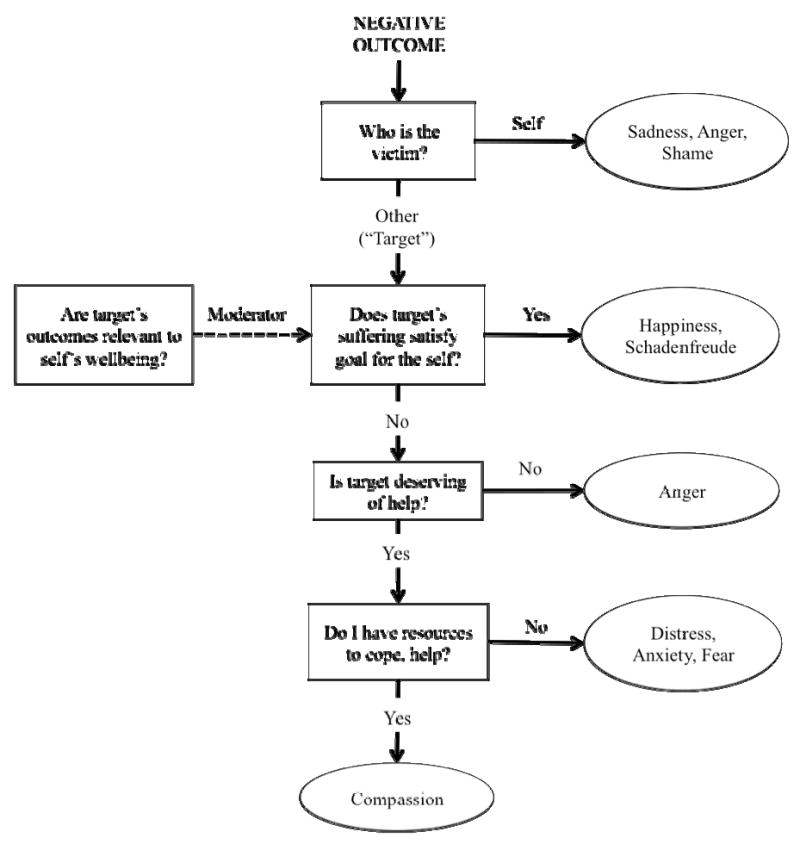
What is compassion? And how did it evolve? In this review, we integrate 3 evolutionary arguments that converge on the hypothesis that compassion evolved as a distinct affective experience whose primary function is to facilitate cooperation and protection of the weak and those who suffer. Our empirical review reveals compassion to have distinct appraisal processes attuned to undeserved suffering; distinct signaling behavior related to caregiving patterns of touch, posture, and vocalization; and a phenomenological experience and physiological response that orients the individual to social approach. This response profile of compassion differs from those of distress, sadness, and love, suggesting that compassion is indeed a distinct emotion. We conclude by considering how compassion shapes moral judgment and action, how it varies across different cultures, and how it may engage specific patterns of neural activation, as well as emerging directions of research.
(c) 2010 APA, all rights reserved.
Figures
References
-
- Adams RB, Kleck RE. Effects of direct and averted gaze on the perception of facially communicated emotion. Emotion. 2005;5:3–11. - PubMed
-
- Adolphs R, Spezio M. Role of the amygdala in processing visual social stimuli. Progress in Brain Research. 2006;156:363–378. - PubMed
-
- Aron A, Aron EN, Smollan D. Inclusion of other in the self scale and the structure of interpersonal closeness. Journal of Personality and Social Psychology. 1992;63:596–612.
-
- Armstrong K. The great transformation: The beginning of our religious traditions. New York: Alfred A. Knopf; 2006.