


doi: 10.1093/nar/gkq321.
Epub 2010 May 3.
ALTER: program-oriented conversion of DNA and protein alignments
Affiliations
- PMID: 20439312
- PMCID: PMC2896128
- DOI: 10.1093/nar/gkq321
Item in Clipboard
ALTER: program-oriented conversion of DNA and protein alignments
Nucleic Acids Res.
2010 Jul.
Abstract
ALTER is an open web-based tool to transform between different multiple sequence alignment formats. The originality of ALTER lies in the fact that it focuses on the specifications of mainstream alignment and analysis programs rather than on the conversion among more or less specific formats. In addition, ALTER is capable of identify and remove identical sequences during the transformation process. Besides its user-friendly environment, ALTER allows access to its functionalities in a programmatic way through a Representational State Transfer web service. ALTER's front-end and its API are freely available at http://sing.ei.uvigo.es/ALTER/ and http://sing.ei.uvigo.es/ALTER/api/, respectively.
Figures
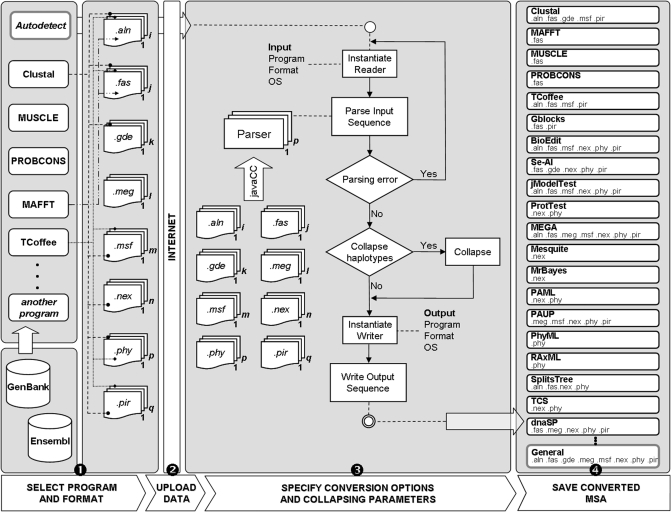
Schematic ALTER workflow. The user can select between different input alignment programs and formats, and obtain a MSA specifically formatted for a particular program.
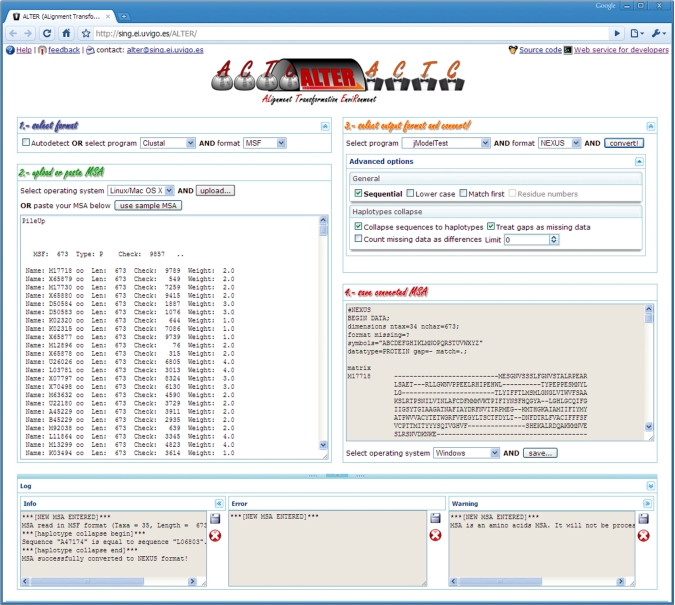
Example of a MSA conversion in ALTER. The ‘Info panel’ in the log area shows information related with the process carried out. Help, support for feedback and contact information options are available from the upper left area. Source code and a description of web services are available from the upper right area.
References
-
- Posada D, editor. Bioinformatics for DNA sequence analysis. New York, NY, USA: Humana Press; 2009. - PubMed
-
- Gouy M, Guindon S, Gascuel O. SeaView version 4: a multiplatform graphical user interface for sequence alignment and phylogenetic tree building. Mol. Biol. Evol. 2010;27:221–224. - PubMed
-
- Larkin MA, Blackshields G, Brown NP, Chenna R, McGettigan PA, McWilliam H, Valentin F, Wallace IM, Wilm A, Lopez R, et al. Clustal W and Clustal X version 2.0. Bioinformatics. 2007;23:2947–2948. - PubMed
