. 2010 Jul;78(7):3007-18.
doi: 10.1128/IAI.00813-09. Epub 2010 May 3.

Role of trehalose biosynthesis in Aspergillus fumigatus development, stress response, and virulence

Affiliations

Role of trehalose biosynthesis in Aspergillus fumigatus development, stress response, and virulence

Nadia Al-Bader et al. Infect Immun. 2010 Jul.

Abstract

Aspergillus fumigatus is a pathogenic mold which causes invasive, often fatal, pulmonary disease in immunocompromised individuals. Recently, proteins involved in the biosynthesis of trehalose have been linked with virulence in other pathogenic fungi. We found that the trehalose content increased during the developmental life cycle of A. fumigatus, throughout which putative trehalose synthase genes tpsA and tpsB were significantly expressed. The trehalose content of A. fumigatus hyphae also increased after heat shock but not in response to other stressors. This increase in trehalose directly correlated with an increase in expression of tpsB but not tpsA. However, deletion of both tpsA and tpsB was required to block trehalose accumulation during development and heat shock. The DeltatpsAB double mutant had delayed germination at 37 degrees C, suggesting a developmental defect. At 50 degrees C, the majority of DeltatpsAB spores were found to be nonviable, and those that were viable had severely delayed germination, growth, and subsequent sporulation. DeltatpsAB spores were also susceptible to oxidative stress. Surprisingly, the DeltatpsAB double mutant was hypervirulent in a murine model of invasive aspergillosis, and this increased virulence was associated with alterations in the cell wall and resistance to macrophage phagocytosis. Thus, while trehalose biosynthesis is required for a number of biological processes that both promote and inhibit virulence, in A. fumigatus the predominant effect is a reduction in pathogenicity. This finding contrasts sharply with those for other fungi, in which trehalose biosynthesis acts to enhance virulence.


Figures
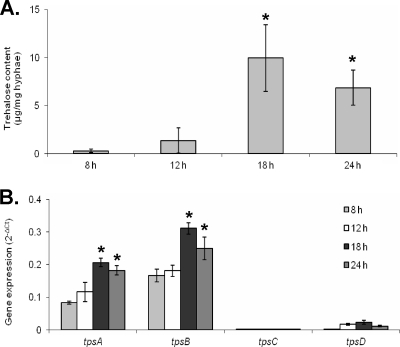
FIG. 1.
FIG. 1.
Trehalose levels increase in mature hyphae and correlate directly with expression of tpsA and tpsB. Developmental time courses were performed with wild-type A. fumigatus grown in YEPD medium. Samples of hyphae were isolated at the indicated time points. (A) Trehalose content of hyphae at the indicated time points. (B) RNA expression of trehalose synthase genes during development as assessed by real-time RT-PCR. Data were normalized to TEF1 expression. All results are expressed as mean ± standard error and represent at least three different experiments performed on different days. *, statistically significant difference relative to 8-h hyphae (P < 0.05).
FIG. 2.
FIG. 2.
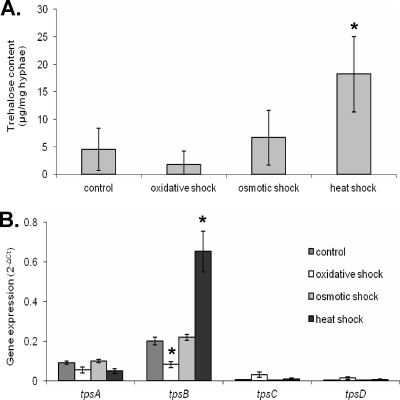
The trehalose content of hyphae increases in response to heat shock and directly correlates with an increase in expression of tpsB. Wild-type hyphae were grown for 12 h and then exposed to shock with either 100 mM H2O2, 0.5 M NaCl, or at 50°C for 1 h. (A) Trehalose content of hyphae at the indicated time points. (B) RNA expression of trehalose synthase genes during development as assessed by real-time RT-PCR. Data were normalized to TEF1 expression. All results are expressed as mean ± standard error and represent at least three different experiments performed on different days. *, statistically significant difference relative to control hyphae (P < 0.05).
FIG. 3.
FIG. 3.
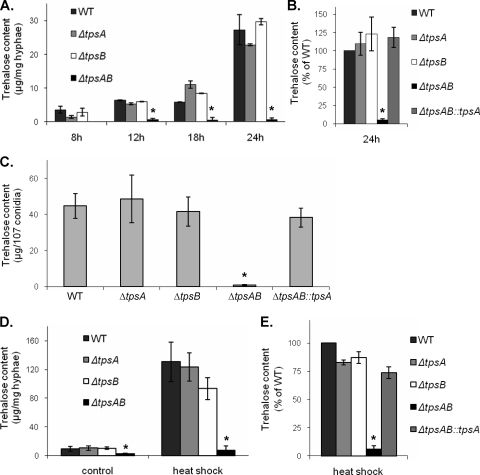
Trehalose production is abrogated in ΔtpsAB hyphae and conidia. WT, wild type. (A) Trehalose content of hyphae isolated from the indicated strains during a developmental time course. Note that data from the ΔtpsAB mutant are omitted at 8 h since this organism had not produced hyphae at this time point. (B) Complementation of the ΔtpsAB mutant restores trehalose content during development. (C) Trehalose content of conidia of the indicated strains. (D) The trehalose content was measured in hyphae grown for 12 h and then incubated at 50°C for 1 h. Control hyphae were incubated at 37°C for 1 h. To compensate for the germination delay of the ΔtpsAB mutant, hyphae were pregrown for 15 h before heat shock. (E) Complementation of the ΔtpsAB mutant restores trehalose content during heat shock. All experiments were repeated in triplicate on three separate days and are presented as mean ± standard error. *, statistically significant difference (P < 0.05) compared to the wild-type strain at any time point.
FIG. 4.
FIG. 4.
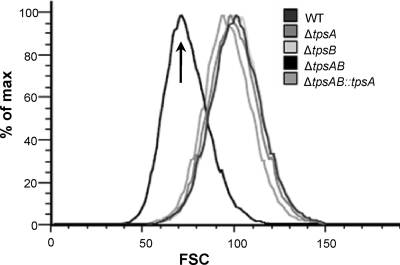
Conidia from the ΔtpsAB mutant are smaller than those from other strains. Conidial size of the indicated strains was assessed by flow cytometry. About 106 conidia of each strain was chemically fixed for analysis, and the estimated volume of conidia was measured by forward scatter (FSC) using the wild-type strain as a reference.
FIG. 5.
FIG. 5.
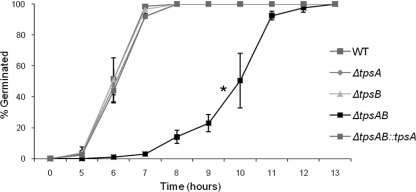
The ΔtpsAB mutant is delayed in germination at 37°C. Germination of wild-type, ΔtpsA, ΔtpsB, ΔtpsAB, and ΔtpsAB::tpsA conidia was monitored hourly in YEPD medium. For each time point, 100 cells were scored for each strain and percent germination was assessed. Data represent the means from two independent experiments ± standard error.
FIG. 6.
FIG. 6.
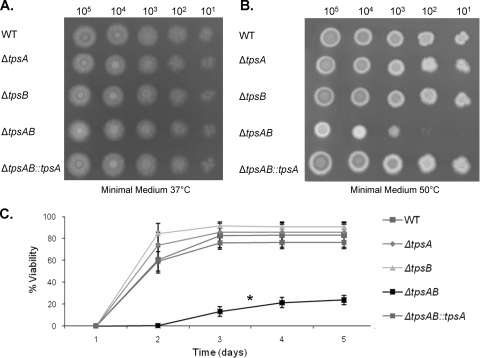
The ΔtpsAB mutant is delayed in growth and development and significantly less viable at 50°C. Serial dilutions of conidia of the indicated strains were plated on Aspergillus minimal glucose medium and grown at 37°C or 50°C. (A) Photograph of colonial morphology of strains grown for 2 days at 37°C. (B) Photograph of colonial morphology of strains grown for 3 days at 50°C. (C) Conidia of the indicated strains were plated on Aspergillus minimal glucose medium at 37°C and at 50°C, and fungal colonies were counted daily for 5 days. The percent viability was measured by expressing counts at 50°C as a percentage of counts at 37°C for the same strain. Experiments were repeated in triplicate on three independent occasions. Data are presented as the mean ± standard error.
FIG. 7.
FIG. 7.
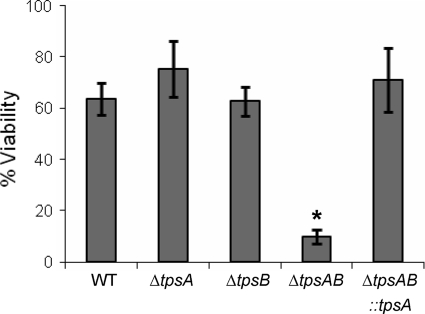
The ΔtpsAB mutant is highly susceptible to oxidative shock. Swollen conidia of the indicated strains were exposed to 100 mM H2O2 for 10 min and then recovered on Aspergillus minimal glucose medium. Fungal colonies were then enumerated after 2 days of incubation. Viability was expressed as the mean number of fungal colonies for each strain on plates inoculated with conidia exposed to oxidative shock as a percentage of those on plates inoculated with untreated conidia. Data are presented as the mean ± standard error. All experiments were repeated in triplicate on three separate occasions. *, statistically significant (P < 0.05) difference in survival relative to the wild-type strain.
FIG. 8.
FIG. 8.
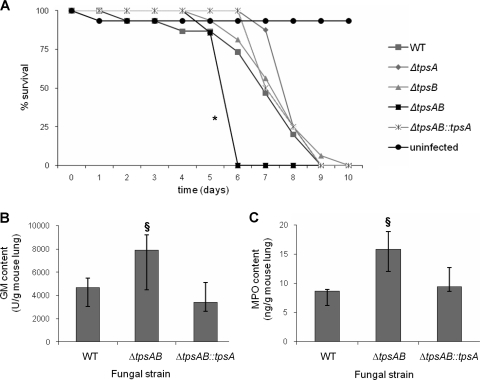
The ΔtpsAB mutant is hypervirulent in a murine model of invasive aspergillosis. (A) Survival of mice infected with the indicated strains. Mice were immunosuppressed with cortisone acetate and infected intranasally with A. fumigatus wild-type, ΔtpsA, ΔtpsB, ΔtpsAB and ΔtpsAB::tpsA, strains. Eight infected mice per strain were monitored for survival relative to a group of eight uninfected mice. Data represent combined results from two independent experiments. *, statistically significant difference (P < 0.05) relative to the wild-type and ΔtpsAB::tpsA strains using the log rank test. (B and C) The concentrations of galactomannan (GM) (B) and myeloperoxidase (MPO) (C) were measured from the lungs of mice infected with A. fumigatus wild-type, ΔtpsAB, and ΔtpsAB::tpsA strains after 4 days of infection. Results represent the median ± interquartile range for five to eight mice per strain. §, statistically significant difference (P < 0.05) relative to the wild-type strain using the Wilcoxon rank sum test.
FIG. 9.
FIG. 9.
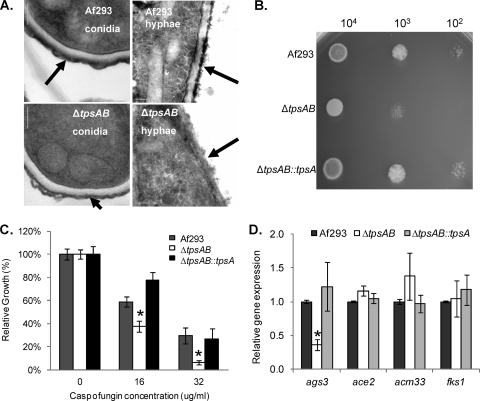
Either tpsA or tpsB is required for normal cell wall architecture in A. fumigatus. (A) Transmission electron microscopy of conidia and hyphae of the A. fumigatus strains demonstrates a loss of the electron-dense outer layer (arrows) in both conidia and hyphae of the ΔtpsAB mutant. Scale bars indicate 200 nm. (B) Tenfold serial dilutions of Af293, ΔtpsAB, and ΔtpsAB::tpsA conidia were spot inoculated on plates of Aspergillus minimal glucose medium containing 75 μg/ml of calcofluor white. Photographs of each plate were taken after strains were grown for 2 days at 37°C. (C) Relative growth of individual strains in the presence of various concentrations of caspofungin. (D) RNA expression of cell wall-active genes as assessed by real-time RT-PCR. Data were normalized to TEF1 expression. All results are expressed as mean ± standard error and represent at least three different experiments performed on different days. *, statistically significant difference relative to wild-type strain Af293 (P < 0.05).
FIG. 10.
FIG. 10.
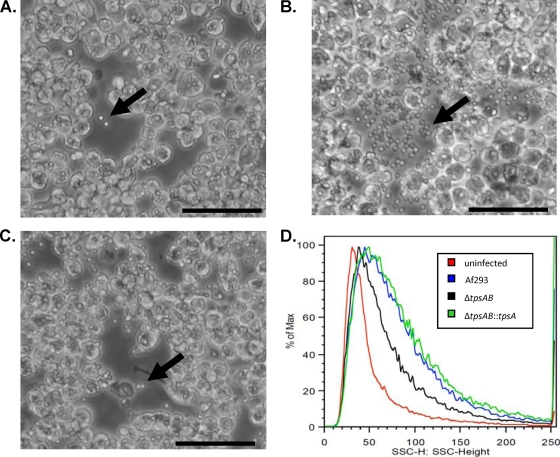
Either tpsA or tpsB is required for normal phagocytosis by macrophages. Cultures of RAW264.7 cells were infected with conidia of the indicated A. fumigatus strains and incubated for 4 h. (A to C) Photomicrographs of RAW264.7 cultures infected with conidia of wild-type Af293 (A) or the ΔtpsAB (B) or ΔtpsAB::tpsA (C) strain. Arrows indicated nonadherent, unphagocytosed, extracellular conidia. (D) Flow cytometric analysis of macrophage cells infected as for panels A to C. Side-scatter kinetics were determined as a measure of the number of cell-associated conidia. Bars, 50 μm.

References

    1. Alvarez-Peral, F. J., O. Zaragoza, Y. Pedreno, and J. C. Arguelles. 2002. Protective role of trehalose during severe oxidative stress caused by hydrogen peroxide and the adaptive oxidative stress response in Candida albicans. Microbiology 148:2599-2606. - PubMed
    1. Antachopoulos, C., J. Meletiadis, E. Roilides, T. Sein, and T. J. Walsh. 2006. Rapid susceptibility testing of medically important zygomycetes by XTT assay. J. Clin. Microbiol. 44:553-560. - PMC - PubMed
    1. Antachopoulos, C., J. Meletiadis, T. Sein, E. Roilides, and T. J. Walsh. 2008. Comparative in vitro pharmacodynamics of caspofungin, micafungin, and anidulafungin against germinated and nongerminated Aspergillus conidia. Antimicrob. Agents Chemother. 52:321-328. - PMC - PubMed
    1. Antachopoulos, C., J. Meletiadis, T. Sein, E. Roilides, and T. J. Walsh. 2007. Concentration-dependent effects of caspofungin on the metabolic activity of Aspergillus species. Antimicrob. Agents Chemother. 51:881-887. - PMC - PubMed
    1. Beffa, T., F. Staib, J. Lott Fischer, P. F. Lyon, P. Gumowski, O. E. Marfenina, S. Dunoyer-Geindre, F. Georgen, R. Roch-Susuki, L. Gallaz, and J. P. Latge. 1998. Mycological control and surveillance of biological waste and compost. Med. Mycol. 36(Suppl. 1):137-145. - PubMed

Publication types

MeSH terms

LinkOut - more resources