


Low 25-hydroxyvitamin D levels in adolescents: race, season, adiposity, physical activity, and fitness
- PMID: 20439594
- PMCID: PMC3935324
- DOI: 10.1542/peds.2009-2055
Low 25-hydroxyvitamin D levels in adolescents: race, season, adiposity, physical activity, and fitness
Abstract
Objectives: The objectives were to characterize the vitamin D status of black and white adolescents residing in the southeastern United States (latitude: approximately 33 degrees N) and to investigate relationships with adiposity.
Methods: Plasma 25-hydroxyvitamin D levels were measured with liquid chromatography-tandem mass spectroscopy for 559 adolescents 14 to 18 years of age (45% black and 49% female). Fat tissues, physical activity, and cardiovascular fitness also were measured.
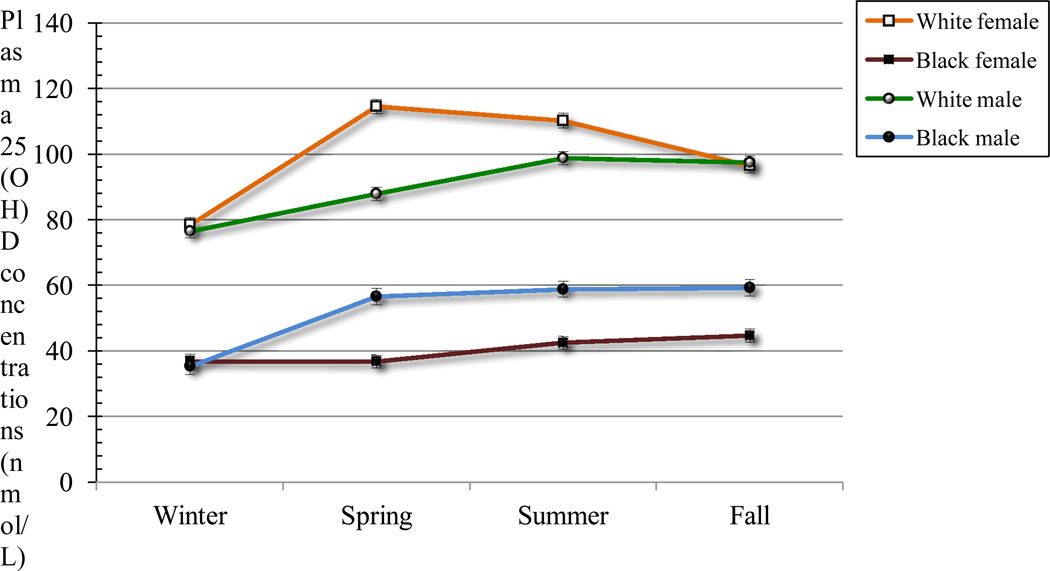
Results: The overall prevalences of vitamin D insufficiency (<75 nmol/L) and deficiency (< or = 50 nmol/L) were 56.4% and 28.8%, respectively. Black versus white subjects had significantly lower plasma 25-hydroxyvitamin D levels in every season (winter, 35.9 + or - 2.5 vs 77.4 + or - 2.7 nmol/L; spring, 46.4 + or - 3.5 vs 101.3 + or - 3.5 nmol/L; summer, 50.7 + or - 4.0 vs 104.3 + or - 4.0 nmol/L; autumn, 54.4 + or - 4.0 vs 96.8 + or - 2.7 nmol/L). With adjustment for age, gender, race, season, height, and sexual maturation, there were significant inverse correlations between 25-hydroxyvitamin D levels and all adiposity measurements, including BMI percentile (P = .02), waist circumference (P < .01), total fat mass (P < .01), percentage of body fat (P < .01), visceral adipose tissue (P = .015), and subcutaneous abdominal adipose tissue (P = .039). There were significant positive associations between 25-hydroxyvitamin D levels and vigorous physical activity (P < .01) and cardiovascular fitness (P = .025).
Conclusions: Low vitamin D status is prevalent among adolescents living in a year-round sunny climate, particularly among black youths. The relationships between 25-hydroxyvitamin D levels, adiposity, physical activity, and fitness seem to be present in adolescence.
Conflict of interest statement
Conflict of interest: None
Figures
References
-
- Rovner AJ, O'Brien KO. Hypovitaminosis D among healthy children in the United States: a review of the current evidence. Arch Pediatr Adolesc Med. 2008;162(6):513–519. - PubMed
-
- Looker AC. Body fat and vitamin D status in black versus white women. J Clin Endocrinol Metab. 2005;90(2):635–640. - PubMed
-
- Malabanan A, Veronikis IE, Holick MF. Redefining vitamin D insufficiency. Lancet. 1998;351(9105):805–806. - PubMed
-
- Bischoff-Ferrari HA, Giovannucci E, Willett WC, Dietrich T, Dawson-Hughes B. Estimation of optimal serum concentrations of 25-hydroxyvitamin D for multiple health outcomes. Am J Clin Nutr. 2006;84(1):18–28. - PubMed
