


Rituximab maintenance treatment of relapsed/resistant follicular non-Hodgkin's lymphoma: long-term outcome of the EORTC 20981 phase III randomized intergroup study
- PMID: 20439641
- PMCID: PMC2903319
- DOI: 10.1200/JCO.2009.26.5827
Rituximab maintenance treatment of relapsed/resistant follicular non-Hodgkin's lymphoma: long-term outcome of the EORTC 20981 phase III randomized intergroup study
Abstract
Purpose: In 2006, we published the results of the European Organisation for Research and Treatment of Cancer phase III trial EORTC 20981 on the role of rituximab in remission induction and maintenance treatment of relapsed/resistant follicular lymphoma (FL). At that time, the median follow-up for the maintenance phase was 33 months. Now, we report the long-term outcome of maintenance treatment, with a median follow-up of 6 years.
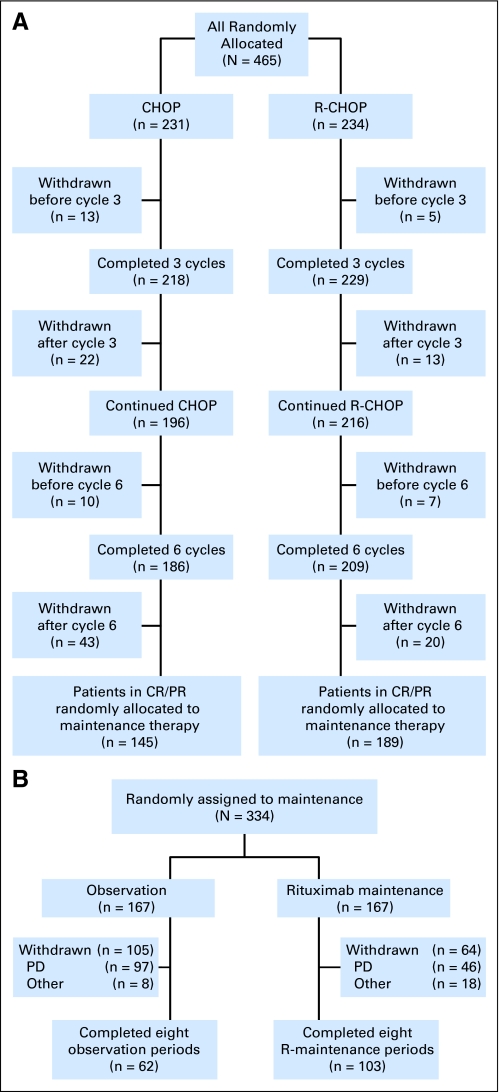
Patients and methods: Overall, 465 patients were randomly assigned to induction with either six cycles of cyclophosphamide, doxorubicin, vincristine, prednisone (CHOP) or rituximab plus CHOP (R-CHOP). Those in complete remission or partial remission after induction (n = 334) were randomly assigned to maintenance treatment with rituximab (375 mg/m(2) intravenously once every 3 months) or observation.
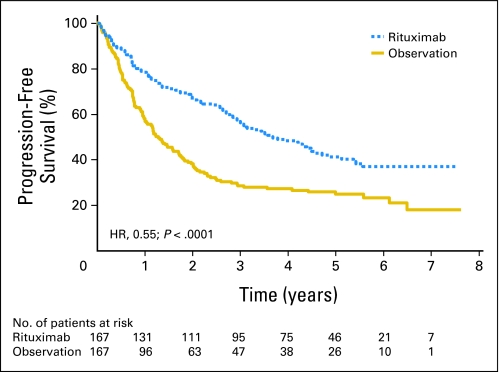
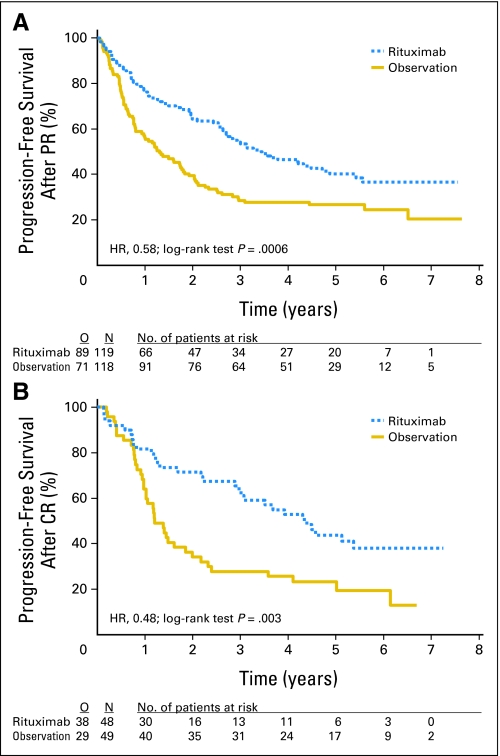
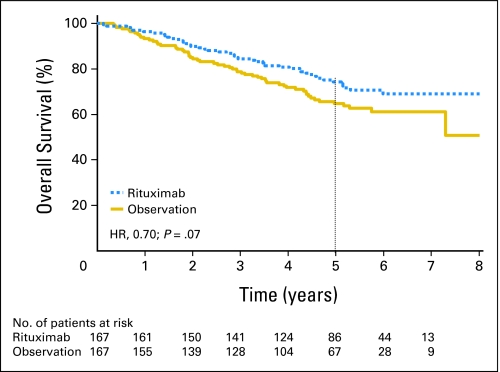
Results: Rituximab maintenance significantly improved progression-free survival (PFS) compared with observation (median, 3.7 years v 1.3 years; P < .001; hazard ratio [HR], 0.55), both after CHOP induction (P < .001; HR, 0.37) and R-CHOP (P = .003; HR, 0.69). The 5-year overall survival (OS) was 74% in the rituximab maintenance arm, and it was 64% in the observation arm (P = .07). After progression, a rituximab-containing salvage therapy was given to 59% of patients treated with CHOP followed by observation, compared with 26% after R-CHOP followed by rituximab maintenance. Rituximab maintenance was associated with a significant increase in grades 3 to 4 infections: 9.7% v 2.4% (P = .01).
Conclusion: With long-term follow-up, we confirm the superior PFS with rituximab maintenance in relapsed/resistant FL. The improvement of OS did not reach statistical significance, possibly because of the unbalanced use of rituximab in post-protocol salvage treatment.
Conflict of interest statement
Authors' disclosures of potential conflicts of interest and author contributions are found at the end of this article.
Figures

References
-
- Hiddemann W, Kneba M, Dreyling M, et al. Frontline therapy with rituximab added to the combination of cyclophosphamide, doxorubicin, vincristine, and prednisone (CHOP) significantly improves the outcome for patients with advanced-stage follicular lymphoma compared with therapy with CHOP alone: Results of a prospective randomized study of the German Low-Grade Lymphoma Study Group. Blood. 2005;106:3725–3732. - PubMed
-
- Marcus R, Imrie K, Belch A, et al. CVP chemotherapy plus rituximab compared with CVP as first-line treatment for advanced follicular lymphoma. Blood. 2005;105:1417–1423. - PubMed
-
- Salles G, Mounier N, de Guibert S, et al. Rituximab combined with chemotherapy and interferon in follicular lymphoma patients: Results of the GELA-GOELAMS FL2000 study. Blood. 2008;112:4824–4831. - PubMed
-
- Herold M, Haas A, Srock S, et al. Rituximab added to first-line mitoxantrone, chlorambucil, and prednisolone chemotherapy followed by interferon maintenance prolongs survival in patients with advanced follicular lymphoma: An East German Study Group Hematology and Oncology Study. J Clin Oncol. 2007;25:1986–1992. - PubMed
-
- van Oers MH. Rituximab maintenance therapy: A step forward in follicular lymphoma. Haematologica. 2007;92:826–833. - PubMed
Publication types
MeSH terms
Substances
Supplementary concepts
Grants and funding
LinkOut - more resources
Full Text Sources
Other Literature Sources
Medical
Research Materials
