


Expression quantitative trait loci: replication, tissue- and sex-specificity in mice
- PMID: 20439777
- PMCID: PMC2907192
- DOI: 10.1534/genetics.110.116087
Expression quantitative trait loci: replication, tissue- and sex-specificity in mice
Abstract
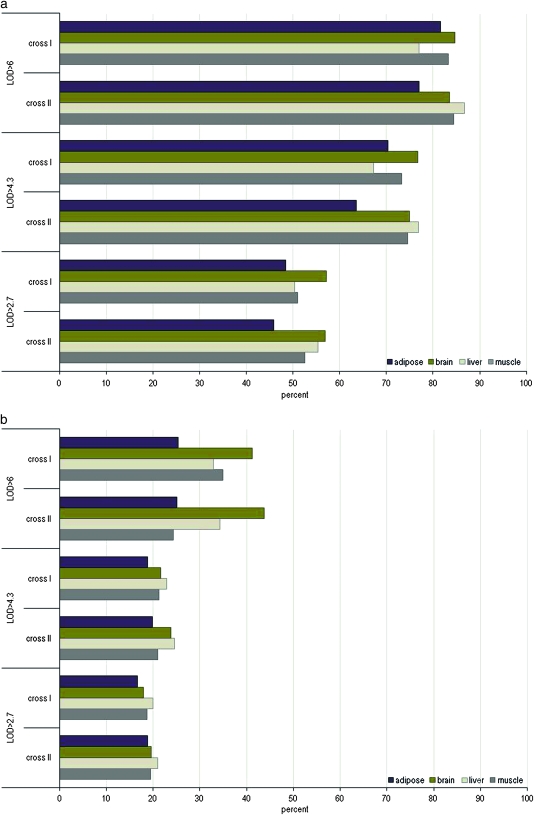
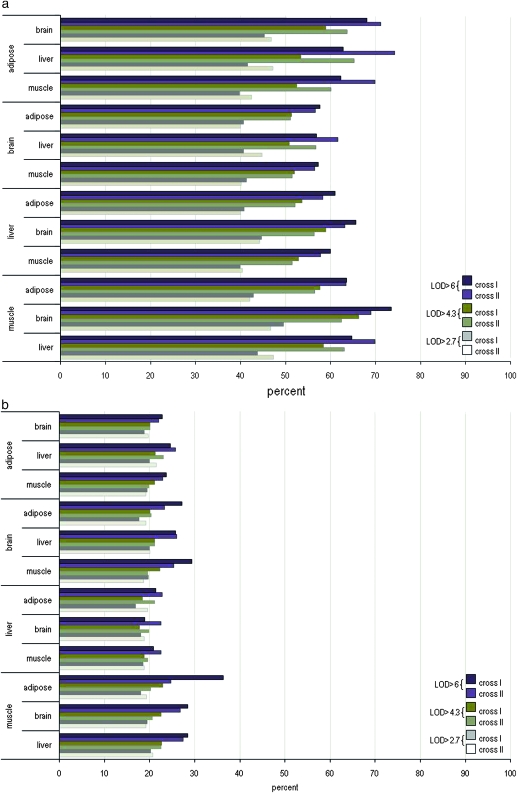
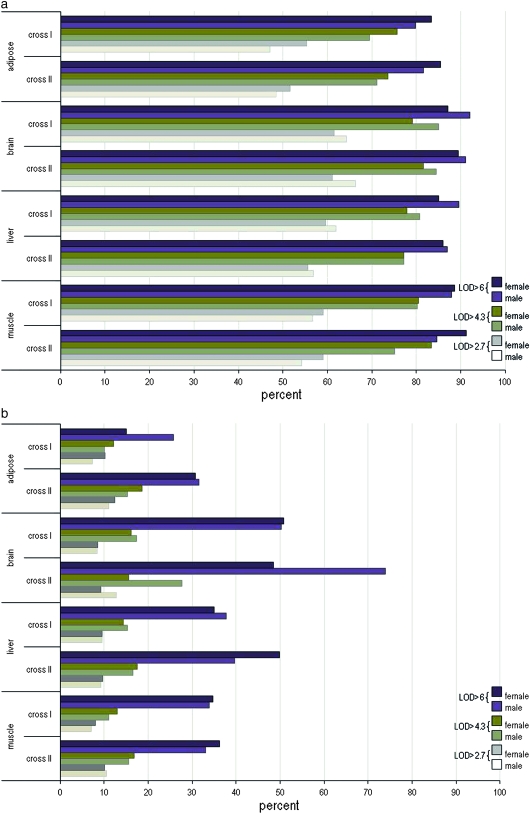
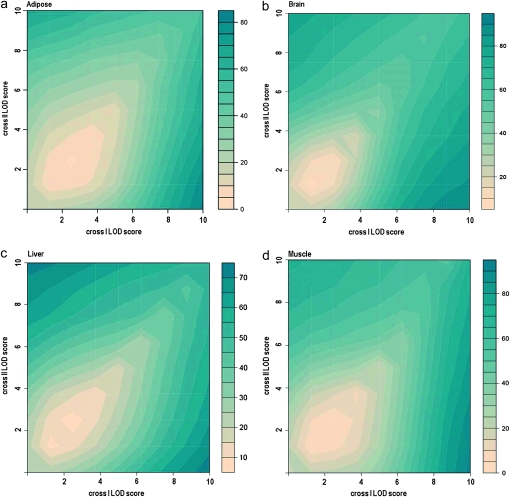
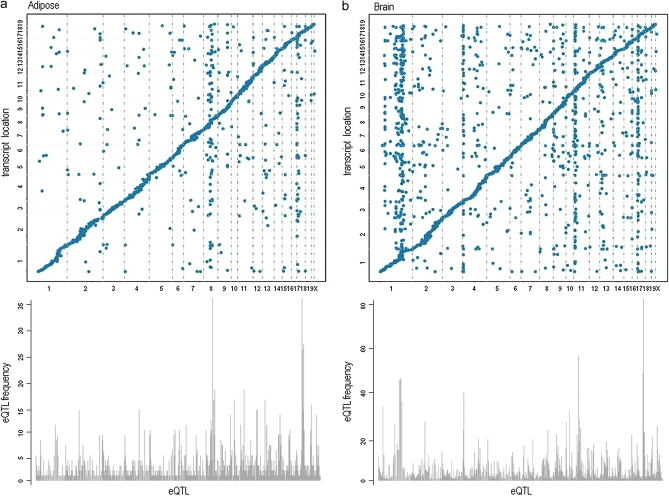
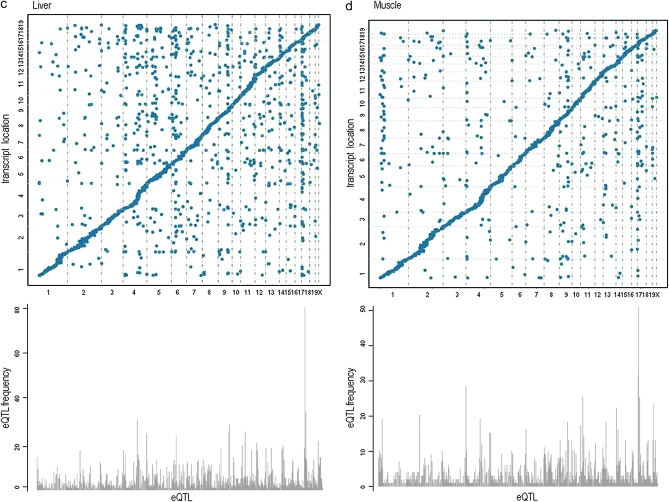
By treating the transcript abundance as a quantitative trait, gene expression can be mapped to local or distant genomic regions relative to the gene encoding the transcript. Local expression quantitative trait loci (eQTL) generally act in cis (that is, control the expression of only the contiguous structural gene), whereas distal eQTL act in trans. Distal eQTL are more difficult to identify with certainty due to the fact that significant thresholds are very high since all regions of the genome must be tested, and confounding factors such as batch effects can produce false positives. Here, we compare findings from two large genetic crosses between mouse strains C3H/HeJ and C57BL/6J to evaluate the reliability of distal eQTL detection, including "hotspots" influencing the expression of multiple genes in trans. We found that >63% of local eQTL and >18% of distal eQTL were replicable at a threshold of LOD > 4.3 between crosses and 76% of local and >24% of distal eQTL at a threshold of LOD > 6. Additionally, at LOD > 4.3 four tissues studied (adipose, brain, liver, and muscle) exhibited >50% preservation of local eQTL and >17% preservation of distal eQTL. We observed replicated distal eQTL hotspots between the crosses on chromosomes 9 and 17. Finally, >69% of local eQTL and >10% of distal eQTL were preserved in most tissues between sexes. We conclude that most local eQTL are highly replicable between mouse crosses, tissues, and sex as compared to distal eQTL, which exhibited modest replicability.
Figures
References
-
- Bystrykh, L., E. Weersing et al., 2005. Uncovering regulatory pathways that affect hematopoietic stem cell function using ‘genetical genomics’. Nat. Genet. 37(3): 225–232. - PubMed
-
- Davenport, E. L., G. J. Morgan and F. E. Davies, 2008. Untangling the unfolded protein response. Cell Cycle 7(7): 865–869. - PubMed
Publication types
MeSH terms
Grants and funding
LinkOut - more resources
Full Text Sources
Molecular Biology Databases
