


Plasma copeptin and the risk of diabetes mellitus
- PMID: 20439785
- PMCID: PMC3763235
- DOI: 10.1161/CIRCULATIONAHA.109.909663
Plasma copeptin and the risk of diabetes mellitus
Abstract
Background: Animal studies suggest that the arginine vasopressin system may play a role in glucose metabolism, but data from humans are limited.
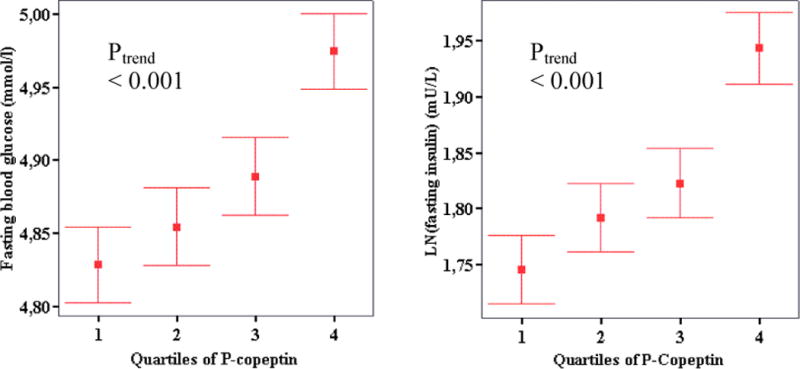
Methods and results: We analyzed plasma copeptin (copeptin), a stable C-terminal fragment of the arginine vasopressin prohormone. Using baseline and longitudinal data from a Swedish population-based sample (n=4742; mean age, 58 years; 60% women) and multivariable logistic regression, we examined the association of increasing quartiles of copeptin (lowest quartile as reference) with prevalent diabetes mellitus at baseline, insulin resistance (top quartile of fasting plasma insulin among nondiabetic subjects), and incident diabetes mellitus on long-term follow-up. New-onset diabetes mellitus was ascertained through 3 national and regional registers. All models were adjusted for clinical and anthropometric risk factors, cystatin C, and C-reactive protein. In cross-sectional analyses, increasing copeptin was associated with prevalent diabetes mellitus (P=0.04) and insulin resistance (P<0.001). During 12.6 years of follow-up, 174 subjects (4%) developed new-onset diabetes mellitus. The odds of developing diabetes mellitus increased across increasing quartiles of copeptin, even after additional adjustment for baseline fasting glucose and insulin (adjusted odds ratios, 1.0, 1.37, 1.79, and 2.09; P for trend=0.004). The association with incident diabetes mellitus remained significant in analyses restricted to subjects with fasting whole blood glucose <5.4 mmol/L at baseline (adjusted odds ratios, 1.0, 1.80, 1.92, and 3.48; P=0.001).
Conclusions: Elevated copeptin predicts increased risk for diabetes mellitus independently of established clinical risk factors, including fasting glucose and insulin. These findings could have implications for risk assessment, novel antidiabetic treatments, and metabolic side effects from arginine vasopressin system modulation.
Conflict of interest statement
Drs. Struck, Morgenthaler and Bergmann are employees of B.R.A.H.M.S AG. B.R.A.H.M.S AG holds patent rights on the copeptin assay. There are no other conflicts of interest in connection with this manuscript. All researchers have been independent from funders.
Figures
References
-
- Reichlin T, Hochholzer W, Stelzig C, Laule K, Freidank H, Morgenthaler NG, Bergmann A, Potocki M, Noveanu M, Breidthardt T, Christ A, Boldanova T, Merki R, Schaub N, Bingisser R, Christ M, Mueller C. Incremental value of copeptin for rapid rule out of acute myocardial infarction. J Am Coll Cardiol. 2009;54:60–68. - PubMed
-
- Voors AA, von Haehling S, Anker SD, Hillege HL, Struck J, Hartmann O, Bergmann A, Squire I, van Veldhuisen DJ, Dickstein K. C-terminal provasopressin (copeptin) is a strong prognostic marker in patients with heart failure after an acute myocardial infarction: results from the OPTIMAAL study. Eur Heart J. 2009;30:1187–1194. - PubMed
-
- Morel A, O’Carroll AM, Brownstein MJ, Lolait SJ. Molecular cloning and expression of a rat V1a arginine vasopressin receptor. Nature. 1992;356:523–526. - PubMed
-
- Folny V, Raufaste D, Lukovic L, Pouzet B, Rochard P, Pascal M, Serradeil-Le Gal C. Pancreatic vasopressin V1b receptors: characterization in In-R1-G9 cells and localization in human pancreas. Am J Physiol Endocrinol Metab. 2003;285:E566–576. - PubMed
Publication types
MeSH terms
Substances
Grants and funding
LinkOut - more resources
Full Text Sources
Other Literature Sources
Medical
Research Materials
