Cortisol production patterns in young children living with birth parents vs children placed in foster care following involvement of Child Protective Services
- PMID: 20439794
- PMCID: PMC3213033
- DOI: 10.1001/archpediatrics.2010.54
Cortisol production patterns in young children living with birth parents vs children placed in foster care following involvement of Child Protective Services
Abstract
Objective: To examine differences in waking to bedtime cortisol production between children who remained with birth parents vs children placed in foster care following involvement of Child Protective Services (CPS).
Design: Between-subject comparison of cortisol patterns among 2 groups of children.
Setting: Children referred from the child welfare system.
Participants: Three hundred thirty-nine children aged 2.9 to 31.4 months who were living with birth parents (n = 155) or placed in foster care (n = 184) following CPS involvement as well as 96 unmatched children from low-risk environments. Main Exposures Involvement by CPS and foster care. Main Outcome Measure Salivary cortisol samples obtained at waking and bedtime for children on 2 days.
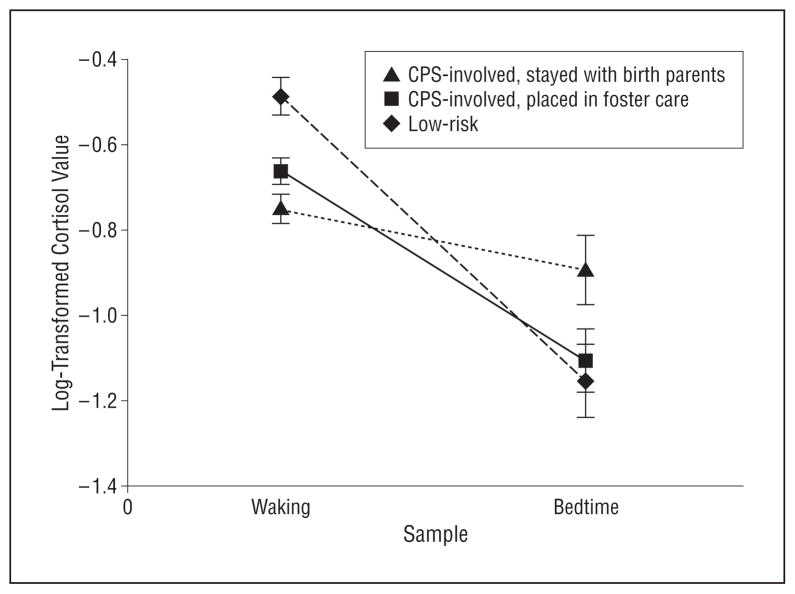
Results: Child Protective Services-involved children who continued to live with birth parents and CPS-involved children placed in foster care differed in cortisol production, with children living with their birth parents showing flatter slopes in waking to bedtime values.
Conclusions: Continuing to live with birth parents following involvement of CPS is associated with greater perturbation to the diurnal pattern of cortisol production than living with foster parents. Foster care may have a regulating influence on children's cortisol among children who have experienced maltreatment.
Figures
Comment in
-
What do Romanian children living in orphanages manifesting repetitive behaviors and American children in foster care with abnormal cortisol levels have in common? More than you would think.Arch Pediatr Adolesc Med. 2010 May;164(5):492-3. doi: 10.1001/archpediatrics.2010.66. Arch Pediatr Adolesc Med. 2010. PMID: 20439804 No abstract available.
References
-
- Ladd CO, Huot RL, Thrivikraman KV, Nemeroff CB, Plotsky PM. Long-term adaptations in glucocorticoid receptor and mineralocorticoid receptor mRNA and negative feedback on the hypothalamo-pituitary-adrenal axis following neonatal maternal separation. Biol Psychiatry. 2004;55(4):367–375. - PubMed
-
- Boyce WT, Champoux M, Suomi SJ, Gunnar MR. Salivary cortisol in nursery-reared rhesus monkeys: reactivity to peer interactions and altered circadian activity. Dev Psychobiol. 1995;28(5):257–267. - PubMed
-
- Gunnar MR, Vazquez DM. Low cortisol and a flattening of expected daytime rhythm: potential indices of risk in human development. Dev Psychopathol. 2001;13(3):515–538. - PubMed
-
- Dozier M, Manni M, Gordon MK, et al. Foster children’s diurnal production of cortisol: an exploratory study. Child Maltreat. 2006;11(2):189–197. - PubMed