Familial confounding of the association between maternal smoking during pregnancy and offspring criminality: a population-based study in Sweden
- PMID: 20439834
- PMCID: PMC3644552
- DOI: 10.1001/archgenpsychiatry.2010.33
Familial confounding of the association between maternal smoking during pregnancy and offspring criminality: a population-based study in Sweden
Abstract
Context: The association between maternal smoking during pregnancy (SDP) and offspring disruptive behaviors has been well documented, but it is unclear whether exposure to SDP or the effects of factors correlated with SDP account for the increased risk.
Objective: To test whether the association between SDP and offspring criminal convictions was consistent with a causal connection or due to familial background factors by controlling for measured covariates and using a quasi-experimental approach.
Design: We used a population-based study of children born in Sweden from 1983 to 1989 (N = 609,372) to examine the association between SDP and offspring criminal convictions while controlling for measured traits of both parents. We also compared siblings differentially exposed to SDP (n = 50,339) to account for unmeasured familial factors that could account for the association.
Setting: Population-based study of all children born in Sweden from 1983 to 1989 with information on maternal SDP and offspring criminal convictions based on national registries collected by the Swedish government.
Patients or other participants: Children born in Sweden from 1983 to 1989 (N = 609,372) and siblings differentially exposed to SDP (n = 50,339).
Main outcome measures: Violent and nonviolent convictions, based on the Swedish National Crime Register, a register with detailed information on all convictions in the country.
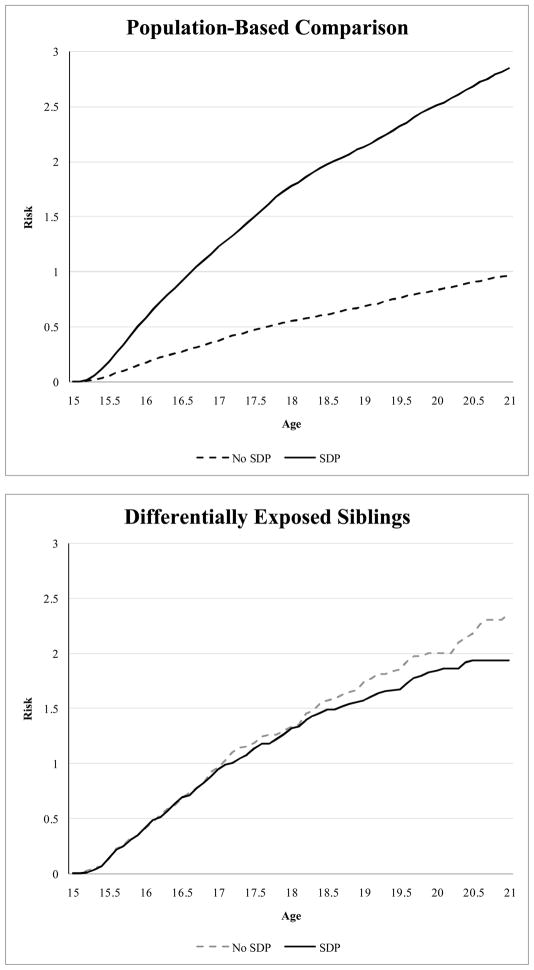
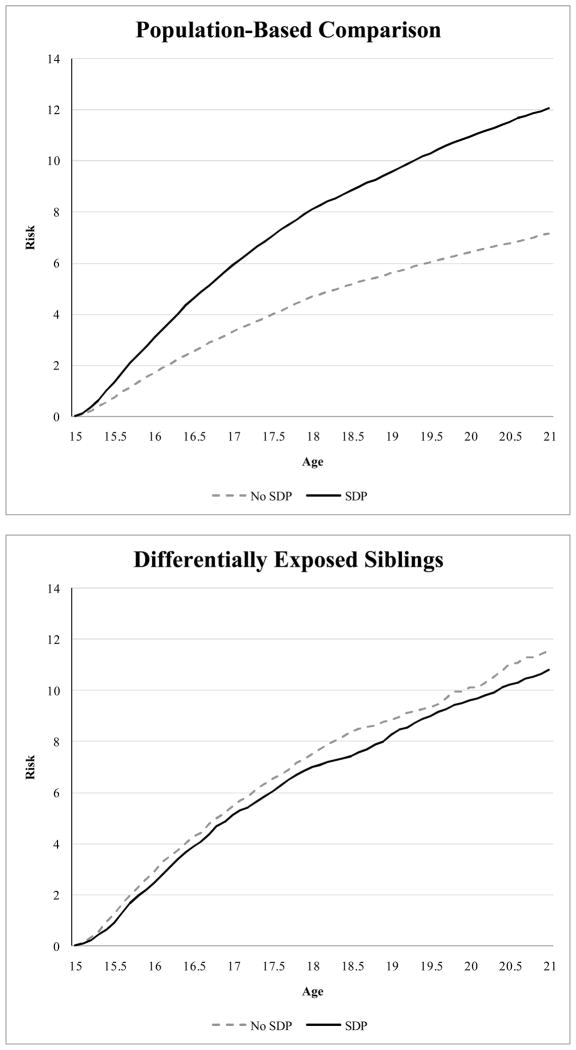
Results: Moderate (hazard rate [HR], 2.47; 95% confidence interval [CI], 2.34-2.60) and high (HR, 3.43; 95% CI, 3.25-3.63) levels of maternal SDP were associated with an increased risk for offspring violent convictions, even when controlling for maternal and paternal traits. There was no association between SDP and violent convictions, however, when comparing differentially exposed siblings (HR(moderate), 1.02; 95% CI, 0.79-1.30; HR(high), 1.03; 95% CI, 0.78-1.37). Smoking during pregnancy also was associated with nonviolent convictions in the entire population (HR(moderate), 1.62; 95% CI, 1.58-1.66; HR(high), 1.87; 95% CI, 1.82-1.92) and when controlling for covariates. But, there was no association when comparing siblings who were differentially exposed (HR(moderate), 0.89; 95% CI, 0.78-1.01; HR(high), 0.89; 95% CI, 0.78-1.02).
Conclusion: The results suggest that familial background factors account for the association between maternal SDP and criminal convictions, not the specific exposure to SDP.
Conflict of interest statement
There are no conflicts of interest.
Figures
Comment in
-
In utero smoking exposure warrants further investigation.Arch Gen Psychiatry. 2010 Oct;67(10):1094. doi: 10.1001/archgenpsychiatry.2010.119. Arch Gen Psychiatry. 2010. PMID: 20921125 Free PMC article. No abstract available.
References
-
- Wakschlag LS, Hans SL. Maternal smoking during pregnancy and conduct problems in high-risk youth: A developmental framework. Development and Psychopathology. 2002;14:351–369. - PubMed
-
- Cnattingius S. The epidemiology of smoking during pregnancy: Smoking prevalence, maternal characteristics, and pregnancy outcomes. Nicotine and Tobacco Research. 2004;6:S125–S140. - PubMed
-
- Huizink AC, Mulder EJH. Maternal smoking, drinking or cannabis use during pregnancy and neurobehavioral and cognitive functioning in human offspring. Neuroscience and Biobehavioral Reviews. 2006;30:24–41. - PubMed