Association of microsatellite variations of Plasmodium falciparum Na+/H+ exchanger (Pfnhe-1) gene with reduced in vitro susceptibility to quinine: lack of confirmation in clinical isolates from Africa
- PMID: 20439955
- PMCID: PMC2861372
- DOI: 10.4269/ajtmh.2010.09-0327
Association of microsatellite variations of Plasmodium falciparum Na+/H+ exchanger (Pfnhe-1) gene with reduced in vitro susceptibility to quinine: lack of confirmation in clinical isolates from Africa
Abstract
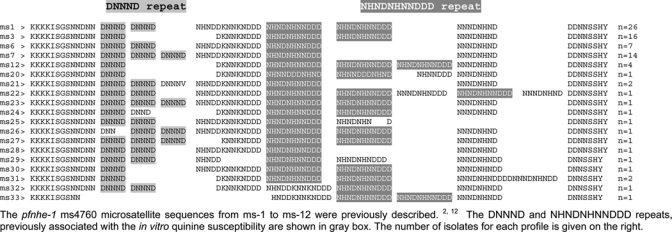
We sought to test the association of polymorphisms in Plasmodium falciparum nhe-1 (Pfnhe-1, gene PF13_0019) with in vitro susceptibility to quinine, which was previously reported in a limited number of reference strains or culture-adapted isolates. Determination of in vitro susceptibility to quinine, genotyping of Pfnhe-1 ms4760 microsatellite and polymorphism in codon 76 of Pfcrt were performed for 83 isolates obtained from symptomatic malaria-infected travelers returning from various African countries to France or from subjects living in Madagascar. Nineteen different ms4760 microsatellite profiles of Pfnhe-1 were found including 14 not previously described. Multivariate analysis showed no significant association between the in vitro susceptibility to quinine with particular ms4760 profiles. Contrary to previous reports, we only observed that the number of NHNDNHNNDDD repeats was positively associated with the increased IC50 of QN (P = 0.01). We concluded that the studied polymorphisms in Pfnhe-1 did not appear as valid molecular markers of in vitro susceptibility to quinine in P. falciparum isolates from Africa. Because we did not include any isolate of Asian origin in our series, these results did not exclude the possibility of regional associations, for example in South-East Asia.
Figures
References
-
- Neiva A. Ueber die Bildung einur chininresistenten Rasse des Malariaparasiten. Mem Inst Oswaldo Cruz. 1910;2:131–140.
-
- Nocht B, Werner H. Beobachtungen uber eine relative Chininresistenz bei malaria aus Brasilien. Dtsch Med Wochenschr. 1910;36:1557–1560.
-
- Peters W. Chemotherapy and Drug Resistance in Malaria. Second edition. London: Academic Press; 1987. pp. 543–568. (Resistance of human malaria I, III, and IV). 593–658, 659–786.
-
- Wongsrichanalai C, Pickard AL, Wernsdorfer WH, Meshnick SR. Epidemiology of drug-resistant malaria. Lancet Infect Dis. 2002;2:209–218. - PubMed
-
- Ferdig MT, Cooper RA, Mu J, Deng B, Joy DA, Su XZ, Wellems TE. Dissecting the loci of low-level quinine resistance in malaria parasites. Mol Microbiol. 2004;52:985–997. - PubMed
Publication types
MeSH terms
Substances
Associated data
- Actions
- Actions
- Actions
- Actions
- Actions
- Actions
- Actions
LinkOut - more resources
Full Text Sources
Miscellaneous