


Three versus six months of exercise training in breast cancer survivors
- PMID: 20443054
- PMCID: PMC3025531
- DOI: 10.1007/s10549-010-0913-0
Three versus six months of exercise training in breast cancer survivors
Abstract
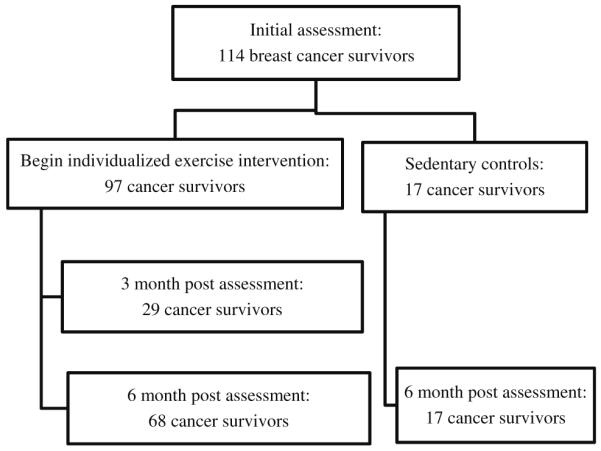
Breast cancer is the most prevalent type of cancer in American women. Exercise appears to diminish many of the side effects resulting from breast cancer and its treatment. Very little research, however, has compared the outcomes of varying lengths of combined aerobic and resistance training exercise interventions on physiological and psychological parameters in breast cancer survivors. The purpose of this study was to compare the physiological and psychological outcomes following 3 and 6 months of exercise in breast cancer survivors. Breast cancer survivors (N = 114) participated in either 3 months of prescriptive, individualized exercise (3M; n = 29), 6 months of prescriptive, individualized exercise (6M; n = 68), or served as sedentary controls (C; n = 17). Cancer survivors completed a medical evaluation and assessment at baseline followed by a predetermined 3- or 6-month exercise intervention. Cancer survivors in the control group performed no exercise between the initial assessment and 6-month reassessment. Cardiovascular endurance, pulmonary function, muscular endurance, fatigue, and symptoms of depression were assessed at baseline and post intervention. Repeated measures ANCOVA revealed improvements (P < 0.05) in cardiovascular endurance, fatigue, and symptoms of depression in breast cancer survivors undergoing 3- and 6-month individualized exercise interventions. Breast cancer survivors exercising for 6 months showed additional improvements (P < 0.05) in pulmonary function and muscular endurance. Cancer survivors in the control group did not improve in cardiovascular endurance, pulmonary function, muscular endurance, or fatigue. Three months of individualized, prescriptive exercise leads to improved cardiovascular endurance, fatigue, and symptoms of depression in breast cancer survivors. Additional benefits are seen if exercise is continued for a total of 6 months.
Figures
References
-
- American Cancer Society . Cancer facts and figures. American Cancer Society; Atlanta: 2009.
-
- DeVita VT, Hellman S, Rosenberg SA. Cancer, principles & practice of oncology. 7th edn. Lippincott Williams & Wilkins; Philadelphia: 2005. p. Ixxv.p. 2898.
-
- Hayes S, Battistutta D, Newman B. Objective and subjective upper body function six months following diagnosis of breast cancer. Breast Cancer Res Treat. 2005;94(1):1–10. - PubMed
-
- Albert US, et al. Early self-reported impairments in arm functioning of primary breast cancer patients predict late side effects of axillary lymph node dissection: results from a population-based cohort study. Breast Cancer Res Treat. 2006;100(3):285–292. - PubMed
Publication types
MeSH terms
Grants and funding
LinkOut - more resources
Full Text Sources
Medical
