


Lipotoxicity in obese pregnancy and its potential role in adverse pregnancy outcome and obesity in the offspring
- PMID: 20443782
- PMCID: PMC2860697
- DOI: 10.1042/CS20090640
Lipotoxicity in obese pregnancy and its potential role in adverse pregnancy outcome and obesity in the offspring
Abstract
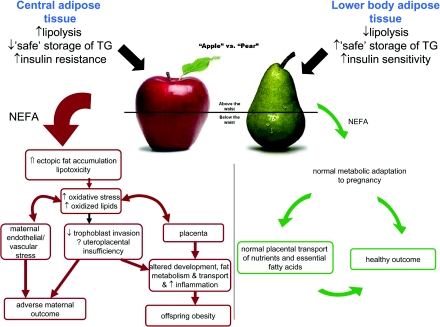
Increasing maternal obesity is a challenge that has an impact on all aspects of female reproduction. Lean and obese pregnant women gain similar fat mass, but lean women store fat in the lower-body compartment and obese women in central compartments. In the non-pregnant, central storage of fat is associated with adipocyte hypertrophy and represents a failure to adequately store excess fatty acids, resulting in metabolic dysregulation and ectopic fat accumulation (lipotoxicity). Obese pregnancy is associated with exaggerated metabolic adaptation, endothelial dysfunction and increased risk of adverse pregnancy outcome. We hypothesize that the preferential storage of fat in central rather than 'safer' lower-body depots in obese pregnancy leads to lipotoxicity. The combination of excess fatty acids and oxidative stress leads to the production of oxidized lipids, which can be cytotoxic and influence gene expression by acting as ligands for nuclear receptors. Lipid excess and oxidative stress provoke endothelial dysfunction. Oxidized lipids can inhibit trophoblast invasion and influence placental development, lipid metabolism and transport and can also affect fetal developmental pathways. As lipotoxicity has the capability of influencing both maternal endothelial function and placental function, it may link maternal obesity and placentally related adverse pregnancy outcomes such as miscarriage and pre-eclampsia. The combination of excess/altered lipid nutrient supply, suboptimal in utero metabolic environment and alterations in placental gene expression, inflammation and metabolism may also induce obesity in the offspring.
Figures
References
-
- Jarvie E., Ramsay J. E. Obstetric management of obesity in pregnancy. Semin. Fetal Neonatal Med. 2010;15:83–88. - PubMed
-
- Snijder M. B., Visser M., Dekker J. M., Goodpaster B. H., Harris T. B., Kritchevsky S. B., De Rekeneire N., Kanaya A. M., Newman A. B., Tylavsky F. A., Seidell J. C. Low subcutaneous thigh fat is a risk factor for unfavourable glucose and lipid levels, independently of high abdominal fat. The Health ABC Study. Diabetologia. 2005;48:301–308. - PubMed
-
- den T. I., Seidell J. C., van Noord P. A., Baanders-van Halewijn E. A., Ouwehand I. J. Fat distribution in relation to age, degree of obesity, smoking habits, parity and estrogen use: a cross-sectional study in 11,825 Dutch women participating in the DOM-project. Int. J. Obes. 1990;14:753–761. - PubMed
-
- Gustafson B., Gogg S., Hedjazifar S., Jenndahl L., Hammarstedt A., Smith U. Inflammation and impaired adipogenesis in hypertrophic obesity in man. Am. J. Physiol. Endocrinol. Metab. 2009;297:E999–E1003. - PubMed
Publication types
MeSH terms
Grants and funding
LinkOut - more resources
Full Text Sources
Medical
